
Livraison le jour même ou le lendemain

Qualité garantie

Débloquez vos offres de bienvenue: Livraison GRATUITE | Jusqu'à -80 % | 30 jours d'essai gratuits à JoyPlus
Téléchargez l'application
Need to light up a closet, wardrobe, or countertop without cutting into walls or calling an electrician? The rechargeable LED light strip with motion sensor has quickly become the go-to solution, offering both convenience and savings. But be warned: the market is flooded with models that often deliver disappointing performance. To help you avoid any unpleasant surprises, our guide cuts through the noise and gives you the keys to making the right choice.
Too many users end up disappointed by products that don't live up to their claims. Here are the three most frequent headaches that can turn a great idea into a source of daily frustration.
To outsmart these traps, simply focus on a few objective technical specifications. These are the real arbiters of quality when evaluating a wireless closet light.
Battery life is directly dependent on the battery's capacity, expressed in milliampere-hours (mAh). For moderate use (a few activations per day), don't go below 800?mAh. For high-traffic areas, aim for 1000?mAh or more. Another crucial point: insist on a USB-C port, which is far more convenient and durable than the ancient micro-USB. A good USB LED light strip should last for weeks, not days.
Most models use a passive infrared (PIR) sensor. There are two data points to keep a close eye on:
The best models add a light sensor (dusk-to-dawn) that prevents the lamp from turning on in broad daylight. It's a simple but incredibly effective feature for preserving battery life.
Don't underestimate the lighting ambiance. There are three main options:
Models that allow you to choose the color temperature are obviously more versatile. Finally, for installation, opt for magnetic mounts: they allow you to detach the strip in a snap for recharging.
Rather than an endless list, here are three options that meet specific needs and check all the boxes on our list of requirements.
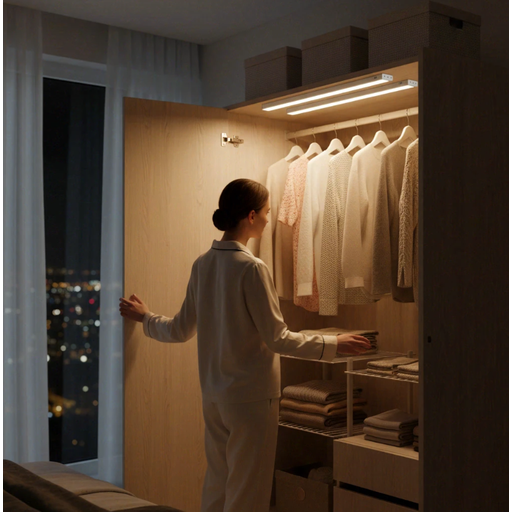
Why we chose it: This pack of two compact strips is a smart and budget-friendly solution for outfitting several small closets or drawers. Their discreet size and simplicity make them an excellent entry-level option.
The 800 mAh battery is well-sized for this 20 cm format. It provides respectable battery life for moderate use, steering clear of the constant-recharging trap.
The choice between 3 color temperatures and its availability as a 2-pack of LED strips gives it a versatility and value for money that's nearly unbeatable for a first-time setup.
Why we chose it: This model is a step up in terms of power and battery life. It's ideal for larger or more frequently used areas like a wardrobe, an entryway, or as an automatic kitchen light. Its 30 cm length ensures a more uniform blanket of light.
With its high-capacity 1100 mAh battery, this model tackles the battery life problem head-on. It's designed to truly extend the time between charges, even with frequent activation.
Its high-performance PIR sensor offers a range of 3 to 5 meters, guaranteeing reliable and responsive detection. Its ultra-slim design (barely 10 mm thick) ensures seamless integration under any shelf.
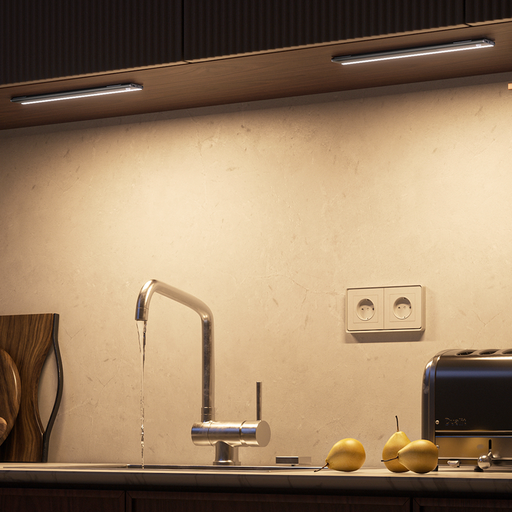
Why we chose it: For those who appreciate good design and are looking for more advanced features. Yeelight, a well-known brand in the Xiaomi ecosystem, offers a model with a first-class finish and performance, plus a smart linking feature as a bonus.
This model outsmarts the finicky sensor trap with high-quality components and a "smart linking" feature: multiple lights can activate in unison for perfectly synchronized and responsive lighting.
Its premium design and build quality make it a device that is as elegant as it is effective. The brand's reputation is a guarantee of reliability, both for the sensor and the battery management.
We've put together a comprehensive and up-to-date selection of products that meet our selection criteria and European safety standards.
The lifespan rests on two pillars: the LEDs and the battery. The LEDs themselves have an exceptional longevity, often exceeding 20,000 hours, which translates to years of use. The weak link is the lithium-ion battery, which loses capacity after a certain number of charge cycles (typically between 300 and 500). On a quality product, this equates to several years of normal use before the battery life begins to noticeably decline.
The key to success is surface preparation. Meticulously clean the surface with isopropyl alcohol to remove any trace of grease or dust, then dry it completely. Apply the adhesive strip, exerting firm, even pressure along its entire length for at least 30 seconds. If possible, wait a few hours before attaching the magnetic strip to allow the adhesive to fully cure. Avoid granular, porous, or uneven surfaces.
No, the standby power consumption of a PIR sensor is negligible. The vast majority of the energy is used when the LEDs are on. This is why a well-calibrated sensor that only activates in the dark and upon detecting real movement is essential for maximizing battery life. A quality device can thus remain on standby for months without draining its battery.