
Livraison le jour même ou le lendemain

Qualité garantie

Débloquez vos offres de bienvenue: Livraison GRATUITE | Jusqu'à -80 % | 30 jours d'essai gratuits à JoyPlus
Téléchargez l'application
Getting up at night shouldn't mean stumbling around in the dark. Whether it's to comfort a child, slip to the bathroom without waking the whole house, or simply avoid tripping over the rug, good accent lighting is essential. In this context, the rechargeable motion-sensor night light has emerged as the smartest solution: it's practical, discreet, and energy-efficient. The problem is, the market is flooded with models making tempting promises, which often hide deal-breaking flaws.
Before you decide, here are the 3 pitfalls to avoid so you don't regret your purchase:
To avoid these disappointments, you need to focus on a few technical specifications that make all the difference. These are what separate a useless gadget from a truly effective automatic night light.
This is crucial! Battery life is directly linked to the battery's capacity, expressed in milliampere-hours (mAh). Aim for a model with at least 500 mAh to get several weeks of use in detection mode before needing a recharge. Also, consider the charging connector: USB-C, now the standard, is far more convenient and universal than the ancient micro-USB. A good rechargeable LED night light should make you forget about batteries and constant recharging.
A good motion sensor (usually a PIR, or Passive Infrared, type) is the brains of the night light. There are two data points to check on the spec sheet:
A nice bonus? A dusk-to-dawn sensor (LUX) that prevents the night light from activating in broad daylight, thereby conserving precious battery life.
The quality of the light is essential for eye comfort.
Rather than an endless list, we've selected models that meet specific needs, applying the checklist we've just defined.
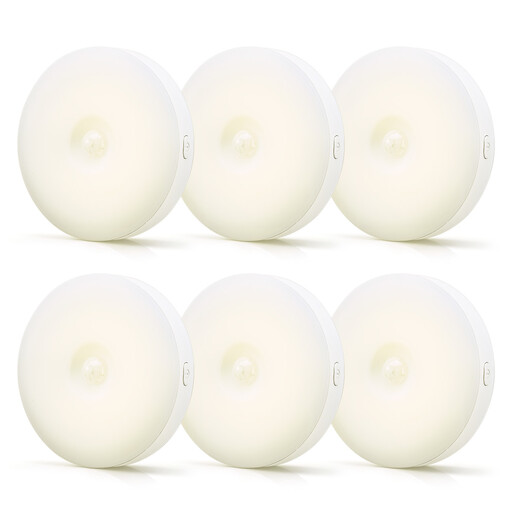
Why this model? Perfect for those who want to equip several strategic points (hallways, stairs, bathrooms, closets) without breaking the bank. This 6-pack offers a turnkey solution to make nighttime navigation safer for the whole family.
The sensor claims a range of up to 6 metres, and the 3 colour temperatures let you choose a soft light. The pack format solves the coverage issue affordably.
An unbeatable quantity-to-price ratio. Installation is a breeze thanks to the adhesive magnetic mounts, so you don't have to get the drill out.

Why this model? For parents who want a light source that's both reassuring and fun. For use on a bedside table, touch control is much more suitable than a motion sensor.
It avoids the harsh light trap with its touch-adjustable intensity. Its soft silicone design is completely safe for little ones.
Its soft material is safe for little hands. The touch control and dimming feature are perfect for nighttime feeding or for letting the child manage their own little light.
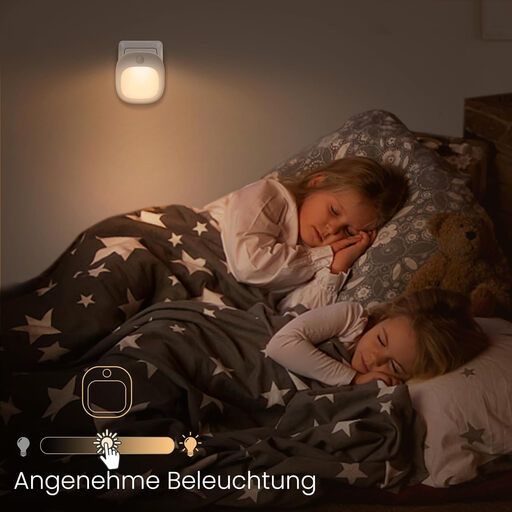
Why this model? It's the expert's choice for those who want absolute control over their lighting. This pack of 2 is ideal for a couple or for outfitting a bedroom and hallway with fine-tuned, personalised settings.
It ticks all the boxes on our checklist: a 500 mAh battery for solid battery life, a precise sensor (3-5 m, ≤20 LUX), and above all, ultra-comprehensive settings with 3 colour temperatures and 5 intensity levels.
Advanced lighting customisation. Its dual-mode (detection or always-on) makes it incredibly versatile for any use around the house.
Discover our complete, up-to-date selection of products that meet our quality criteria and safety standards.
The lifespan of a rechargeable LED night light depends on two components: the LED and the battery. The LEDs themselves are virtually eternal (often rated for over 20,000 hours), so that's not a concern. The battery, like a smartphone's, wears out over time and can handle a limited number of charge cycles (usually between 300 and 500). With a recharge every couple of months, that ensures several years of peace of mind.
In a hallway, mount it at mid-height on a wall to scan a wide area. On a staircase, place it near the bottom to light up the first few steps as you approach. In a bedroom, the ideal spot is near the floor, away from the bed, so it activates when you step on the floor, not every time you turn over in your sleep.
Absolutely not; its consumption is negligible. An LED night light typically consumes less than 1 watt. In detection mode, it only runs for a few minutes per day in total. Its annual cost on your electricity bill is therefore trivial, in the range of a few cents. It's one of the most economical lighting solutions available.