
Livraison le jour même ou le lendemain

Qualité garantie

Débloquez vos offres de bienvenue: Livraison GRATUITE | Jusqu'à -80 % | 30 jours d'essai gratuits à JoyPlus
Téléchargez l'application
A rechargeable LED night light can soothe a baby’s night-time wakings, light up a hallway, or serve as a handy lamp when you’re travelling. But not all models meet the same needs. A battery that runs out too quickly, an overly sensitive sensor, or brightness that’s difficult to adjust can turn a practical purchase into an accessory you end up abandoning.
Here are the criteria to consider before choosing a motion sensor night light, a touch night light, or a rechargeable night lamp.
A very bright light isn’t necessarily suitable for a bedroom. For moving around at night, moderate brightness is often more than enough. In a bathroom or on a staircase, however, a stronger light is usually preferable. So check the luminous flux, measured in lumens, rather than relying solely on the mention ‘LED’.
A night light of around 30 lm is better for finding your way than for lighting up an entire room. Several adjustable levels let you tailor the brightness to the time of day and your needs.
A motion sensor can be very practical, provided you know its range and what triggers it. Some models only work in the dark, while others may switch on in broad daylight or react to a pet passing by.
For a night light intended for a hallway, be sure to check:
A cordless night light needs to stay easy to recharge. A built-in battery and a USB or USB-C port save you from buying batteries regularly, but take the time to check its capacity and the claimed battery life for each mode of use.
For a magnetic wall-mounted night light, also examine the fixing system. An adhesive strip must be applied to a clean, dry, and sufficiently smooth surface. A removable magnetic mount makes both recharging and moving the lamp easier.
Colour temperature is measured in kelvins. A warm light, between 2,800 and 3,200 K, creates a soft ambience. A cooler light, around 5,000 to 5,500 K, improves visibility of objects. In between, a shade close to 4,000 to 4,500 K can work well for a hallway.
A dimmable night light or a 3-colour night light offers more flexibility than a model limited to a single setting. In a baby’s room, choose a simple control and even light distribution, without presenting the product as a medical device.
A 500 mAh battery can be sufficient for occasional use in detection mode. A 1,200 mAh capacity will be better suited to a decorative lamp used for several hours at high brightness. These values are only a guide: actual battery life depends on the brightness level chosen, how often the light is triggered, and the battery’s condition.
USB-C has the advantage of a reversible plug and is now very common. Micro-USB or standard USB can also work if you already have a compatible charger, computer, or power bank.
ABS and metal are commonly used for compact lamps. Soft silicone can make a children’s night light nicer to handle, but it doesn’t replace the need to follow usage instructions. Avoid immersion, excessive humidity, high temperatures, and dismantling the battery.
The CE mark and, where indicated, RoHS, should appear on the product or in its documentation. They don’t replace reading the warnings: when plugged in, an electric lamp must be kept out of reach of young children.

Why this choice suits this profile: This pack is ideal for a first installation in two high-traffic areas, such as a bedroom and a hallway, with simple USB charging.
The sensor activates in the dark, and the five brightness levels mean you don’t have to make do with a single light setting.
Three colour temperatures, built-in 500 mAh battery, claimed range of 3 to 5 m, and compact size of 7.45 × 6.99 × 2.55 cm.

Why this choice suits this profile: Its animal shape and soft finish fit perfectly in a child’s bedroom or make a decorative gift. The brightness control is easy to use.
The three brightness levels mean you don’t always have to use the maximum setting. The red or green indicator also lets you keep track of the charging status.
1,200 mAh battery, USB-C port, claimed run time of up to 6 hours at maximum brightness, and materials: ABS, PP and silicone.
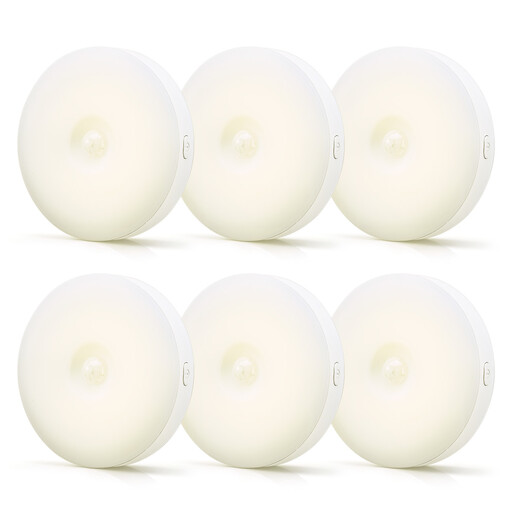
Why this choice suits this profile: The six lamps let you light up several walkways, cupboards, steps or storage areas without installing any fixed wiring.
The removable magnetic mount makes recharging simple. The claimed PIR sensor covers a range of 0 to 6 m, with a 120° detection angle.
Three colour modes, adhesive or metal surface installation, cordless operation, and a hanging cord included.
We’ve put together a comprehensive, real-time list of products that meet these strict selection criteria and European safety requirements.
For a night light with a motion sensor, position the sensor facing the walkway, with no furniture or curtains in front of it. In a bedroom, avoid pointing it directly at the face to minimise any discomfort from the light.
Before first use:
In a baby’s or child’s room, the lamp must remain stable and out of reach when the cable is plugged in. A decorative night light should not be used as a toy, even if its finish is soft.
The cost depends on the power, how long the light is on, and how often it’s recharged. Low-power models with a motion sensor generally limit the time the light is on. To estimate the cost, check the wattage and claimed battery life, then compare these figures with how often you use it.
A cordless night light with a PIR sensor and magnetic mount is ideal when several points along a walkway need lighting. On a staircase, pay particular attention to the range, detection angle, and how securely the mount holds. A medium brightness can help you find your way without lighting up the whole room.
Battery life varies depending on the battery capacity and the brightness level selected. Some models claim up to 10 hours in sensor mode, while a lamp used continuously at high brightness may last significantly less. Always check which mode the claimed battery life refers to before you buy.