
Livraison le jour même ou le lendemain

Qualité garantie

Débloquez vos offres de bienvenue: Livraison GRATUITE | Jusqu'à -80 % | 30 jours d'essai gratuits à JoyPlus
Téléchargez l'application
Buying a rechargeable LED night light might seem simple. But between unrealistic battery life claims and features that give up the ghost after a few weeks, it's easy to make the wrong choice. Whether it's to comfort a child at night, light up a dark hallway, or add an accent light to a closet, the goal is the same: reliable, convenient, and safe lighting.
Before you buy, here are three common pitfalls to avoid so your smart purchase doesn't turn into a costly disappointment:
To avoid these traps, simply focus on a few objective technical specifications. These are what reveal the true quality and durability of a cordless bedside lamp.
Runtime is directly dependent on battery capacity, measured in milliampere-hours (mAh).
Also, remember to check the charging port. USB-C has become the standard for its durability and reversible connector, which is far more convenient than the antiquated micro-USB.
The quality of the light has a direct impact on ambiance and visual comfort.
For automatic lighting, the sensor's quality makes all the difference. Most models use a passive infrared (PIR) sensor that detects the heat from a moving body. A good sensor should specify a clear detection range (usually 3 to 5 metres) and only activate in the dark (thanks to a light sensor, measured in LUX) to conserve battery.
Finally, consider the installation: a stable base for placing it on a nightstand, a magnetic mount for a wall-mounted night light or closet light, or even a hook for maximum versatility.
Instead of an endless list, we've selected models that meet specific needs, keeping our performance and safety criteria in mind.

Why we love it: Its playful design and soft silicone shell make it a comforting nighttime companion for a child. Its warm, three-level adjustable light is perfect for not disrupting the sleep cycle.
It meets the safety criteria with its materials (ABS, PP, and silicone) guaranteed to be safe to the touch. Its 1200 mAh battery ensures decent runtime (up to 6 hours at full power), enough to avoid running out of juice in the middle of the night.
Soft, flicker-free light. Adjustable brightness (3 levels). Modern charging via USB-C port.

Why we love it: Sold as a pair, this pack is the perfect solution for automated accent lighting. Ideal for a hallway, staircase, or bathroom, it turns on in the dark upon detecting motion, then switches off automatically to save battery.
It avoids the imprecise sensor trap with a PIR model that has clear specs (3 to 5m range, activates below 20 LUX). A rare feature at this price point, it offers advanced customisation with 3 colour temperatures and 5 brightness levels.
Reliable motion detection. Choice of warm, neutral, and cool light. Compact and discreet design.
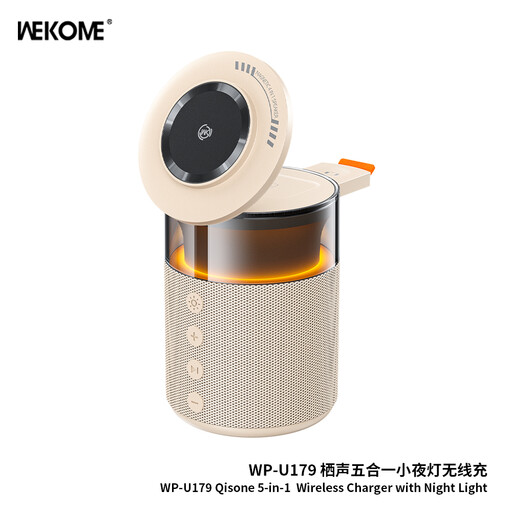
Why we love it: Much more than a simple night light, this is a true Swiss Army knife for the nightstand. It combines a lamp, a fast wireless charger (up to 15W), a clock, and an alarm. Perfect for saving space and modernising your setup.
It avoids the single-function gadget trap by focusing on well-thought-out versatility. The spec sheet clearly states that a QC 3.0 or PD adapter is required to enable fast charging, preventing the unpleasant surprise of slow charging with a standard adapter.
All-in-one solution (light, charging, clock). Fast wireless charging. Modern and minimalist design.
Discover our full selection of products that meet our quality criteria and European safety standards.
Runtime heavily depends on the battery capacity (mAh) and the chosen brightness level. A 1200?mAh model will last about 6 to 8 hours at full power but can exceed 20 hours at a low brightness. In motion detection mode, where the light only turns on intermittently, the battery can last for weeks.
It typically uses a passive infrared (PIR) sensor that reacts to the heat of a moving body. To be truly effective, it's paired with a light sensor that prevents it from turning on in broad daylight. When you enter its detection range (between 3 and 5 metres) in the dark, it automatically turns on for a set duration (often 15 to 30 seconds) before switching off on its own.
Without a doubt, a warm light (around 2700?K) is the best choice for a bedroom, and it's essential for a baby's night light. This orange-hued glow, similar to a sunset, promotes the production of melatonin, the sleep hormone. Conversely, a cool or bluish light (above 5000?K) disrupts the body's internal clock and can make it harder to fall asleep.