
Livraison le jour même ou le lendemain

Qualité garantie

Débloquez vos offres de bienvenue: Livraison GRATUITE | Jusqu'à -80 % | 30 jours d'essai gratuits à JoyPlus
Téléchargez l'application
Who hasn't grumbled while searching for an item in a dark closet, cooking on a poorly lit countertop, or rummaging through their wardrobe in the early morning? Faced with these daily frustrations, the rechargeable wireless LED light strip emerges as the simple and effective miracle solution. However, the market is flooded with models whose tempting promises often hide nasty surprises in practice.
To avoid regretting your purchase after just a few weeks, here are the most common pitfalls to avoid:
To avoid these disappointments, ignore the marketing claims and focus on a few objective technical specifications. They will give you a much more accurate idea of the product's real-world performance.
The endurance of a USB-rechargeable LED bar directly depends on its battery capacity, expressed in milliampere-hours (mAh). The higher this value, the larger the energy reserve and, in theory, the longer the battery life.
A good LED strip should adapt to your needs and environment. Be sure to check its operating options:
The number one advantage of these lights is their tool-free installation. The most common and cleverest system is the magnetic mount with an adhesive back. The principle is simple: a thin, self-adhesive metal plate is fixed to the surface of your choice (wood, plasterboard, tile). The magnetised strip then clings to it. The major benefit: you can detach it in a single motion to recharge it, then just as easily put it back in place.
We have selected a few models that stand out for their technical specifications and meet specific needs.

Why we chose it: Perfect for illuminating targeted areas like deep drawers, shoe racks, or the inside of a wardrobe. The compact 20cm format and the two-pack allow you to equip several spots without breaking the bank.
The 800 mAh battery is well-suited for occasional use in a closet. The PIR sensor, with its standard range of 3 to 5 metres, is reliable and prevents false triggers.
It offers 3 colour temperatures, a feature often reserved for more expensive models, allowing you to adapt the lighting mood to the room.
Why we chose it: The excellent compromise for lighting wardrobes, countertops, or entryways. Its 40cm length provides good light diffusion, and its endurance makes it suitable for regular use.
With its 1100 mAh battery, it sidesteps the trap of disappointing battery life. This capacity is well-sized for frequent use, significantly spacing out recharges.
The two-pack of 40cm strips offers a very competitive size/battery/price ratio for equipping larger spaces without multiplying small light points.
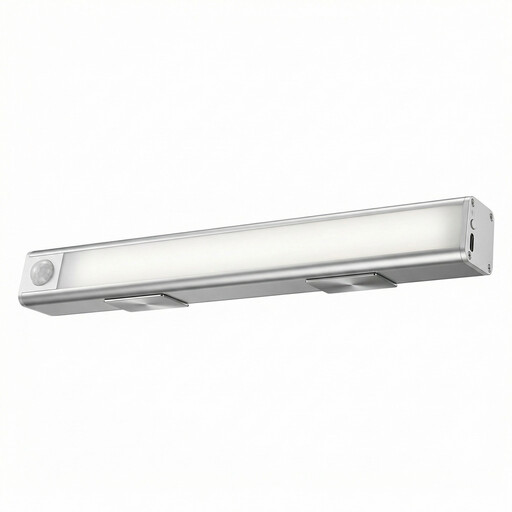
Why we chose it: Its 60cm length and 190-lumen output make it the perfect solution for powerful, uniform main lighting across the entire width of a large wardrobe, workbench, or long countertop.
Its aluminium and ABS body is a guarantee of sturdiness and good heat dissipation, a far cry from "all-plastic" models that can heat up or warp.
Equipped with a USB Type-C port, it ensures modern and convenient charging. Its 114 LEDs guarantee very uniform light diffusion, without dark spots.
We've put together a complete selection of products that meet our quality criteria and current safety standards.
It couldn't be simpler, thanks to the magnetic mount. The product almost always comes with one or more adhesive metal plates.
The lifespan is determined by two components: the LEDs and the battery.
If your light is acting like a ghost by turning on for no reason, there are several possible causes: