
Livraison le jour même ou le lendemain

Qualité garantie

Débloquez vos offres de bienvenue: Livraison GRATUITE | Jusqu'à -80 % | 30 jours d'essai gratuits à JoyPlus
Téléchargez l'application
A rechargeable handheld fan can make commutes, queues, concerts or days at the office far more pleasant. But not all compact models are created equal. A battery life quoted only at the lowest setting, a poorly directed airflow, or a battery that’s hard to monitor can turn a practical purchase into an accessory that ends up forgotten at the bottom of a drawer.
Here are the criteria to consider before choosing a mini USB fan, a pocket fan or a model you can wear around your neck.
A high RPM figure catches the eye, but it isn’t enough to judge comfort in use. The shape of the air outlet, the number of blades and the concentration of the airflow all play a part. A very focused breeze can be welcome in direct sunlight, while a more diffuse flow is often nicer at the office.
You also need to distinguish between maximum speed and battery life. A powerful portable fan will naturally consume more at its highest setting than at its lowest speed.
A duration of 20, 30 or 40 hours usually corresponds to the lowest setting and very specific conditions of use. To compare two products, look at the stated battery life range, the charging time and the battery capacity.
A 5000 mAh battery offers a comfortable reserve for travel, but it can also make the device heavier and extend the charging time. For a short daily commute, a lighter model may actually prove more practical.
A pocket fan should be comfortable to hold, with easily accessible buttons and a grille that limits contact with moving parts. A lock prevents accidental start-ups in a bag. A cord or lanyard can also come in handy on public transport or at an outdoor event.
For a device with a lithium-ion battery, consult the manual, the charging instructions and the information provided by the manufacturer. Also check for the CE marking and the contact details of the responsible operator within the European Union. Do not charge the device if it becomes abnormally hot, if its casing is damaged, or if the cable shows signs of wear.
For regular use, choose a cordless fan with a battery indicator. An LED screen lets you check the remaining level before you leave, whereas a simple light can lack precision.
USB-C or USB charging allows you to use a mains charger, a power bank or certain computer ports. However, check whether the supplied cable is USB-A to USB-C or USB-C to USB-C, and whether the mains adapter is included. The stated charging time should be compared to the battery capacity: a 5000 mAh model may take several hours depending on its charging circuit.
Multiple speeds let you adapt the airflow to each situation: low output in a library, a medium setting at the office, or a more intense flow outdoors. Models with 5 speeds are simple to use, while a setting from 1 to 100 levels allows much more gradual adjustment.
A quiet fan is a relative concept: the noise depends on the speed selected and the distance between the device and the user. For meetings, work sessions or quiet places, it’s better to favour a range of gentle settings than an impressive maximum speed.
A model weighing 130 to 180 g slips easily into a bag or pocket. Heavier devices can house a larger battery, but become less comfortable to hold for long periods. A foldable model can double as a desk fan, while a neck fan frees your hands during a walk or a visit.
Extra features are only worthwhile if they meet a real need. A 3-in-1 fan combining ventilation, a light and a power bank can reduce the number of accessories you need to carry, but check the battery life available when several functions are used at the same time.
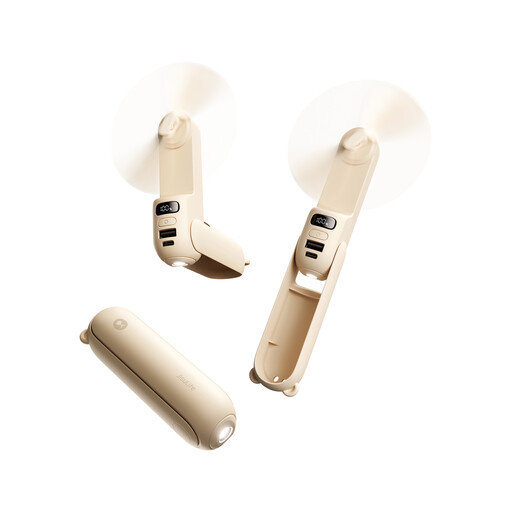
Why this choice suits this profile: Its foldable design and stated weight of around 130 g make it ideal for daily commutes, students and anyone looking for a device that’s easy to store.
The LED screen shows the speed and battery level, while the 3 speeds prevent you from relying on a single setting. Its foldable design minimises bulk in a bag.
Stated battery life of 15 to 24 hours, charges in 1 to 2 hours, functions as a fan, light and power bank.
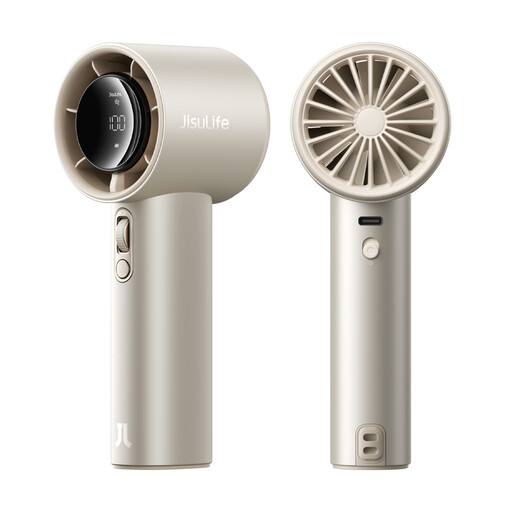
Why this choice suits this profile: Its aluminium alloy casing, LED screen and adjustment dial appeal to users who care about finish and precise airflow.
Battery life should be assessed according to the level chosen: the spec sheet states 3 to 15 hours in normal use, despite a maximum value quoted in some presentations.
5000 mAh battery, up to 100 speed levels, stated airspeed of up to 9 m/s and fast charging in around 1.5 to 2 hours.
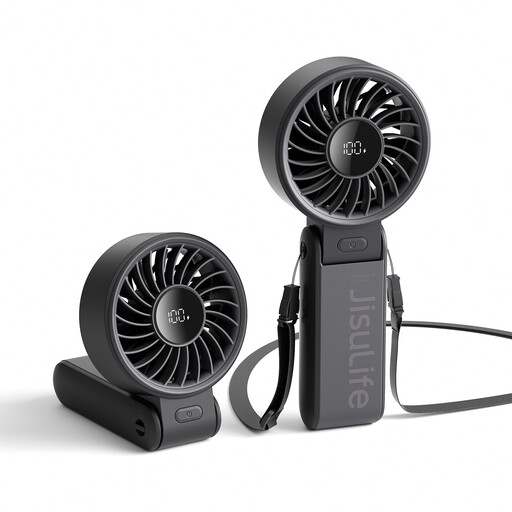
Why this choice suits this profile: Usable by hand, on a desk or around the neck, it suits professionals, travellers and event-goers who want to keep their hands free.
The five speeds make it more flexible to use than a single-setting device. The screen displays the speed and remaining charge, making it easier to prepare for a long outing.
5000 mAh battery, stated battery life of 3.5 to 19 hours, foldable design and 3-in-1 function: by hand, on a desk or around the neck.
We’ve put together a comprehensive, real-time selection of products that meet these demanding criteria and European safety regulations.
Use the supplied cable and an adapter compatible with the specifications in the manual. Charging via mains, computer or power bank is usually possible through USB. Place the device on a clear surface and avoid covering it while charging.
It depends on the battery capacity, the speed selected and the functions activated. For a realistic estimate, check the duration stated for the different levels rather than just the maximum value. A 5000 mAh model can suit long days, but its weight and charging time may be higher.
The rules depend on the battery capacity and the airline. Devices containing a lithium-ion battery generally need to be kept in cabin baggage, but conditions can vary. Check your carrier’s guidelines before you travel and protect the device against accidental activation.