
Livraison le jour même ou le lendemain

Qualité garantie

Débloquez vos offres de bienvenue: Livraison GRATUITE | Jusqu'à -80 % | 30 jours d'essai gratuits à JoyPlus
Téléchargez l'application
Choosing a recessed LED spotlight? It seems easy. Yet, whether for a renovation or a new build, nasty surprises are all too common. The wrong choice guarantees disappointment: flickering lights, impossible installation in a shallow ceiling void, or worse, a genuine safety risk in your bathroom. As the Head of Product Recommendations at Joybuy, my mission is to guide you beyond marketing hype and arm you with the right technical criteria. Let's break down the three most frequent mistakes and, most importantly, how to avoid them.
Before you pull out your credit card, watch out for these common pitfalls that can quickly turn a lighting project into a headache.
To avoid these setbacks, a few technical concepts are essential. They will ensure your choice is not only aesthetically pleasing but also perfectly functional and safe.
The Ingress Protection (IP) rating is an international standard that assesses a device's resistance to solid objects (like dust) and liquids (water). It consists of two digits:
For a bathroom LED spotlight, compliance with electrical standards like NF C 15-100 is non-negotiable. It defines several safety "zones":
A room's atmosphere is largely determined by the light's colour temperature, measured in Kelvins (K):
Good to know: More and more models offer an adjustable colour temperature (CCT), allowing you to switch from one mood to another with a simple switch or app. If you opt for a dimmable LED spotlight, ensure it is compatible with "trailing edge" dimmers, which are the most common type for LED technology.
For a hassle-free installation, the key is to check the total recessed depth, which includes the spotlight AND its power supply (driver/connector). A truly ultra-slim LED spotlight worthy of the name must have a total height (spotlight and connector included) of under 35?mm to fit into the shallowest ceiling voids.
Finally, one last crucial technical point: voltage.
Rather than an endless list, we've matched specific products to concrete needs, ensuring they tick all the boxes for performance and safety.
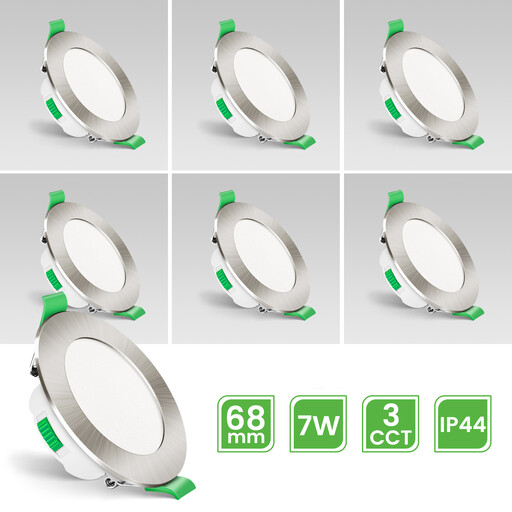
Who it's for: Those renovating their bathroom for whom safety is non-negotiable. Its IP65 certification allows for a worry-free installation, even directly above the shower.
Its IP65 rating eliminates any risk related to moisture, where an IP20 or even an IP44 would fall short.
It combines maximum protection, high brightness (800 lm), and a choice of colour temperature (3000K/4000K/5700K). The Swiss Army knife for bathrooms.
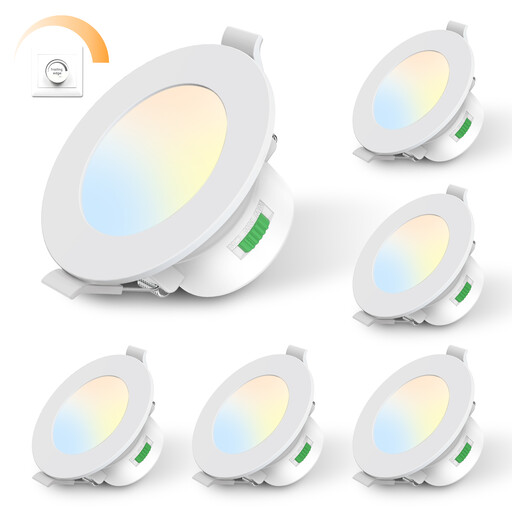
Who it's for: DIYers or professionals who need to equip an entire room without breaking the bank. This pack of recessed LED spotlights offers unbeatable value for money.
Its truly ultra-slim design (only 29 mm recessed depth) puts an end to the anxiety of shallow ceiling voids.
Impressive versatility (adjustable colour temperature + dimmable) in a cost-effective pack that's incredibly easy to install (direct 230V connection).
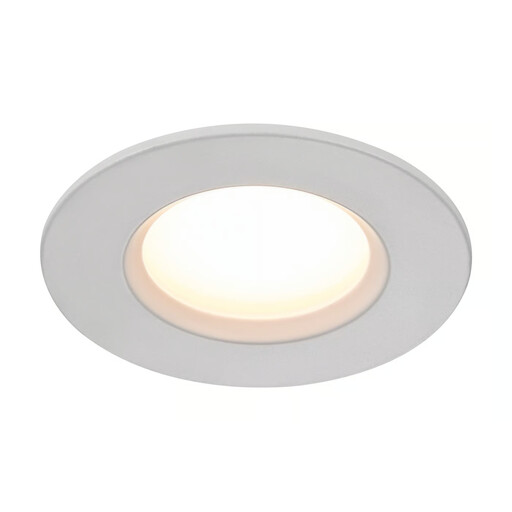
Who it's for: Smart home fans who want to control their lighting with precision. This smart LED spotlight integrates into your ecosystem for total control from a smartphone.
No more headaches with dimmer switches! Dimming is handled natively by the app (via Bluetooth Mesh), which eliminates any risk of hardware incompatibility.
Absolute control over intensity and temperature (from 2200K to 6500K), plus an IP65 rating that makes it an all-rounder: it's suitable for anywhere from the shower to an outdoor canopy.
We have selected a full range of products that strictly adhere to these demanding specifications and French safety standards.
As its name suggests, a recessed LED spotlight is integrated into a false ceiling. Only its bezel is visible, creating a clean, modern look. In contrast, a surface-mounted spotlight is fixed directly onto the ceiling, so its entire body is visible. The choice depends on the aesthetic you're aiming for and your ceiling's constraints.
Yes, but it's a delicate operation. It is imperative to choose spotlights that are certified for direct contact with insulation (often marked "IC-rated") or to install a protection cover (fire hood). This device creates a safety gap that prevents direct contact between the spotlight and the insulation (e.g., fibreglass, cellulose). This is the only way to prevent any risk of overheating and fire. The golden rule: never cover a standard spotlight with insulation.
It all depends on the luminous output of your spotlights (in lumens) and the room's purpose. Here are a few guidelines: