
Livraison le jour même ou le lendemain

Qualité garantie

Débloquez vos offres de bienvenue: Livraison GRATUITE | Jusqu'à -80 % | 30 jours d'essai gratuits à JoyPlus
Téléchargez l'application
Choosing the right recessed LED spotlight might seem simple, but it's a project where technical details make all the difference between successful lighting and a costly disappointment. As industry experts, our role is to help you see clearly and make the right choice. Too many buyers end up with unsuitable products, falling victim to misleading marketing or incomprehensible spec sheets. Let's break down the three most common mistakes together to ensure your lighting project is a success.
The scenario is a classic one: you invest in a dimmable LED spotlight hoping to create a soft, ambient mood, but once installed, it's a disaster. It flickers, buzzes, or simply refuses to work with your dimmer switch. The cause? A technical incompatibility between the spotlight and the type of dimmer (leading-edge or trailing-edge). This crucial information is too often missing from product descriptions, leading to frustration and additional costs.
Installing a standard spotlight in a damp room isn't just a mistake; it's a potential safety hazard. A recessed spotlight for bathrooms must have an appropriate Ingress Protection (IP) rating to withstand water splashes and ambient humidity. Yet, many are tempted by IP20-rated spots (designed for dry rooms) and install them near a shower. The result is twofold: a violation of electrical safety standards (like NF C 15-100 in France) and almost immediate product degradation.
This is the oversight that can turn a quick installation into a major construction project. With modern renovations and increasingly thin false ceilings, the recess depth is a critical factor. A spotlight that's too deep simply cannot be installed, forcing you to return the product or, worse, modify your ceiling structure. The ultra-slim LED spotlight has become the go-to solution, but you must remain vigilant and verify that its shallow depth (often less than 35?mm) is compatible with the available space.
To avoid these setbacks, focus on a few key parameters that guarantee the performance, longevity, and safety of your indoor LED lighting.
The IP rating is an international standard that classifies a device's level of sealing. For home use, two values are key:
A room's atmosphere is largely defined by its lighting. There are two concepts to master:
Before adding a pack of recessed LED spotlights to your cart, take out your tape measure and check two crucial dimensions:
To help you visualise how these criteria apply in practice, here are a few options that meet specific needs.
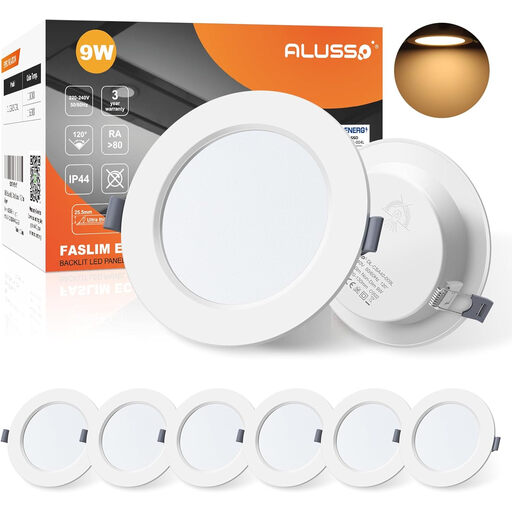
Our take : The perfect solution for those seeking efficiency without breaking the bank. This pack offers unbeatable value for money to outfit a hallway, kitchen, or living room with warm, uniform light.
Its clearly specified IP44 rating eliminates any risk in damp rooms (outside the direct shower area). Being non-dimmable, it also sidesteps any potential compatibility issues with a dimmer switch.
Offered as a pack of 6, it helps keep costs under control. Its very shallow depth (25.5 mm) ensures a hassle-free installation, even in the slimmest of false ceilings.
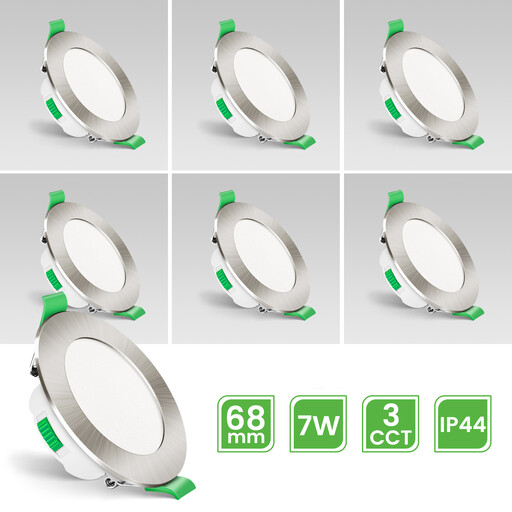
Our take : The Swiss Army knife of lighting. This spotlight is made for those who want total control: switch from bright light for cooking to a cosy atmosphere for dinner, all with a single product.
It ticks all the boxes to avoid the common pitfalls: it's dimmable (compatible with modern dimmers), offers a choice of 3 colour temperatures, and its ultra-slim design (29 mm) fits anywhere.
Its absolute versatility. The colour selector lets you set the mood once and for all before installation, while the dimmable function provides precise daily adjustments.
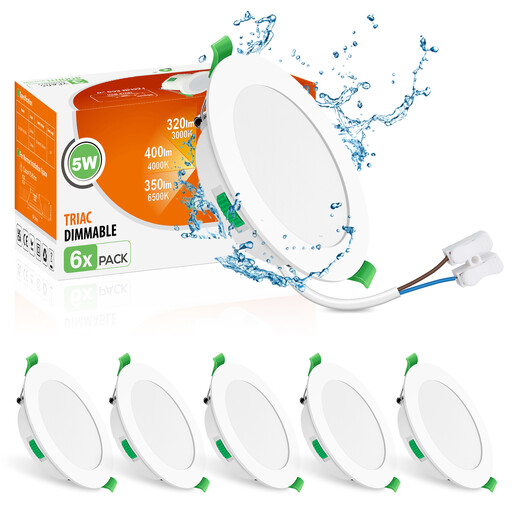
Our take : The peace-of-mind choice for the most critical installations. Perfect for lighting a shower enclosure or the area above a bathtub, where waterproofing is non-negotiable.
Its IP65 rating is the definitive answer to the safety pitfall in wet environments. Completely waterproof, it complies with the standard for installation in bathroom zone 1.
The best of both worlds: maximum protection (IP65) combined with all the modern features: dimmable, 3 colour temperatures, and an ultra-slim 30 mm profile.
Discover our full selection of products that meet these quality criteria and UK/EU safety standards.
A quality LED spotlight typically has a lifespan of 25,000 to 30,000 hours. Based on 4 hours of use per day, that's equivalent to over 15 years of peace of mind. A world of difference compared to old halogen bulbs.
No, the vast majority of modern LED spotlights connect directly to your 230V electrical system. This is a huge advantage: installation is simplified, and you no longer have to worry about an external transformer, which was a potential source of failure and took up valuable space in the false ceiling.
While it's ultimately a matter of taste, here are some useful guidelines: