
Livraison le jour même ou le lendemain

Qualité garantie

Débloquez vos offres de bienvenue: Livraison GRATUITE | Jusqu'à -80 % | 30 jours d'essai gratuits à JoyPlus
Téléchargez l'application
Choosing a recessed LED spotlight? It seems simple enough. In reality, the devil is in the details, and a simple renovation project can quickly turn into a major headache. The wrong choice can lead to unsuitable lighting, installation nightmares, and even safety hazards. As a product expert at Joybuy, my mission is to guide you through the jungle of options to help you make a truly informed choice, cutting through the marketing jargon.
Before you break out the hole saw, let's review the most common mistakes—the ones that are costly in both time and money.
To avoid these pitfalls, here are the technical specifications you must verify. They are your guarantee of a relevant, safe, and long-lasting installation.
The Ingress Protection (IP) rating is a European standard that classifies a device's resistance to the intrusion of solid objects (the first digit) and liquids (the second digit). It's a non-negotiable safety criterion.
The lighting atmosphere of a room is built on two pillars: the temperature of the light and its intensity.
Colour Temperature (CCT)?: Measured in Kelvin (K), it defines the "colour" of the white light.
Dimming?: A dimmable LED spotlight allows you to vary the light intensity. This is essential for switching from functional task lighting for cooking to ambient mood lighting for dinner. A smart LED spotlight takes this a step further, offering precise control from your smartphone.
Two measurements are critical:
Instead of an endless list, here are models that meet specific needs, based on the criteria we've just covered.
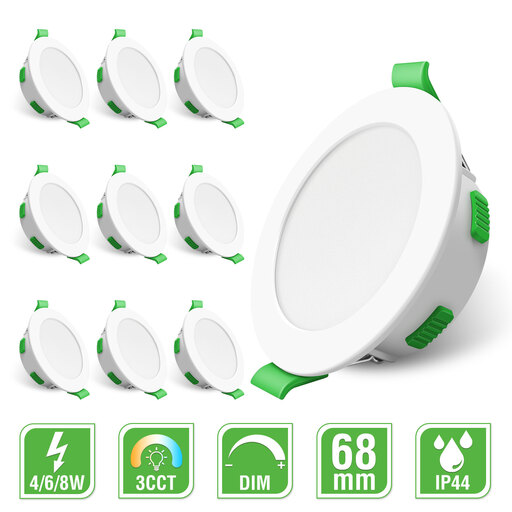
Why we chose it : Perfect for outfitting an entire room or multiple areas on a controlled budget. This set offers a cohesive "all-in-one" solution for DIY enthusiasts and large-scale renovation projects.
Its ultra-slim (29 mm) design solves the problem of shallow suspended ceilings. The 3CCT function and dimmable compatibility prevent you from being stuck with a single lighting mood. Its IP44 rating makes it suitable for kitchens and bathrooms (outside the shower area).
Versatility and excellent value for money. A single purchase provides a complete technical solution (temperature, intensity, shallow depth).
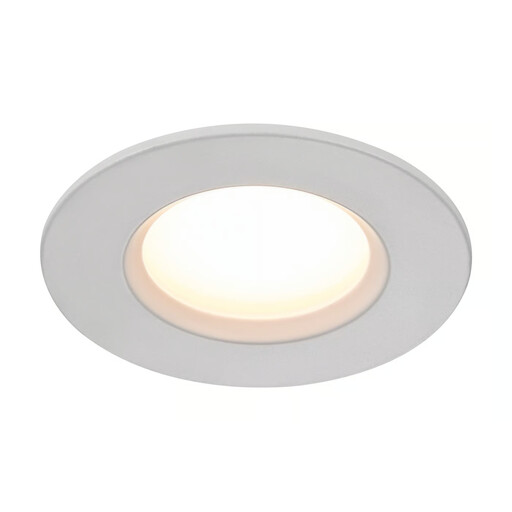
Why we chose it : For those who want absolute control over their lighting. This smart LED spotlight integrates into a home automation ecosystem and offers maximum flexibility for any room, including the most humid ones.
Its IP65 rating qualifies it for any installation, indoors or out, eliminating any risk related to moisture. The CCT (2200-6500K) function and dimming via the dedicated app offer limitless customisation, avoiding the trap of a fixed atmosphere.
Total control over colour temperature and intensity via Bluetooth. Its high protection rating (IP65) makes it ultra-versatile.
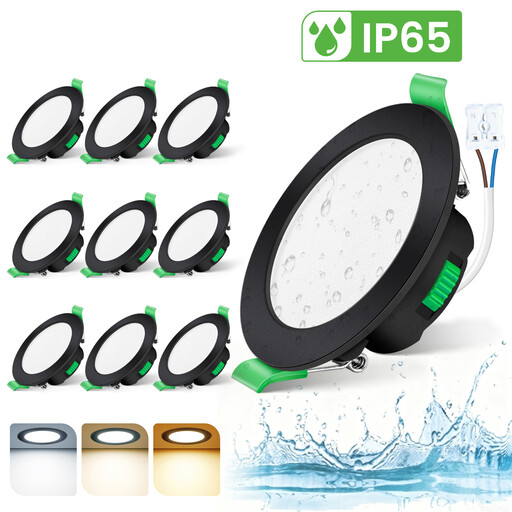
Why we chose it : For those seeking a modern, elegant finish without compromising on safety. This black LED spotlight is perfect for a contemporary bathroom, a kitchen with dark accents, or a covered patio.
The IP65 rating guarantees maximum protection against water, making it safe even in the most exposed areas. Its CCT function and dimmable compatibility ensure great atmospheric flexibility, while its ultra-slim design makes it easy to install anywhere.
It combines IP65 protection, high flexibility (CCT, dimmable), and a matte black finish that is highly sought-after for contemporary interiors.
We have selected a full range of products that meet these quality criteria and current safety standards.
This is one of their greatest strengths. Most quality models have a lifespan of between 20,000 and 30,000 hours. Based on an average use of 4 hours per day, that's over 13 years of peace of mind. This longevity is incomparable to old halogen bulbs.
If you have good DIY and electrical skills, the installation is entirely feasible. The golden rule: always turn off the main power supply at the circuit breaker before handling anything. For more complex installations (bathrooms, wiring many spotlights in series), hiring a qualified electrician remains the best guarantee of compliance and safety.
There's no absolute rule, as it all depends on the spotlight's light output (in lumens), ceiling height, wall colour, and the room's function. As a general guideline for comfortable main lighting, you can use the following benchmarks: