
Livraison le jour même ou le lendemain

Qualité garantie

Débloquez vos offres de bienvenue: Livraison GRATUITE | Jusqu'à -80 % | 30 jours d'essai gratuits à JoyPlus
Téléchargez l'application
Renovating a bathroom is a project where every detail counts. Lighting, far from being a mere accessory, is the cornerstone: it sculpts the atmosphere, ensures comfort, and, most importantly, guarantees your safety. But faced with a jungle of options, it's easy to fall into traps that drain your budget and leave your installation non-compliant. As the Head of Product Recommendations at Joybuy, my role is to guide you toward making the right choice with complete peace of mind.
Before you get started, here are the 3 classic mistakes to avoid at all costs when choosing your recessed LED spotlight for the bathroom:
To avoid these pitfalls, focus on a few non-negotiable technical specifications. They are your guarantee of safety, longevity, and comfort for your installation.
The French electrical standard NF C 15-100 is very clear and divides the bathroom into several safety "zones."
In short: for general lighting outside of wet zones, an IP44 spotlight may suffice. But for any installation above the shower or bathtub, IP65 is a non-negotiable safety requirement.
The atmosphere of your bathroom is largely defined by its light.
Many models include an adjustable colour temperature (often noted as 3CCT), which allows you to choose between these moods via a small switch directly on the spotlight.
Here are a few options that meet specific needs while adhering to our criteria for safety and performance.
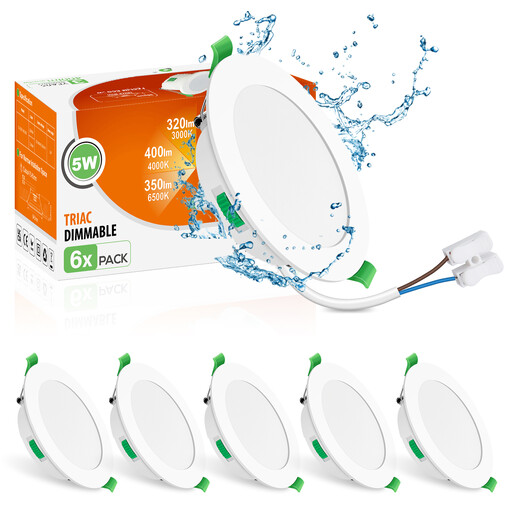
Why we chose it: Perfect for a complete renovation, this pack of recessed LED spotlights is an all-in-one solution. It checks all the boxes: compliance, versatility, and excellent value, without compromising on essential features.
Its IP65 rating qualifies it without question for installation above a shower. Its direct 230V connection spares you the headache of a bulky transformer.
The 3CCT function lets you select your light atmosphere (3000K/4000K/6500K) via a switch on the spotlight before finalising the installation.
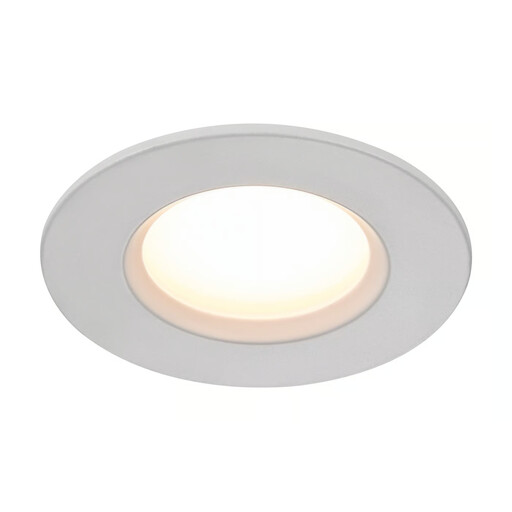
Why we chose it: The obvious choice for those who want to control their bathroom like the rest of their smart home. This smart spotlight offers full control from a smartphone, combining technology with maximum safety.
Here, dimming is managed by the integrated Bluetooth Mesh technology (via the Nordlux Smart app). This saves you from buying and installing a costly wall dimmer.
The colour temperature is fully adjustable from 2200K (candlelight) to 6500K (daylight), offering unparalleled flexibility to create the perfect atmosphere for any moment.
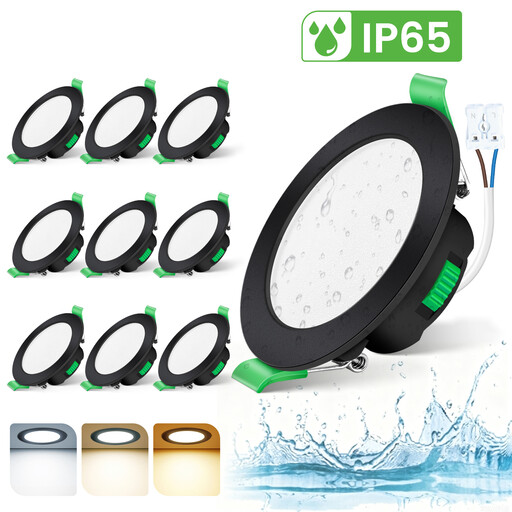
Why we chose it: When every millimetre counts. This model is the miracle solution for false ceilings with very shallow voids, without sacrificing safety (IP65) or features.
It sidesteps the 'fake ultra-slim' trap with its record-breaking installation depth of just 29 mm and its direct 230V connection. A truly compact model that's simple to integrate.
Despite its extreme slimness, it has everything you need: IP65 certification, a dimmable function, and 3 colour temperatures to choose from. A true powerhouse of technology in a minimalist package.
We have selected a full range of products for you that strictly adhere to these selection criteria and safety standards.
The IP (Ingress Protection) rating evaluates a device's sealing effectiveness. The first digit indicates protection against solids (dust), the second against liquids.
Bathroom electrics are governed by very strict rules (like the NF C 15-100 standard) to eliminate any risk of electrocution. Even if a 230V spotlight seems simple to connect, hiring a qualified electrician is not an option—it's a necessity. Only a professional can guarantee a compliant, safe, and properly earthed installation.
It all depends on the size of the room, the luminous output of the spotlights (in lumens), and the desired atmosphere. As a guideline, aim for an average illuminance of 300 lux for the general area and up to 500 lux around the mirror for functional lighting. For spotlights of 400-600 lumens, plan for about one spotlight every 1 to 1.5 m? to achieve uniform lighting. Don't forget to supplement this with more direct, targeted lighting at the mirror.