
Livraison le jour même ou le lendemain

Qualité garantie

Débloquez vos offres de bienvenue: Livraison GRATUITE | Jusqu'à -80 % | 30 jours d'essai gratuits à JoyPlus
Téléchargez l'application
Whether you're a professional mechanic, a maintenance technician, or a dedicated DIY auto enthusiast, choosing a ratchet wrench is a critical decision. The wrong tool can turn a simple repair into a real headache, especially when space is tight. Faced with an overwhelming array of models, sizes, and features, it's easy to feel lost.
This guide is designed to help you navigate the options. We'll break down the key criteria for selecting the perfect ratchet wrench for your needs and introduce a curated selection of models that stand out from the crowd.
By the Joybuy product experts
Before diving into our top picks, it's crucial to understand the features that make all the difference. Here are the three key points to evaluate to ensure you make the right choice.
The first big question to ask yourself: should you opt for a traditional mechanical model or embrace the power of an electric one?
At the heart of a ratchet's mechanism is a gear. Its tooth count is an absolutely crucial performance indicator.
Why is this so important? In a tight corner where your hand has very little room to move, a small swing arc makes all the difference. It allows you to keep turning a fastener where a standard ratchet with fewer teeth would be completely useless.
The drive square is the male end where the socket attaches. Its size determines the range of compatible sockets and the amount of force the tool can handle. The three most common sizes are:
A good ratchet wrench set typically includes multiple ratchet sizes to cover the widest range of situations.
We have selected three products that meet distinct needs, from the demanding DIYer to the professional.

View Product: EAFC 12V 45NM Electric Ratchet Wrench
Why it stands out: This electric ratchet wrench is built for speed and access to tight areas. Its ultra-slim 3 cm head and rechargeable battery-powered motor make it a top choice for mechanics and maintenance technicians.
Advantages:
Who is it for? Ideal for automotive professionals, industrial maintenance technicians, and DIYers who perform frequent repairs and want to maximize their efficiency.
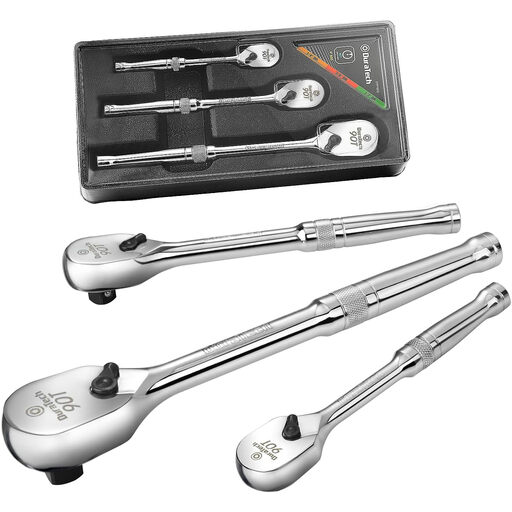
View Product: DURATECH 3-Piece Ratchet Set
Why it stands out: This ratchet wrench set is the ideal kit for intensive mechanical use. It contains the three most useful drive sizes (1/4", 3/8", 1/2"), each featuring a 90-tooth mechanism.
Advantages:
Who is it for? Perfect for professional mechanics or serious hobbyists looking to equip themselves with a reliable, high-performance set of mechanical ratchets that covers all their needs.
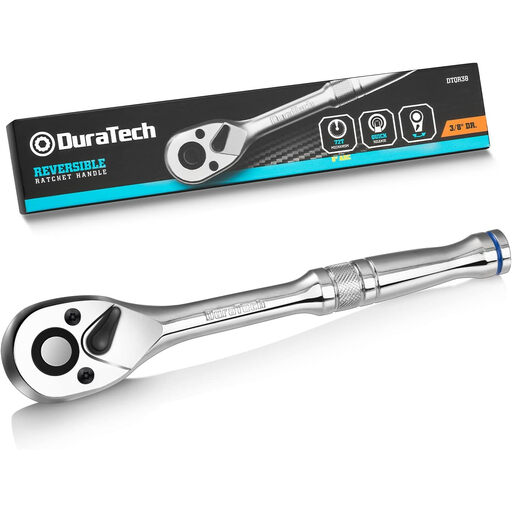
View Product: DURATECH 3-in-1 Reversible Ratchet Handle
Why it stands out: This tool takes an innovative approach by integrating three drive sizes (1/4", 3/8", 1/2") into a single handle. It's a clever solution for minimizing clutter in your toolbox.
Advantages:
Who is it for? An excellent choice for those who prioritize efficiency and space-saving, such as mobile technicians, home DIYers, or anyone wanting a versatile and easy-to-carry tool.
Our selection focuses on specific needs, but the world of tools is vast. To explore a wider range of tools for your repair or maintenance projects, feel free to browse our complete collection.
? Discover our complete collection of repair kits
1. What's the difference between a 72-tooth and a 90-tooth ratchet? The main difference is the swing arc. A 90-tooth ratchet needs only 4?degrees of movement to engage the next tooth, compared to 5?degrees for a 72-tooth model. This advantage, while seemingly small on paper, becomes very tangible when you're working in a tight space where every degree of movement counts.
2. Can you use a ratchet for torque-specific tightening? Absolutely not! That's not its function. A ratchet is designed for quickly turning fasteners. For precise final tightening, especially on sensitive mechanical parts (cylinder heads, wheels, etc.), it is imperative to use a torque wrench, which is the only tool that guarantees the required accuracy. Forcing a final tightening with a ratchet risks damaging its internal mechanism and, even worse, applying a completely incorrect amount of torque.