
Livraison le jour même ou le lendemain

Qualité garantie

Débloquez vos offres de bienvenue: Livraison GRATUITE | Jusqu'à -80 % | 30 jours d'essai gratuits à JoyPlus
Téléchargez l'application
Whether you're a professional mechanic, a maintenance technician, or a passionate DIYer, choosing the right ratchet wrench is essential for working quickly, efficiently, and safely. But with manual, electric, and torque models on the market, it's not always easy to know which to choose.
This guide breaks down the advantages of each type of wrench and helps you find the tool that truly meets your needs, beyond the marketing hype.
Before diving into our selection, here are the key points to consider to make the right choice.
It all depends on how you plan to use it?:
The drive square is the male part of the ratchet where the socket attaches. The most common sizes are?:
The mechanism's tooth count (72, 90, 120...) directly affects the swing arc, which is the minimum swing needed to engage the next tooth. The higher the tooth count (e.g., 90-tooth), the smaller the swing arc (e.g., 4°). This is a decisive advantage for working in the tightest corners.
For maximum versatility, a ratchet and socket set is often the smartest investment. It typically includes one or more ratchets, a complete assortment of sockets, extensions, and sometimes adapters. In terms of materials, opt for chrome vanadium or alloy steel, which guarantee excellent durability.
Here are a few models that stand out from the crowd, each tailored to specific needs.
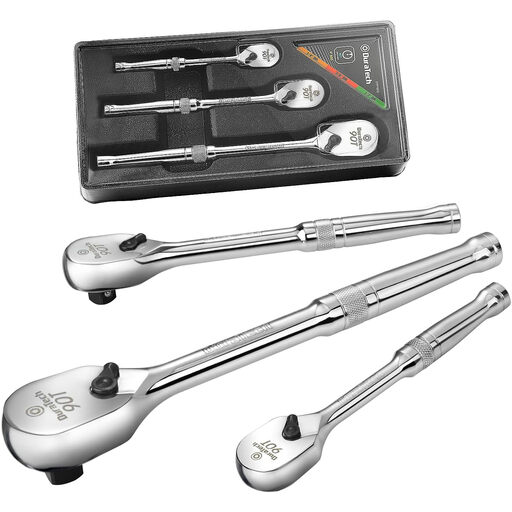
Why It Stands Out
This set checks the essential box for versatility. By including the three most common drive sizes (1/4", 3/8", and 1/2"), it allows you to tackle a wide range of jobs, from the most delicate to the most demanding. Its 90-tooth mechanism requires only a 4° swing arc, ideal for getting into hard-to-reach areas. The fully sealed ratchet head resists dust and debris, a real plus for workshop longevity.
Pros
Who Is It For??
For the professional mechanic or demanding DIYer looking for a reliable and complete manual ratchet set for their workshop.
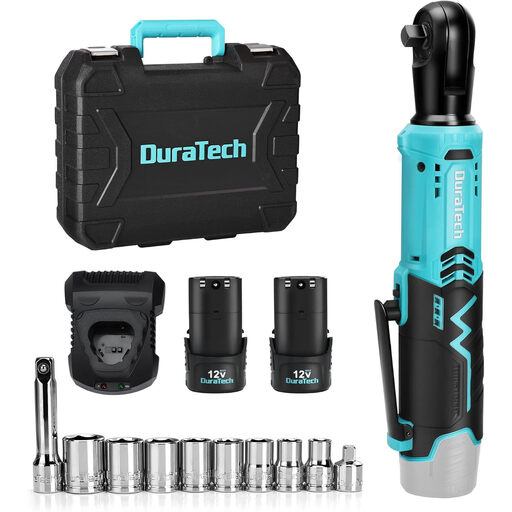
Why It Stands Out
This electric ratchet wrench is built for productivity. With a maximum torque of 65 Nm and a variable speed of up to 180 RPM, it fastens and loosens bolts at high speed, effortlessly. Its built-in LED light is a real plus for seeing clearly in the dark corners of an engine bay. The kit includes two 2.0 Ah batteries and a fast charger, allowing you to work without interruption.
Pros
Who Is It For??
For professionals and enthusiasts who perform frequent assembly/disassembly tasks and want to save precious time while reducing fatigue.
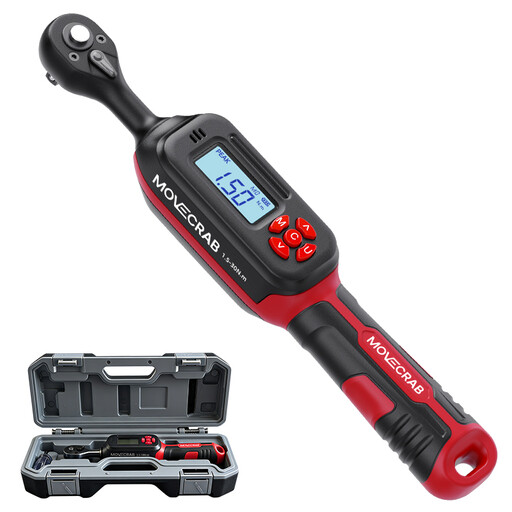
Why It Stands Out
When precision is the top priority, this digital torque wrench is the clear choice. It ensures an accuracy of ±2% and features a triple alert system (vibration, sound, LED) that unambiguously signals when the target torque is reached, eliminating any risk of over-tightening. Its digital screen displays the value in real-time and allows you to easily switch between units (N.m, ft.lb, in.lb, kgf.cm). The "Track" (live tracking) and "Peak" (peak memory) modes are formidable advanced features for quality control.
Pros
Who Is It For??
A must-have for work on engines, transmissions, braking systems, or any part where a precise tightening torque is required by the manufacturer.
Does your project require a different tool? Want to explore other accessories like special sockets or extensions? Discover our complete selection in the Wrench Organizers category to find the perfect equipment for your workshop.
The entire difference lies in the swing arc. A 72-tooth ratchet requires a 5-degree swing to engage the next tooth, compared to just 4 degrees for a 90-tooth model. A higher tooth count is therefore a major advantage when working in very tight spaces, where every degree of movement counts.
Absolutely not for the final tightening of sensitive parts! The electric ratchet wrench is a tool for speed, perfect for quickly running down or removing a bolt. For the final tightening to the exact torque, using a torque wrench (manual or digital) is mandatory. It's the only way to guarantee you're following the manufacturer's specifications and won't damage a part or its threads.
A few simple steps are all it takes to extend your tool's life. After each use, wipe it down with a cloth to remove grease and dirt. Avoid dropping it or, even worse, using it as a hammer. Occasionally, a drop of fine oil in the reversing mechanism will ensure it operates smoothly. Finally, store it in a dry place to prevent any corrosion.
By the Joybuy Product Recommendation Officer