
Livraison le jour même ou le lendemain

Qualité garantie

Débloquez vos offres de bienvenue: Livraison GRATUITE | Jusqu'à -80 % | 30 jours d'essai gratuits à JoyPlus
Téléchargez l'application
It's hard to resist the magic of a 3D-printed object that boasts a perfect colour gradient and a satin finish. Rainbow silk PLA filament transforms even the simplest creation into a spectacular piece. But how do you choose the right spool? Will the gradient look harmonious on your model? Will the filament's quality save you from the nightmare of failed prints?
This guide is here to help you make an informed decision. Our mission: to give you practical advice and reliable recommendations, without the marketing jargon, so you can find the perfect filament for your projects.
Before diving into our selection, let's review the essential criteria that will guide your choice.
This is THE decisive factor for a gradient PLA filament: the speed at which the colours change. This is what will dictate the final look of your print.
A poorly wound rainbow PLA spool is every maker's nightmare. The knots that can form can ruin hours of printing. Opt for filaments advertised as having neat and consistent winding. Also, check the diameter tolerance. A 1.75?mm filament with a tight tolerance (e.g., ±?0.02?mm) ensures more consistent extrusion and, ultimately, better print quality.
The term Silk PLA refers to PLA enriched with additives that give it its unique appearance: shiny, smooth, and light-reflective. This satin effect has the advantage of hiding layer lines, for a visibly cleaner and more professional result. If this effect is your priority, make sure the product is described as "Silk".
We have selected multicolour 3D printer filaments for you that stand out from the crowd, both for their performance and for their user reviews.
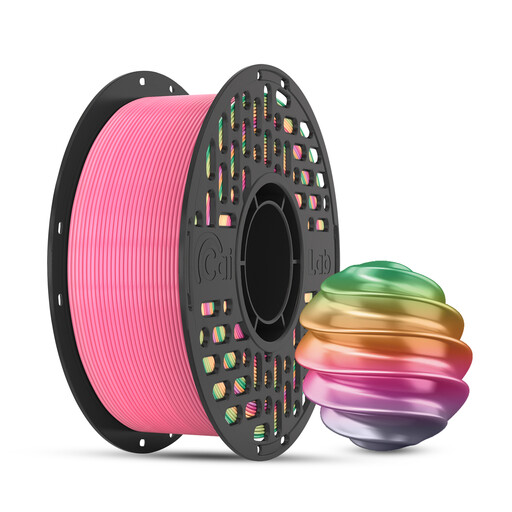
Why it stands out: This filament is notable for its vibrant colours and a fast transition reminiscent of vibrant candy. Its "Silk Candy" effect ensures an intense shine, perfect for pieces that need to catch the eye.
Pros:
Who is it for? For makers who want maximum visual impact on their decorative objects, toys, or prototypes. Ideal if you're looking for saturated colours and a spectacular sheen.

Why it stands out: This version offers a more classic and harmonious gradient. The transition between hues is particularly smooth, making it an excellent all-rounder. The silky finish is elegant without being flashy.
Pros:
Who is it for? For hobbyists and designers looking for a reliable and versatile rainbow filament, suitable for both artistic pieces and everyday objects where looks matter.
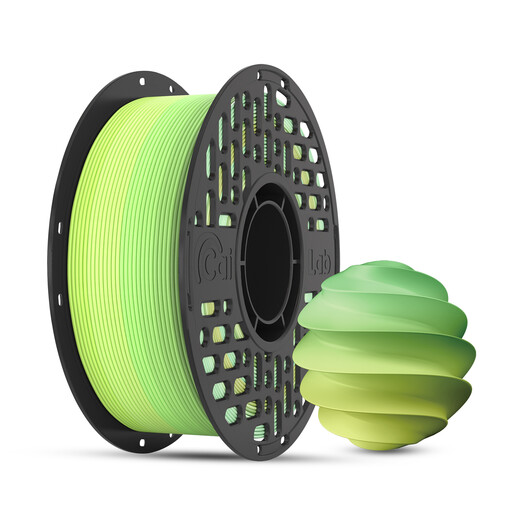
Why it stands out: The Rainbow #9 strays from the beaten path with a unique colour palette, offering deeper or more pastel tones depending on the batch. It's the ideal filament for those who want to move away from the traditional rainbow and experiment with bolder colour combinations.
Pros:
Who is it for? For artists, content creators, and makers who want their prints to stand out with an unexpected colour palette.
Our selection highlights some solid choices, but the world of rainbow silk PLA filament is vast. Longer or shorter colour cycles, unique finishes, brand-new colour combinations... the possibilities are endless.
? Discover our complete collection of rainbow gradient 3D filaments to explore more options.
1. How do I get the best rainbow effect on my prints? For a successful rainbow effect, the secret is volume. Print large objects, or run several small parts on the build plate at the same time. The more filament you use, the smoother and more visible the gradient will be. Increasing the infill percentage is also a good trick.
2. What is the recommended printing temperature for silk PLA? Generally, silk PLA prints between 190?°C and 220?°C. However, always follow the manufacturer's recommendations on the spool. Don't hesitate to print a temperature tower to find the perfect setting for your machine.
3. Is silk PLA as strong as standard PLA? Due to the additives that give it its shine, silk PLA is often slightly less impact-resistant than standard PLA. This makes it perfect for decorative objects, prototypes, or parts that don't need to withstand impacts. For mechanical or functional parts, you're better off with PLA+ or PETG, which are much more robust.