
Livraison le jour même ou le lendemain

Qualité garantie

Débloquez vos offres de bienvenue: Livraison GRATUITE | Jusqu'à -80 % | 30 jours d'essai gratuits à JoyPlus
Téléchargez l'application
Rainbow PLA filament promises 3D prints with shifting colours and a spectacular visual effect. But this promise can hide pitfalls that quickly turn a creative project into a real headache. A nearly invisible gradient on a small part, a spool that tangles mid-print, or a "silky" finish that's silky in name only are all common issues.
This guide breaks down the essential criteria for choosing the perfect rainbow PLA filament for your projects and helps you avoid the most common disappointments.
Before you check out, keep an eye on these three points that separate a good spool from a guaranteed source of frustration.
To ensure you make the best choice, here are the technical specifications to scrutinise.
This is THE decisive criterion for a gradient PLA filament. Rarely highlighted by manufacturers, it nonetheless determines the entire final result:
Diameter consistency is non-negotiable for a quality filament. For a 1.75 mm multicolour 3D filament, aim for a low tolerance, around ±0.03 mm, and ideally ±0.02 mm. Excessive diameter variation causes inconsistent extrusion (under-extrusion or over-extrusion), leading to a risk of clogged nozzles and unsightly surface defects.
A quick glance at the spool can tell you a lot. A properly wound filament shows neat, aligned coils with no overlapping. This is a guarantee of peace of mind, especially for long prints that last several hours. The best practice: always secure the free end of the filament in the designated holes on the spool after each use. It's the best way to avoid creating a knot yourself.
To guide you, here is our selection from the CaiLab colour gradient filament range, organised by use case to help you find the right model for you.
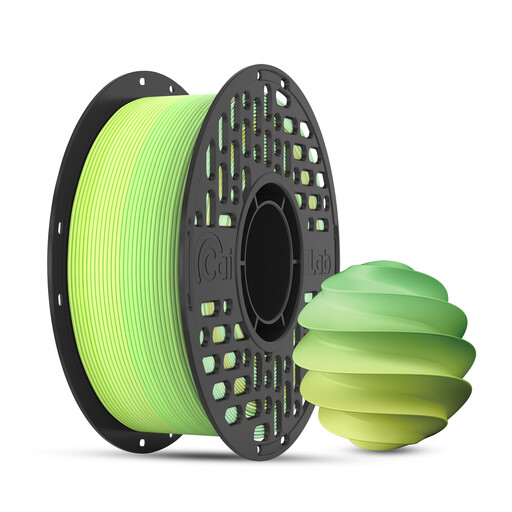
Why we love it: Perfect for small parts where every gram counts. Its rapid colour transitions guarantee a multicolour effect even on modest objects like keychains, figurines, or articulated toys.
This filament ensures a visible colour change even with little extruded material. Say goodbye to the "fake rainbow" trap where your creation remains hopelessly monochrome.
Its excellent inter-layer adhesion and good fluidity allow for fine details and vibrant colours, even on small prints.
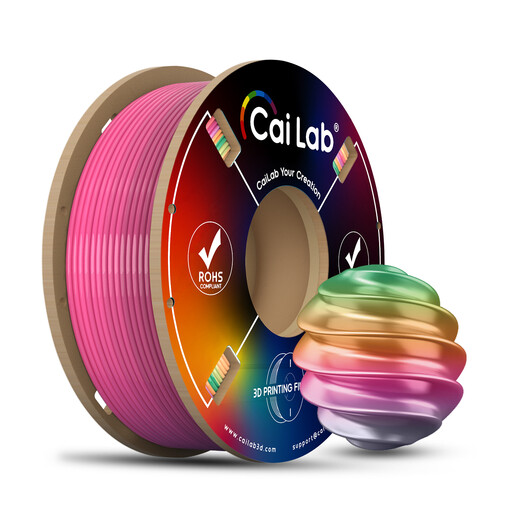
Why we love it: For anyone who wants to give their creations a premium, luminous look. Its silky finish catches the light, enhancing the object's curves and details. Perfect for vases, decorative boxes, or artistic pieces.
Unlike simply glossy filaments, this "silk" version offers a true satin sheen without sacrificing strength. This helps you avoid the disappointment of a dull finish or an overly brittle material.
A spectacular visual effect thanks to its pastel colour gradient, for objects with a smooth, premium look straight off the print bed.
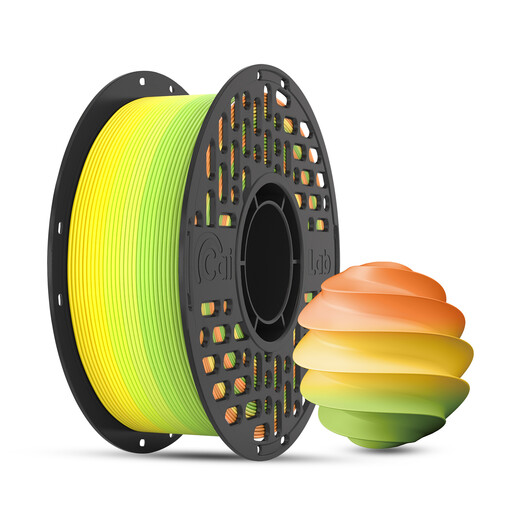
Why we love it: Designed for large-scale projects like sculptures or large vases. Its long, gradual colour transitions create a subtle and harmonious gradient over the entire height of the part.
The impeccable winding of the 1 kg spool minimises the risk of knots, a critical point on long prints where the slightest snag is fatal. The filament's consistency ensures reliable extrusion, hour after hour.
A palette of warm colours (yellow, orange, red) for a unique gradient, combined with rock-solid reliability for marathon prints lasting over 24 hours.
Discover our full selection of products that meet our quality criteria and current safety standards.
These terms refer to the length of filament required to transition from one colour to the next. A "fast" gradient changes colour every 10 to 15 metres, ideal for ensuring even small objects feature multiple hues. A "slow" gradient, on the other hand, can stretch over 25 to 50 metres, creating very gentle fades on large parts.
It's all about prevention. If the spool is well-wound from the factory, the risk comes from handling. The best practice: after each use, always secure the end of the filament in one of the designated holes on the side of the spool. This is the only way to prevent it from loosening and forming a knot.
As a rule, it prints like a standard PLA. However, to really bring out its sheen, it's often wise to increase the extrusion temperature slightly (+5 to 10°C compared to your usual settings) and slightly reduce the speed. As with any new filament, the best approach is to print a temperature tower to find the perfect setting for your machine.