
Livraison le jour même ou le lendemain

Qualité garantie

Débloquez vos offres de bienvenue: Livraison GRATUITE | Jusqu'à -80 % | 30 jours d'essai gratuits à JoyPlus
Téléchargez l'application
Color 3D printing unlocks a world of creative possibilities, turning simple functional objects into truly unique creations. Rainbow PLA filament is especially sought-after for its ability to automatically produce smooth, captivating color gradients. But how do you choose the right spool? Will the color transition be fast enough for a small object? Will the finish be glossy or matte?
This guide is here to help you navigate the options. As the Head of Product Curation at Joybuy, my mission is to decode the labels for you and provide practical, jargon-free advice to help you find the perfect filament for your projects.
Before diving into our top picks, let's review the key criteria to ensure you make the right choice and get prints that live up to your expectations.
The number one criterion for a gradient 3D filament is how quickly the colors change. This is typically measured in meters.
So, consider the size of your typical prints before choosing your spool of multicolor PLA.
The final look and feel of your creation will depend entirely on the filament's finish.
The choice here is purely a matter of aesthetics for your color 3D print.
The vast majority of rainbow filaments are made of PLA, a material known for being easy to print. Simply check that the diameter matches your printer; the industry standard is 1.75mm rainbow PLA. Although PLA is user-friendly, "silk" versions may sometimes require a slightly higher extrusion temperature (try an increase of 5 to 10°C over standard PLA) to achieve optimal shine. In any case, we recommend printing a small temperature tower to find the ideal setting.
Here is our selection of filaments that stand out for their color palettes and finishes, all from the CaiLab filament range.
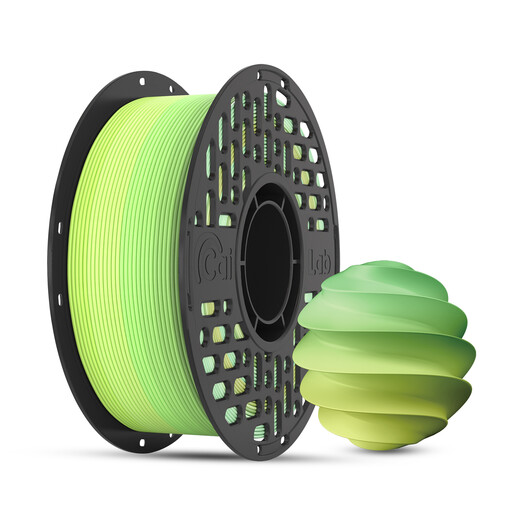
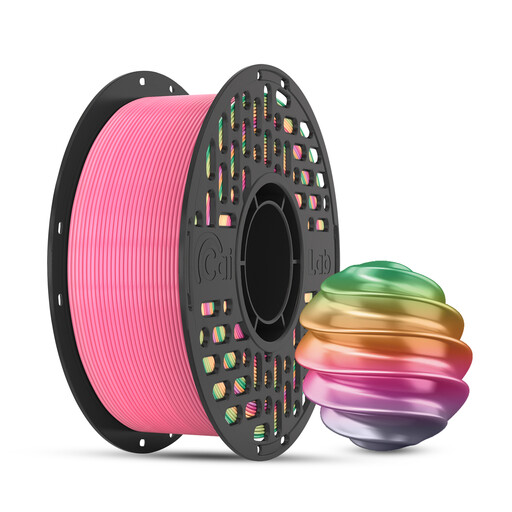
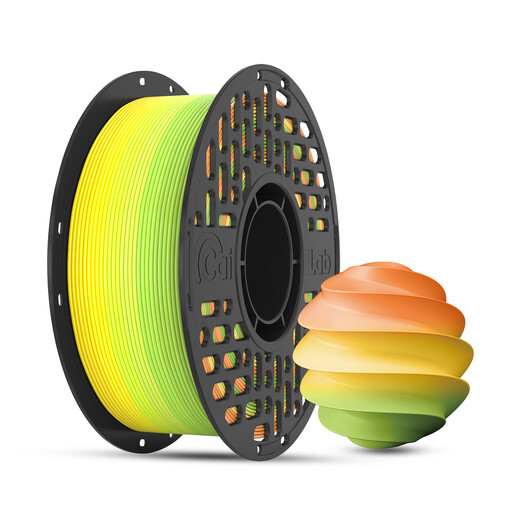
Our selection is just a glimpse of the possibilities offered by gradient filaments. To explore other palettes, finishes, or different gradient speeds, many other options await.
? Discover our full range of rainbow and silk filaments
A rainbow PLA filament (or "gradient") is defined by a smooth, gradual transition between colors. In contrast, a simple "multicolor" filament may feature abrupt, segmented color changes. For a blended effect, be sure to look for the term "rainbow" or "gradient".
It all depends on two factors: the filament's gradient length (in meters) and the amount of material your object requires. For a small part, opt for a short gradient (fast color change). For a large model, a long gradient will produce a better effect. Some manufacturers specify the length needed for a full color cycle.
Generally, no. Silk PLA filament prints almost exactly like standard PLA. However, to achieve its signature shine, it's often wise to slightly increase the print temperature (by 5 to 10°C) and slightly reduce the speed. As always, printing a temperature tower is the best way to find the perfect settings for your machine.