
Livraison le jour même ou le lendemain

Qualité garantie

Débloquez vos offres de bienvenue: Livraison GRATUITE | Jusqu'à -80 % | 30 jours d'essai gratuits à JoyPlus
Téléchargez l'application
Feeling the asphalt vibrate through your hands, nailing every corner with millimetre precision, and mastering your racing line to perfection?that's the promise of a good racing wheel. But be warned: the market is a jungle of models with often-misleading features. Between the marketing jargon and endless spec sheets, it's easy to make the wrong choice, and your investment could end up collecting dust in a closet.
To avoid falling into these traps and ruining your experience, here are the classic mistakes to steer clear of:
sim racing. For a realistic driving experience, aim for a minimum of 900° to replicate the feel of being behind the wheel of a real car.To bring some clarity to the world of racing peripherals, let's focus on the technical specifications that truly make a difference.
This is THE criterion that separates a toy from a true immersion tool. Several technologies compete, with radically different levels of realism and price points:
This point is non-negotiable. Meticulously check which platform(s) the wheel is officially designed for.
Brands like Hori and Thrustmaster offer models dedicated to each ecosystem, while players like Moza have historically focused on PC, with a more recent expansion into the console world.
The rotation angle determines your wheel's range of motion. A 900° angle (two and a half turns from lock to lock) is the standard today for a realistic driving experience. The best models allow you to adjust this angle on the fly to adapt to different types of vehicles (F1, GT, rally).
The wheel and pedal set form an inseparable duo. Entry-level pedal sets make do with two plastic pedals. More serious models offer:
There's a wheel for every driver. Here is our selection, designed for different profiles and budgets.
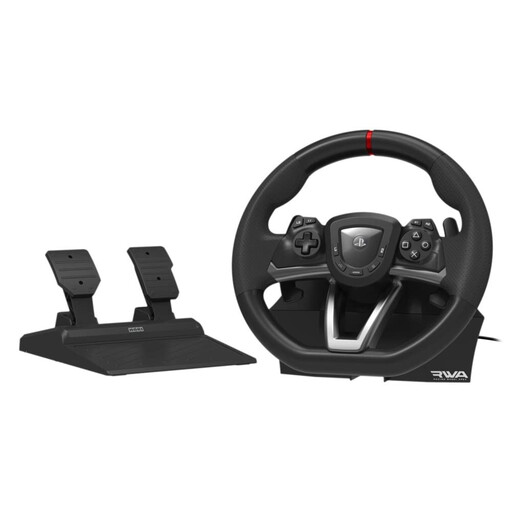
Why we chose it: Perfect for discovering the joys of racing without breaking the bank. Its official Sony license ensures flawless compatibility on PlayStation and PC. It's a serious first step into the world of racing wheels, ideal for family game nights.
Its promise is honest: no complex force feedback, but clear vibrations and official compatibility that protects you from nasty surprises. Its 270° rotation angle is a good compromise for arcade and light simulation games.
Official Sony License: simple setup and immediate recognition. Fully Programmable: allows you to customise controls to your preferences.
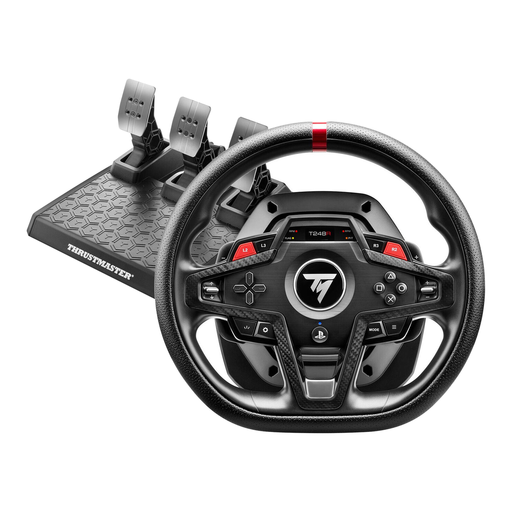
Why we chose it: The T248 is the go-to entry point into the world of sim racing. It offers true force feedback and a quality magnetic pedal set, providing authentic driving sensations on a reasonable budget.
It features a hybrid force feedback system (belt and gear) that far surpasses simple vibrations. Its T3PM magnetic pedal set is precise and durable, light-years ahead of cheap plastic models.
Dynamic Force Feedback: 3 preset, adjustable modes. Integrated Display: shows telemetry data and simplifies settings. Magnetic Pedal Set: for enhanced precision and longevity.
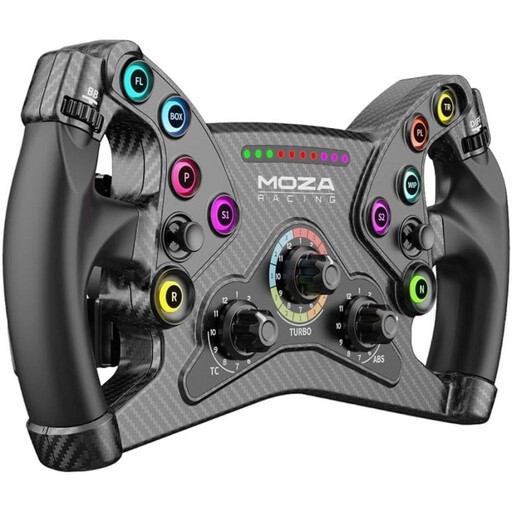
Why we chose it: Built for pure performance, this GT/Formula-style wheel is for drivers building their own custom simulator. Note that this is a wheel rim only, designed to be mounted on a Direct Drive base (sold separately) to achieve the pinnacle of precision.
It's part of a modular ecosystem. Its carbon fibre-reinforced composite construction and magnetic Hall-effect paddles offer a level of quality and precision unattainable in all-in-one models.
Premium Materials: carbon fibre composites and steel. 70 Programmable Inputs: total control during a race. Dual-Clutch Magnetic Paddles: for perfect race starts.
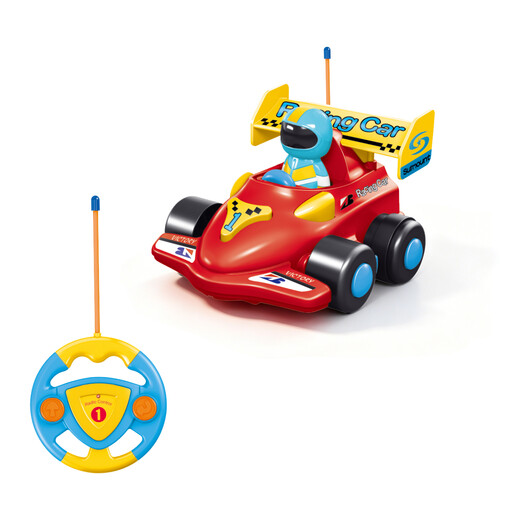
Why we chose it: For budding drivers, safety and simplicity are the only priorities. Note that this is not a console accessory, but a toy: a remote-controlled car operated via a steering wheel controller, perfectly sized for small hands.
The approach is clear: this is a toy designed to be safe and simple, which avoids any confusion with console wheels that are unsuitable for young children.
Simplified Controls: forward, reverse, and turn functions that are easy to master. Robust Construction: designed to withstand bumps and tumbles. Fun Features: lights, engine sounds, and music.
Explore our full selection of products, all tested and approved according to our quality and safety criteria.
It all depends on how you play. For arcade-style racing games (like Mario Kart) or for occasional sessions, a wheel without force feedback or with simple vibrations can be enough. However, as soon as you get into driving simulations (Gran Turismo, Assetto Corsa, F1), force feedback is no longer an option—it's essential. It's what lets you feel the track (loss of grip, kerbs, weight transfer) and connects you to the car. The experience becomes not only more immersive but also helps you perform better.
Its longevity is directly related to its build quality and technology. An entry-level model with plastic components and a gear-driven mechanism will show signs of wear (unwanted noise, play in the steering) much faster than a belt-driven or Direct Drive model with metal parts. A good mid-range wheel, if treated well, will last you for many years. High-end models, on the other hand, are built for thousands of hours of intensive use.
On a console (PS5, Xbox), it's child's play: officially licensed wheels are generally "plug-and-play." Just plug it in and start playing. On PC, the basic setup is just as simple, but it's crucial to go a step further: always download and install the latest drivers and software from the manufacturer. This is the key to unlocking advanced settings (rotation angle, force feedback strength, pedal calibration) and ensuring flawless compatibility with your entire game library.