When choosing a washing machine near a bedroom or living area, first compare its noise level and noise class during the spin cycle on the energy label for the exact model. Then look at its spin efficiency, capacity and energy and water consumption. A favourable noise rating isn’t enough: the machine must also fit in the available space and sit level on a hard, stable floor. Otherwise, vibrations and knocking can become disruptive.
Who are these criteria useful for?
People with a bedroom or living room nearby
If your machine is near a room where you relax or in an open-plan kitchen, it’s worth paying particular attention to the noise it makes during the spin cycle. ADEME recommends checking the energy label to compare noise levels and spin efficiency: a high maximum spin speed alone won’t tell you how disruptive the machine may be.
People with limited space
Width and depth are only part of the picture: you also need room to open the door or access the top of the machine. A shallow front-loading model and a top-loading model therefore suit different space constraints. UFC-Que Choisir points out that a capacity that’s too small can mean running more cycles.
People concerned about vibrations
The noise rating on the label doesn’t describe every vibration the machine might produce once installed. Bosch and Electrolux support advice recommends checking that the machine is level, that all feet are firmly on the floor, that the transit bolts have been removed and that the load is balanced.
What should you check before buying?
Start by comparing the labels of models that will genuinely fit in the space you have in mind. Then consider the capacity you need and the installation requirements: neither a compact design nor a favourable noise rating can make up for an unstable installation.
| Consideration |
What to check before buying |
Who this matters to |
| Noise during the spin cycle |
The dB level and noise class for the exact model, followed by its spin-efficiency class. |
If the machine is near my bedroom or living room, I want to minimise disruption during the spin cycle without compromising how well my washing dries. Around 42% of consumers would put quiet operation at the top of their list. |
| Space and capacity |
The dimensions, access for loading and a capacity suited to the amount of washing you usually do. |
In a tight space, I need to be able to load the machine without blocking the way, and avoid a drum that means doing more loads. Fitting the machine in while still having a useful capacity would be the priority for around 33% of consumers. |
| Vibrations and stability |
Whether it can be installed level on a hard, stable floor, with all four feet firmly on the ground. |
If the floor or nearby rooms make vibrations a concern, I want a stable installation rather than relying solely on the noise information. Around 25% of consumers would put controlling vibrations ahead of other criteria. |
When choosing between designs, a front-loading door needs space in front of the machine, while a top-loading model needs clear space above it. UFC-Que Choisir gives typical dimensions of around 60 cm wide for a front-loader and around 40 cm for a top-loader. Always check the dimensions of the model you choose and the clearance it needs in your home. Neither design, on its own, guarantees quiet operation.
Mistakes to avoid
-
Relying only on the spin speed or the word ‘quiet’
Maximum spin speed, noise during the spin cycle and spin efficiency are separate pieces of information. If the machine will be near a living area, consider each of these separately, without forgetting its energy and water consumption.
On the energy label for the exact model, compare the dB level and noise class with the spin-efficiency class, as well as water consumption per cycle and energy use per 100 cycles. ADEME recommends using this information when choosing a washing machine.
-
Assuming the model is to blame for every vibration
According to Bosch and Electrolux support advice, noise during the spin cycle can be caused by a machine that isn’t level, an unbalanced load, transit bolts that haven’t been removed or moving hoses.
Follow the instructions before using the machine for the first time: remove the transit bolts as directed, adjust the feet to stabilise the machine and check the position of the hoses.
-
Expecting anti-vibration pads to fix an unstable installation
Anti-vibration accessories can’t replace a suitable base. UFC-Que Choisir and Bosch recommend placing the machine on a stable surface; check the floor and make sure the machine is level, even if you’re considering using pads.
First, check that all four feet can sit firmly on the floor in the chosen location. If you want to add pads, check that they’re compatible with the machine and floor rather than assuming they’ll guarantee quieter operation.
-
Choosing a smaller machine without checking how you’ll load it
A compact front-loader, a standard front-loader and a top-loader all need different amounts of clearance. UFC-Que Choisir also notes that a drum that’s too small can mean running more cycles.
Measure the space and the route to it, then check how much room the door needs to open and compare the capacity with the amount of washing you usually do.
Brands to consider for your needs
Bosch
Worth considering if you want detailed manufacturer guidance on stabilising the machine after installation.
- Bosch support explains how the floor, feet, levelling and transit bolts can contribute to unusual noises.
- This guidance doesn’t show that all Bosch washing machines are quieter: compare the label for the model you’re considering.
Electrolux
Worth considering if vibrations during the spin cycle and installation options are your main concerns.
- Electrolux support describes several possible causes of vibration, including levelling, transit bolts, the load and the hoses.
- Electrolux also offers anti-vibration pads, but these don’t replace checking the floor or comparing the noise ratings of the washing machine you choose.
Whirlpool
Worth considering if limited width makes a top-loading model a good option.
- Whirlpool France’s product details for the TDLR 62667 FR give a specific example: 40 cm wide, 6 kg, 1,200 rpm and a stated noise level of 79 dB during the spin cycle.
- These specifications apply to this particular model. A narrower design doesn’t mean that all top-loading models are quieter.
Washing machines to explore on Joybuy
These two front-loading models let you compare different capacities for a home where noise during the spin cycle matters. Before choosing, compare the energy label and the dimensions of the exact variant with your available space, then check that your floor allows for a stable installation.
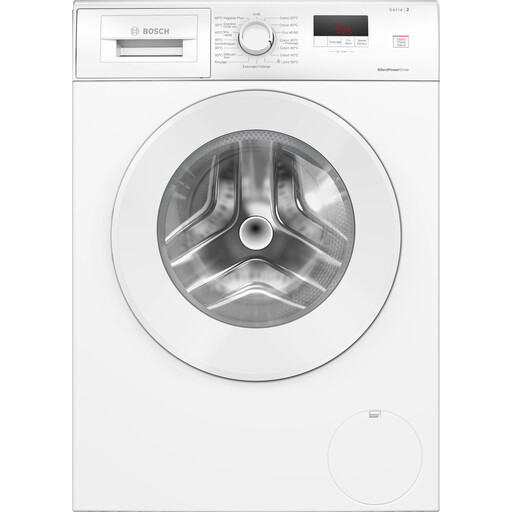 Image unavailable
Bosch WGE02407FR, 7 kg front-loader, 1,400 rpm, Class A
Worth considering if a 7 kg capacity suits the amount of washing you usually do and you have enough room in front of the door.
The stated maximum spin speed is 1,400 rpm and the stated energy class is A. To assess how suitable it is near a living area, compare the noise and spin-efficiency ratings separately on the model’s label. Also check its dimensions and installation instructions.
View on Joybuy
 Image unavailable
Electrolux EW7FI259160V SteamCare SmartSelect Connected, 9 kg, 1,600 rpm
Worth considering if a 9 kg capacity suits the amount of washing you do and there’s enough room for a front-loading machine.
The stated maximum spin speed is 1,600 rpm. On its own, this doesn’t tell you how noisy or prone to vibration the machine will be: check the energy label for the exact model and make sure there’s enough depth, clearance in front of the door and room to level the machine as instructed.
View on Joybuy
Frequently asked questions
How do you compare the noise levels of two washing machines?
Compare their noise levels in dB during the spin cycle and their noise classes on the energy label for each exact model. ADEME says the label also provides separate information about consumption and spin performance. However, the noise rating can’t predict vibrations caused by a poorly installed machine.
Will a washing machine with a low dB rating avoid vibrations?
No. A favourable noise rating won’t make an unstable installation stable. Bosch and Electrolux advice recommends checking that the machine is level, that the feet are firmly on the floor, that the transit bolts have been removed and that the load is balanced. Follow the instructions for the model you’ve installed.
Should you choose the smallest capacity for a studio flat?
No. First check your space constraints, then choose a capacity that suits the amount of washing you usually do. UFC-Que Choisir points out that a drum that’s too small can mean running more cycles. Also measure access to the machine and allow enough room to open it.
Does the durability rating tell you anything about noise?
No. The durability rating doesn’t measure noise or vibrations in your home. According to the French Ministry for Ecological Transition, it has been gradually replacing the repairability rating for washing machines in France since 8 April 2025. Treat it as separate information from the noise class and noise level during the spin cycle.


