
Livraison le jour même ou le lendemain

Qualité garantie

Débloquez vos offres de bienvenue: Livraison GRATUITE | Jusqu'à -80 % | 30 jours d'essai gratuits à JoyPlus
Téléchargez l'application
As warmer weather and heatwaves return, our homes can quickly turn into ovens, especially at night. Sleeping or working in an overheated room becomes an uphill battle. If air conditioning isn't an option, the quiet tower fan stands out as an alternative that is as effective as it is discreet.
But with an overwhelming number of options, it's hard to know where to start. How do you find the truly silent model that won't ruin your sleep? This guide is here to help. As the Head of Product Recommendations at Joybuy, our mission is to give you the keys to making an informed choice based on objective criteria, far from marketing jargon.
Before we get to our top picks, let's review the essential criteria for finding the model that will perfectly meet your needs.
The promise of a quiet tower fan? To cool you down without disturbing your peace. The noise level, expressed in decibels (dB), is therefore the first indicator to watch closely.
Good to know: The quietest models often feature a direct current (DC) motor, which is known to be quieter and more energy-efficient.
A good fan must be effective. Its ability to circulate air depends on several factors:
With children or pets, safety is a non-negotiable point. The very design of the tower fan, often called a bladeless fan (because its blades are hidden), is inherently safer: no risk for curious little hands or paws. Also, make sure its base is stable to prevent any risk of tipping over.
In terms of consumption, choose a low-energy fan. Recent models have a power rating between 40 and 60 watts, a fraction of what an air conditioner consumes. The presence of a timer is also an excellent way to control consumption by programming the device to turn off.
We have selected three models that check all the boxes for silence and performance.
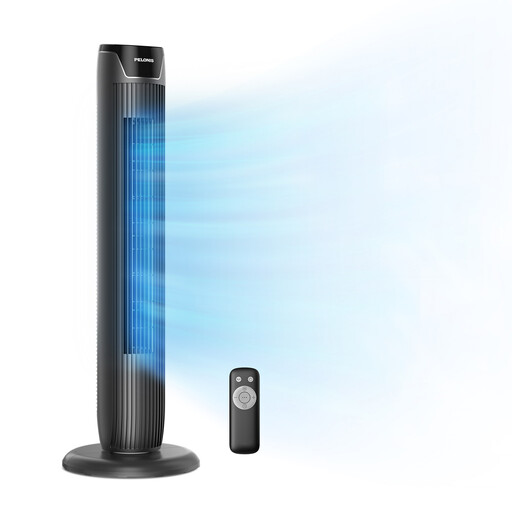
Why it stands out: This model focuses on nearly inaudible operation. The manufacturer claims a record-low noise level of just 27 dB in silent mode, making it ideal for a bedroom. Its intelligent "AI" mode automatically adjusts the airflow based on the ambient temperature, optimizing both comfort and energy consumption.
Its strengths:
Who is it for? The perfect choice for those who demand near-absolute silence, whether in an adult's or a child's bedroom. Its smart mode and remote control make it a convenient ally for everyday comfort.
See the PELONIS 75° Oscillating Tower Fan
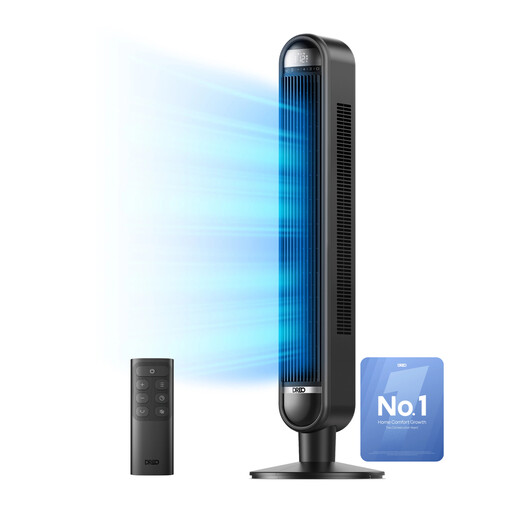
What makes it different: The DREO tower fan is all about power. Its airflow can reach 7.6 m/s and travel up to 7 meters. Paired with a wide 90° oscillation, it circulates air quickly and evenly, even in large rooms. Its sleep mode strikes the right balance between coolness and quiet.
Its strengths:
Who is it for? Ideal for those who need to cool a large living room, office, or spacious bedroom. Its power is a real asset during heat peaks, without sacrificing quiet at night.
See the DREO 42 Inch Quiet Tower Fan
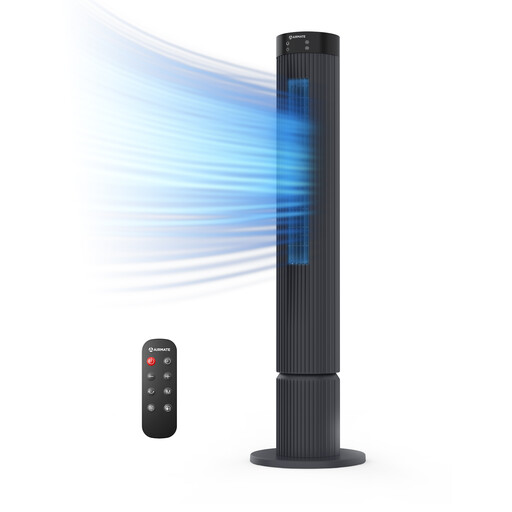
Its key feature: The AIRMATE features a brushless DC motor, the gold standard for silence and longevity. It offers highly granular customization with 12 speeds and a "Turbo" mode for a powerful blast of air. Its modular design even allows you to adjust its height, making it equally at home on a desk or on the floor.
Its strengths:
Who is it for? For tech enthusiasts who love to have total control. With its 12 speeds and adjustable height, it's the Swiss Army knife of fans, perfect for an office as well as a bedroom.
See the AIRMATE Ultra-Quiet Tower Fan
Our selection focuses on models that excel in silence and performance. But the market is full of other fans with various designs, features, and budgets.
To explore all the possibilities, feel free to browse our complete catalog.
Discover our full range of tower fans with remote controls
It's all in the design. The tower fan is vertical and slender. It diffuses air along its entire height through a grille, which makes it more visually discreet and safer. The pedestal fan, on the other hand, has visible blades that create a more concentrated airflow. Although some pedestal models are very quiet, the tower fan often wins out in terms of design and evenness of airflow.
Not necessarily. The marketing term "bladeless fan" most often refers to tower fans where the blades are simply hidden inside the chassis. The noise level depends primarily on the quality of the motor (DC motors are much quieter than AC motors) and the overall aerodynamics of the device. A good tower fan with a DC motor will often be more discreet than a poorly designed, entry-level "bladeless" model.
A modern low-energy fan consumes between 30 and 50 watts at full power, no more. For comparison, a portable air conditioner devours between 1000 and 3000 watts! The impact of a fan on your electricity bill is therefore minimal, even with prolonged use. It's a cooling solution that is both economical and much more environmentally friendly.