
Livraison le jour même ou le lendemain

Qualité garantie

Débloquez vos offres de bienvenue: Livraison GRATUITE | Jusqu'à -80 % | 30 jours d'essai gratuits à JoyPlus
Téléchargez l'application
When temperatures soar, finding an effective fan that won't disturb your sleep or concentration becomes a mission. The quiet tower fan emerges as the ideal compromise between performance, discretion, and design. But with an overwhelming number of options, how do you make the right choice?
This guide is here to help you navigate the options. Our team has analysed the market to bring you practical advice and objective recommendations, cutting through the often-misleading marketing jargon. Our goal: to lead you to the model that will truly meet your needs.
Before diving into our top picks, let's review the essential criteria for finding the model that's perfect for you.
For a fan, silence isn't just a feature—it's the number one priority, especially in a bedroom. While the concept of "quiet" is subjective, it is measured in decibels (dB). Here are a few benchmarks for reference:
For peaceful nights, aim for a model with a noise level that doesn't exceed 35 dB on its lowest speed (or in night mode). A good indicator: devices equipped with DC (direct current) motors are generally much quieter and more energy-efficient than those with conventional AC motors.
No, a powerful yet quiet fan is no longer an oxymoron. Its performance is measured by airflow (in m?/h) or air speed (in m/s). The higher these values, the faster and more effective the cooling, even in a large space.
Don't overlook oscillation. A wide angle (e.g., 90°) is essential for distributing cool air evenly throughout the room and avoiding an unpleasant, constant draft.
It's the details that make all the difference. A fan with a remote control is a must-have to avoid getting up in the middle of the night. Other options can truly make your life easier:
After our analysis, here are three models that stand out for their excellent balance of silence, performance, and features.
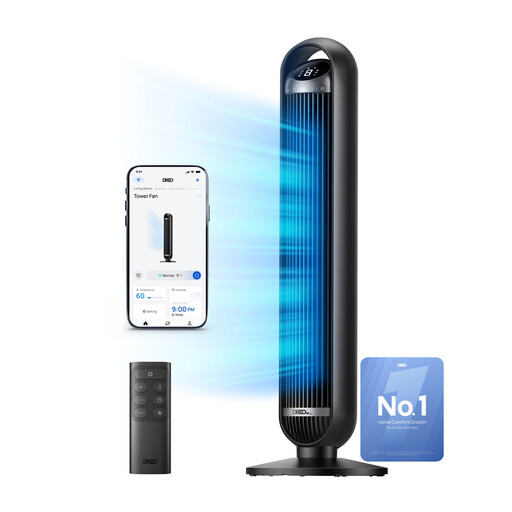
Why it stands out: This tower fan manages the feat of combining nearly inaudible operation with advanced smart features. Thanks to its TurboSilent technology and DC motor, its noise level drops to just 25 dB at low speed. It's hard to find anything quieter for a bedroom or office.
Pros:
Who is it for? For those who demand near-absolute silence for sleeping or working, and for smart home enthusiasts looking to integrate it into their connected home.
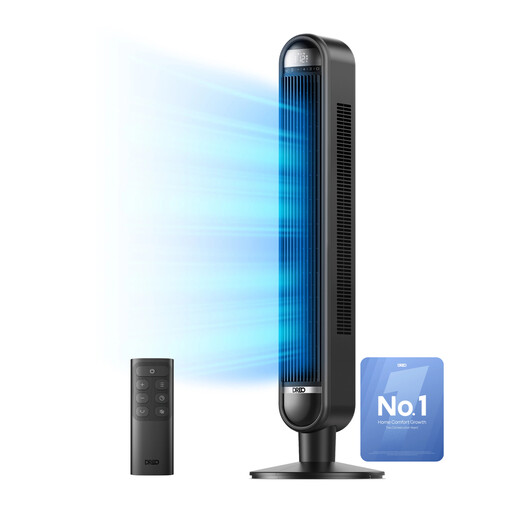
Why it stands out: Standing 106 cm tall and equipped with a high-performance motor, this model is designed to cool large spaces quickly. It generates a powerful airflow (up to 7.6 m/s) while remaining very discreet, at just 34 dB on its lowest speed.
Pros:
Who is it for? Essential for cooling a large living room, master bedroom, or open-plan office. It's the ideal powerful yet quiet fan for those who appreciate extensive programming options.
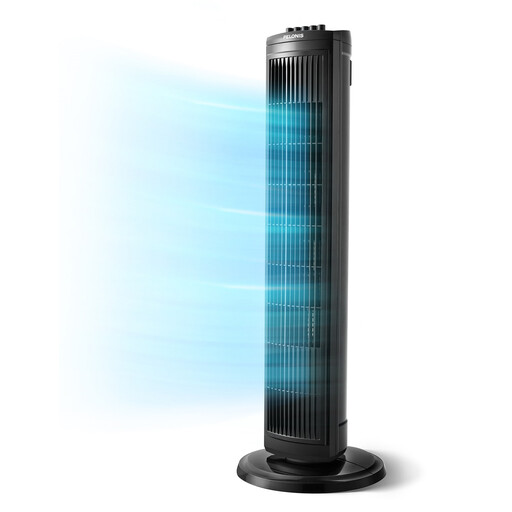
Why it stands out: This compact 76 cm (30-inch) model is the ultimate smart, space-saving solution. Its slender design and narrow base allow it to fit in anywhere, while providing targeted and discreet cooling.
Pros:
Who is it for? Recommended for those looking for a simple, effective, and discreet supplementary fan for a modestly sized room (bedroom, office).
Our selection focuses on models that excel in silence and performance. However, the market is full of other options. To explore different designs, power levels, or budgets, feel free to browse our complete catalogue.
Discover Our Full Range of Oscillating Tower Fans
The tower fan is distinguished by its vertical, slender design. It's more discreet, takes up less floor space, and distributes air along its entire height. In contrast, a classic pedestal fan, with its visible blades and adjustable head, offers a more concentrated airflow but is often bulkier.
Absolutely. The days when power meant noise are long gone. Thanks to more modern DC (direct current) motors, careful aerodynamic design, and better insulation, a powerful yet quiet fan is no longer a pipe dream. These models move a large volume of air while drastically limiting vibrations and motor noise, especially at the lowest speeds.
Simple but regular maintenance is key. Frequently dust the air intake and outlet grilles with a soft cloth or the brush attachment of your vacuum cleaner. On some models, the rear grille can be removed for easier cleaning of the internal blades. This is the best way to ensure optimal airflow, prevent dust-related noise, and extend the life of your appliance. Warning: Always unplug the fan before any cleaning operation.