
Livraison le jour même ou le lendemain

Qualité garantie

Débloquez vos offres de bienvenue: Livraison GRATUITE | Jusqu'à -80 % | 30 jours d'essai gratuits à JoyPlus
Téléchargez l'application
Summer is here, and with it, the desire for a cool, breathable home. For those without central air conditioning, the portable air conditioner seems like a miracle solution. But be warned: the market is a jungle of sometimes misleading marketing promises. Between the advertised decibel levels and the infamous "ventless" models, it's easy to make a mistake and regret your purchase.
As a product expert for the Joybuy editorial team, I'm here to help you decipher the spec sheets. Let's review the pitfalls to avoid and the real criteria for choosing a unit that will deliver on its promises—without turning your bedroom into an engine room.
Before you pull out your credit card, it's essential to understand the common misconceptions and questionable marketing claims.
1. The Myth of the "Ventless" Portable Air Conditioner This is the number one trap. Let's be clear: a real air conditioner works like a refrigerator. It captures heat from a room and expels it outside. This basic physical principle requires an exhaust hose. The devices sold as "ventless" are actually air coolers. By evaporating water, they humidify the air and provide a very slight cooling sensation, which becomes almost non-existent in high humidity. To truly lower the temperature, a portable air conditioner with its hose is non-negotiable.
2. Decibels (dB), a Number That Can Change Everything A unit advertised as "quiet" can quickly turn into an auditory nightmare once it's in your bedroom. The noise level, in decibels (dB), doesn't add up—it multiplies! It's a logarithmic scale: 3 more dB means the noise is perceived as twice as loud. So, a 64 dB model isn't just "a little" louder than a 51 dB one—it's deafening in comparison. When you're trying to sleep, every decibel counts.
3. The Wrong Power (BTU) for Your Room Choosing a supplemental air conditioner that isn't powerful enough is the easiest way to throw money down the drain. The unit will run at full blast without ever reaching the target temperature, causing your electricity bill to skyrocket and wearing out the device prematurely. Conversely, a powerhouse unit in a small bedroom will create short, harsh cooling cycles that are very unpleasant.
To make the right choice, forget the marketing hype and focus on these three objective data points. They are the true reflection of your future air conditioner's performance, comfort, and running costs.
The ability to cool a room is measured in BTU (British Thermal Unit). This is the #1 criterion for ensuring your unit is effective. For a standard ceiling height (2.50 m / 8 ft), here are some simple guidelines:
Note that these are estimates. Poor insulation, large south-facing windows, or a top-floor apartment will require a more powerful model.
For a bedroom air conditioner, quiet operation isn't an option—it's a must. Look for models that do not exceed 55 dB during normal operation. The holy grail? A unit with an effective "night" or "sleep" mode that slows down the fan and compressor to get below the 50 dB mark.
Let's not kid ourselves: an air conditioner consumes energy. To avoid unpleasant surprises on your electricity bill, aim for a low-consumption portable air conditioner.
Also, consider a reversible portable air conditioner: some models can produce heat in the winter. A very practical supplemental heater.
Rather than an endless list, here are our top picks that meet specific needs, strictly applying the criteria we've just discussed.
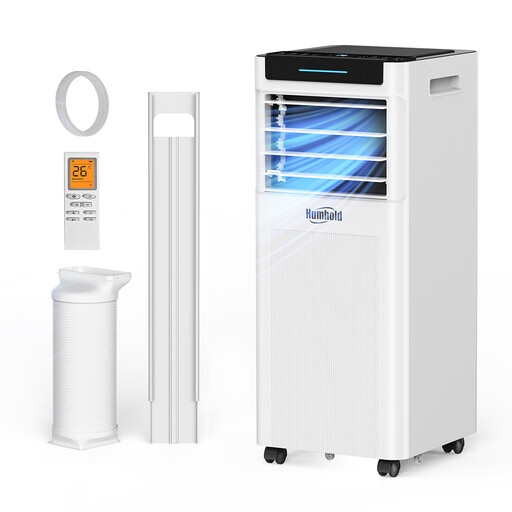
Its strengths: With 7,000 BTU, it's perfectly sized to cool a bedroom or office up to 28 m? (300 sq ft) without running up your bill. Its compact footprint and light weight make it easy to move from one room to another.
It advertises a power level consistent with the recommended room size, avoiding the risk of being underpowered. Its night mode, rated under 49 dB, is a realistic promise for a good night's sleep.
Its self-evaporation system eliminates the chore of emptying the water tank (unless the air is very humid). A real daily convenience.
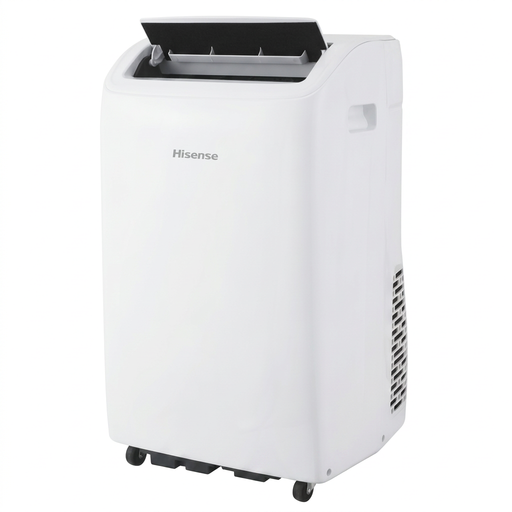
Its strengths: Perfect for a living room or large bedroom, this 9,000 BTU model does it all: cools in the summer and heats in the winter. Bonus: its Wi-Fi connectivity lets you start it from your smartphone to come home to an already cool house.
Its 2.6 kW (9,000 BTU) power is honest and well-suited for medium-sized rooms. The advertised minimum noise of 50 dB is a credible value for a device of this caliber.
It's a true Swiss Army knife. The reversible function (2.4 kW heating) and Wi-Fi control make it a year-round comfort ally.
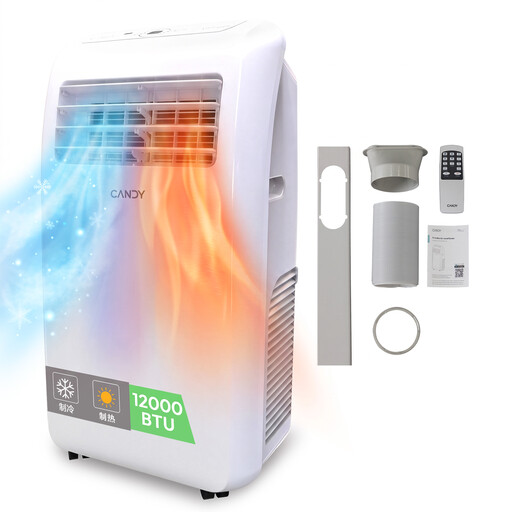
Its strengths: A heavy-duty solution for large spaces up to 35 m? (375 sq ft). With 12,000 BTU for cooling and 3.3 kW for heating, it has plenty of power. All this with an A+ rating, making it high-performing without being an energy guzzler, even with intensive use.
Its power is tailored for large spaces, so there's no risk of being disappointed by its performance. The dual A+ certification (cooling and heating) is the best argument to reassure you about its energy consumption.
It's the champion of versatility. High power (12,000 BTU), excellent efficiency (A+), and 4 modes (cool, heat, dehumidify, fan) ensure optimal comfort in any season.
Discover our full selection of portable air conditioners that meet all our criteria for performance and reliability.
No, absolute silence is impossible for a compressor-based air conditioner. The term "quiet" should be taken with a grain of salt: it refers to models optimized to reduce noise (better insulation, slower fan modes). A good "quiet" model will operate between 48 and 55 dB, which is comparable to the background hum of a modern refrigerator. For most people, this is a perfectly tolerable noise level for sleeping.
Yes, and it's non-negotiable for a true air conditioner. The hose is used to expel hot air outside. Without it, the heat would remain in the room, and the unit would just circulate air continuously without ever lowering the temperature. Rest assured, the window sealing kits provided with the units make installation simple and airtight.
Consumption depends on its power (BTU), its energy class, and how you use it. To give you a rough idea, a 9,000 BTU model with an A rating consumes about 1 kWh (kilowatt-hour) per hour at full power. An A+ rated model will be 10-20% more efficient. To estimate the cost on your bill, multiply this figure by the price per kWh from your electricity provider. Tip: Use the timer and aim for a comfortable temperature (24-25°C / 75-77°F) to keep energy consumption in check.