
Livraison le jour même ou le lendemain

Qualité garantie

Débloquez vos offres de bienvenue: Livraison GRATUITE | Jusqu'à -80 % | 30 jours d'essai gratuits à JoyPlus
Téléchargez l'application
A scratchy throat when you wake up, tight skin, restless sleep? Air that's too dry indoors can quickly become a nightmare. An air humidifier might seem like the miracle solution, but the market is a jungle of marketing promises that are rarely kept. Too many devices, noisy or impossible to clean, end up gathering dust in a cupboard. Before you make a purchase, it's crucial to know how to decipher the specs to find the model that will genuinely improve your comfort, without becoming a new source of stress.
As the Head of Product Recommendations at Joybuy, my job is to test these devices to help you avoid any unpleasant surprises. Here are the key things to watch out for and the criteria that really matter.
To make an informed choice, forget the marketing jargon and focus on these few objective characteristics.
For a bedroom, silence is golden. Here are a few simple benchmarks:
The vast majority of models on the market are ultrasonic humidifiers. A metal plate vibrating at a very high frequency atomises water into a fine, visible mist.
Evaporative technology (like Philips' NanoCloud system) forces air through a wet filter using a fan. The mist is invisible and leaves no white residue or puddles on the floor.
A large-capacity humidifier (4L or more) gives you peace of mind, with a runtime that can exceed 24 hours. The detail that changes everything? A "top-fill" design. You just lift the lid to pour in water, without having to carry a heavy, dripping tank that leaks all over the floor.
Rather than an endless list, here are our targeted recommendations that meet specific needs, all while avoiding the common pitfalls.
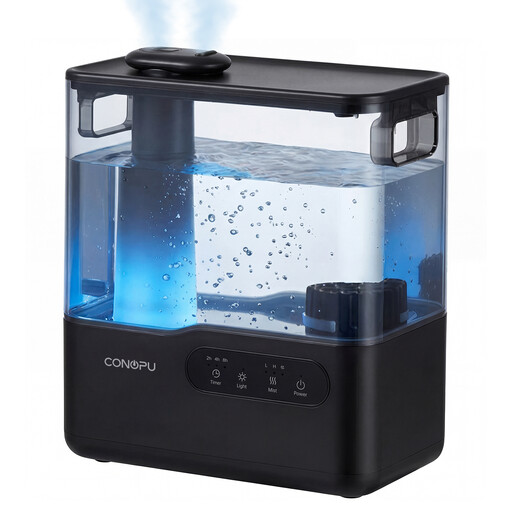
Why it stands out: This is the champion of silence, designed for environments where the slightest noise is forbidden. At 25 dB in sleep mode, it's completely unnoticeable, making it the benchmark as a **baby room humidifier** or for discerning adults. The **night light** function is a welcome bonus.
It provides a verified, ultra-low noise level (25 dB), cutting through vague promises. Its top-fill design and wide opening directly tackle the problem of tedious maintenance.
Absolute discretion, record-breaking runtime (up to 36h) thanks to its 5L tank, and a dedicated tray for diffusing essential oils.
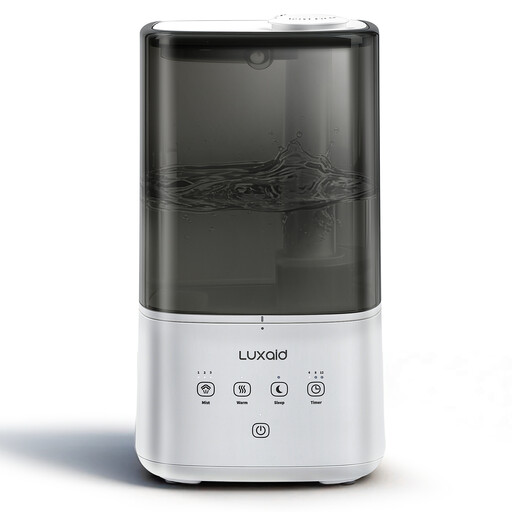
Why it stands out: The Swiss Army knife of comfort. For a large living room or a master suite, it combines an **XXL capacity** of 6L with the versatility of **cool and warm mist**. The warm mist is particularly pleasant in winter and speeds up the room's humidification.
Its 6-litre tank solves the problem of being undersized for large rooms. The top-fill design and removable tank radically simplify maintenance and prevent limescale buildup.
Warm/cool mist option for tailored comfort all year round. Incredibly quiet (20 dB advertised in night mode) given its power.
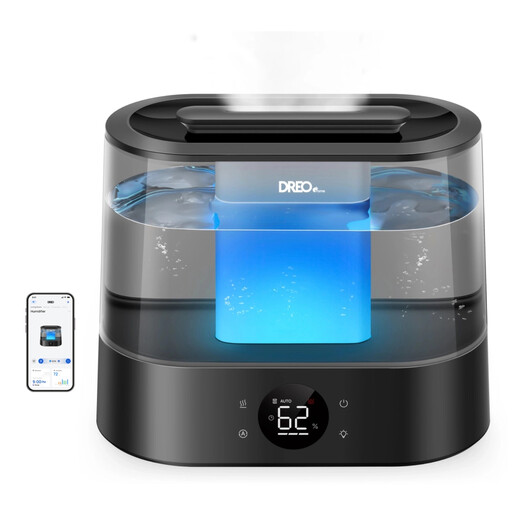
Why it stands out: This is a **smart humidifier** for tech geeks and smart home lovers. Adjust the humidity level with precision, schedule routines, and control it remotely from the app. Its dedicated aroma tray also makes it an excellent **essential oil diffuser**.
Its built-in humidity sensor and smart auto mode prevent over-humidification, a common flaw. The top-fill design and fully detachable tank ensure quick and easy cleaning.
Total control via the DREO app, automated management thanks to the precise sensor, and nearly inaudible operation at 28 dB.
Browse our complete selection of humidifiers, tested and approved by our experts to meet strict performance criteria and UK safety standards.
For an ultrasonic humidifier, demineralised or filtered water is strongly recommended if your tap water is hard (high in minerals). This prevents white dust from settling on your furniture and extends the life of the device. For evaporative models, tap water is fine, as the minerals are trapped by the filter.
Yes, but only if the model is specifically designed for this purpose. Check for a dedicated compartment or tray. Never pour oils directly into the water tank: they could irreversibly damage the plastic and the ultrasonic mechanism.
Its longevity depends on its build quality, but more importantly, on how rigorously it is maintained. A weekly cleaning to remove limescale and prevent bacteria growth is essential. A well-maintained device can function perfectly for several years.