What should you look for?
First, work out what you’d miss most day to day: a quieter room, more storage or space for the appliance. Then compare the energy use of the formats that suit your needs.
| What to consider |
What to check |
Who is it for? |
| Noise in your living space |
Compare the stated noise level and the acoustic class of the exact model. Que Choisir suggests below 40 dBA as a way to narrow down your options, not as a promise of silence. |
If I sleep or work near the appliance, I want to keep the noise it makes to a minimum. Around 29% of consumers put this need first. |
| Fridge and freezer capacity |
Check the capacity in litres of each compartment, rather than just the total, based on your shopping habits and how much frozen food you need to store. |
I’d like enough room for fresh food without giving up the few frozen items I keep. Around 24% of consumers put this need first. |
| Size and installation |
Measure the space and check how the door opens. Compare the required clearances and, for a built-in model, check the niche and ventilation against the instructions. |
If there’s little room in my kitchen, the appliance needs to fit and be ventilated properly. Around 29% of consumers prioritise this compatibility. |
| Ongoing energy use |
Compare the kWh/year of models with similar capacities and configurations, along with their energy information. |
As a fridge runs continuously, I want to take its energy use into account when choosing one. This is the main consideration for around 18% of consumers. |
The choice between a table-top fridge, a compact fridge-freezer and a built-in model also depends on how you use your freezer. Bosch’s KTR15NWEB and KTL15NWEB table-top fridges have the same stated external dimensions. The KTR15NWEB offers 134 litres of fridge space and no freezer compartment, while the KTL15NWEB has 106 litres and includes one. If frozen food is a regular part of your shop, compare the separate capacities of compact fridge-freezers instead. And don’t choose a built-in model based on its dimensions alone: the niche, door and airflow all need to be suitable for the model you choose.
Fridges to compare on Joybuy
These two fridge-freezers offer a choice between a built-in model with a freezer and a compact freestanding option. For a studio flat or open-plan kitchen, compare them based on the installation options, the storage space you need and the stated noise level of each model.
 Image unavailable
Hisense RB3B250SAWC, 252-litre built-in fridge-freezer
Worth considering if you want to fit a fridge-freezer into a fitted kitchen. The model name indicates a capacity of 252 litres, No Frost and an energy rating of C. Before choosing, check the niche dimensions, door fixing, specified ventilation and noise level for this model.
View on Joybuy
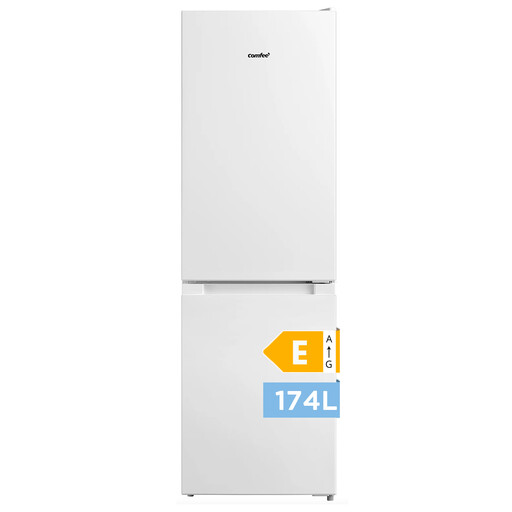 Image unavailable
Comfee' RCB169WH2(E), 174-litre freestanding fridge-freezer
Worth considering if you need a freezer compartment in a freestanding appliance that’s 150 cm tall. The model name indicates a 39 dB noise level, Low Frost, a 4-star freezer and an energy rating of E. Also compare the available space, the capacity of each compartment and the kWh/year shown on the label for the exact model.
View on Joybuy
Frequently asked questions
What noise level should I look for near a bed or in an open-plan kitchen?
Que Choisir suggests a stated noise level below 40 dBA as a way to narrow down your options, but it’s no guarantee that the fridge won’t be disruptive. Compare the exact models and, if noise is a key consideration for you, try to find out how they sound in real-life conditions.
How much capacity does one person need?
Que Choisir suggests 100 to 150 litres of usable capacity for one person. Choose a size that suits how often you shop, and check the space for fresh and frozen food separately.
Is a freezer compartment worth the space it takes up?
It’s useful if you keep a few frozen items, as long as the remaining fridge space is enough for you. Bosch’s KTR15NWEB and KTL15NWEB table-top fridges have the same stated external dimensions. The KTR15NWEB offers 134 litres of fridge space without a freezer, compared with 106 litres for the KTL15NWEB, which has a freezer compartment.
How do I check the ventilation requirements for a built-in fridge?
Follow the installation instructions for the model you choose, checking the niche, door and airflow. Bosch, for example, specifies plinth ventilation for its built-under models; don’t assume another model has the same requirements.
When can I plug in a fridge that was transported on its side?
Check the instructions for the model you’ve bought first. For its appliances, Liebherr recommends waiting at least 12 hours before switching the fridge back on after it has been transported on its side.


