
Livraison le jour même ou le lendemain

Qualité garantie

Débloquez vos offres de bienvenue: Livraison GRATUITE | Jusqu'à -80 % | 30 jours d'essai gratuits à JoyPlus
Téléchargez l'application
Summer nights often turn into a challenge: should you endure the sweltering heat or the incessant drone of a fan? For light sleepers, new parents, or remote workers, silence isn't a luxury—it's non-negotiable. Hunting down the perfect quiet fan for the bedroom, one that cools effectively without disturbing your peace, becomes a crucial mission.
This guide is here to help you make sense of it all. We'll break down the essential criteria and present a hand-picked selection of models, so you can make an informed choice and finally get back to serene nights.
Before we put our selection to the test, let's review the features that truly make a difference. Here are the key points you shouldn't overlook.
Noise is measured in decibels (dB). And in a bedroom, every decibel counts. To give you an idea, a whisper is around 20-30 dB, while a normal conversation climbs to 60 dB. A good fan for sleeping must absolutely stay below the 40 dB mark at its lowest speed.
Models equipped with a DC (direct current) motor are generally the champions of silence. The icing on the cake is that they also prove to be an excellent choice for an energy-efficient fan compared to classic AC motors.
In a bedroom, a fan with a remote control isn't a gimmick; it's a must-have. No more getting out of bed to adjust the speed or turn it off! Other functions perfect the nighttime experience:
To help you make your choice, we have scrutinised several promising models, judging them on their specs: technical characteristics, noise level, and practical features.

What sets it apart: The Monsga AC300 plays in the big leagues by positioning itself as a cutting-edge air circulator. Its secret weapon? A DC motor that allows it to whisper at just 20 dB, the equivalent of rustling leaves. Add to that omnidirectional oscillation (120° horizontal, 90° vertical) and you get total air circulation in the room.
Advantages:
Who is it for? Ideal for those who demand the best of both worlds: a device that is both powerful and virtually inaudible, capable of ventilating a large bedroom while offering total control over the sound and light environment.
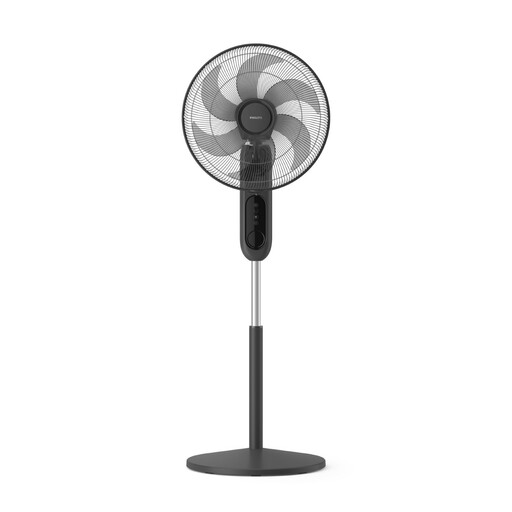
What sets it apart: This quiet pedestal fan from Philips goes all-in on performance, with an impressive airflow of 3,330 m?/h and a stated range of 30 metres. Despite this firepower, it remains discreet with a contained noise level of 38 dB(A) at its minimum, a perfectly acceptable threshold for nighttime.
Advantages:
Who is it for? For those looking to ventilate a large bedroom or living room and who prioritise powerful airflow, without giving up on the quiet needed for rest.
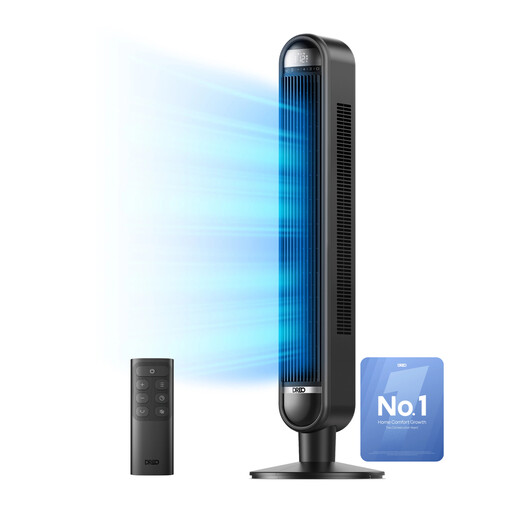
What sets it apart: This quiet tower fan from DREO plays the card of elegance and compactness, without forgetting smart features. Its "Sleep" mode is particularly well-designed: it adjusts the speed to find the perfect balance between coolness and silence, dropping to as low as 34 dB.
Advantages:
Who is it for? The perfect option for those living in an apartment or a limited space, who are looking for a device that is stylish, discreet, and smart, and easy to use day or night.
Every sleeper is unique, and every room has its own constraints. If our selection doesn't check all your boxes, don't panic: other solutions exist.
? Explore our complete collection of Quiet Floor Fans to discover more models.
To put it simply, a standard fan pushes air in a single direction, creating a direct draft. An air circulator, on the other hand, is designed to move the entire volume of air in the room. The result is a gentler breeze and a more consistent temperature. It's also a great ally for improving the efficiency of your air conditioner in the summer or your heater in the winter.
Absolutely, and that's the great feat of recent technologies. Models like the Monsga AC300 prove that a powerful and quiet fan is no longer science fiction. The secret? A winning combination: blade design, careful aerodynamics, and, above all, the use of DC (direct current) motors. They are not only much quieter but also far less energy-hungry than older AC motors.