
Livraison le jour même ou le lendemain

Qualité garantie

Débloquez vos offres de bienvenue: Livraison GRATUITE | Jusqu'à -80 % | 30 jours d'essai gratuits à JoyPlus
Téléchargez l'application
Summer nights often present a dilemma: should you endure the stifling heat or the roar of a fan? For light sleepers, or to preserve the peace and quiet of a child's room, finding a device that cools without shattering the silence is crucial. But how can you distinguish a mere gadget from a true ally for your nights?
This guide is here to help you see things more clearly. As the Head of Product Recommendations at Joybuy, my mission is to separate fact from fiction for you, cutting through the marketing slogans. We will scrutinise the criteria that truly matter and present a selection of devices that excel in both silence and performance.
Before diving into our selection, let's break down what makes a quiet fan truly high-quality. Here are the key points you should never overlook.
The number one criterion is, of course, the noise level, measured in decibels (dB). For a bedroom or an office, a device operating below 35?dB at its lowest speed is a good starting point for peaceful nights. The highest-performing models can even go as low as 20-25?dB, the equivalent of a whisper. This is the figure to watch closely: it's the guarantor of your tranquillity.
The power of a fan isn't just about the strength of its airflow. Air circulation technology has completely changed the game. Unlike a standard fan that simply creates a direct stream of air, an air circulator is designed to move the entire volume of air within a room.
The advantage is twofold:
Modern devices are packed with options that significantly enhance everyday comfort. A fan with a remote control saves you from getting up in the middle of the night to adjust the speed. Special modes (Night, Natural Breeze) automatically modulate the airflow for tailored comfort. Finally, a programmable timer is perfect for having the device turn off by itself once you've fallen asleep, combining convenience and savings.
We have selected three models that stand out from the crowd, each catering to different needs and budgets.
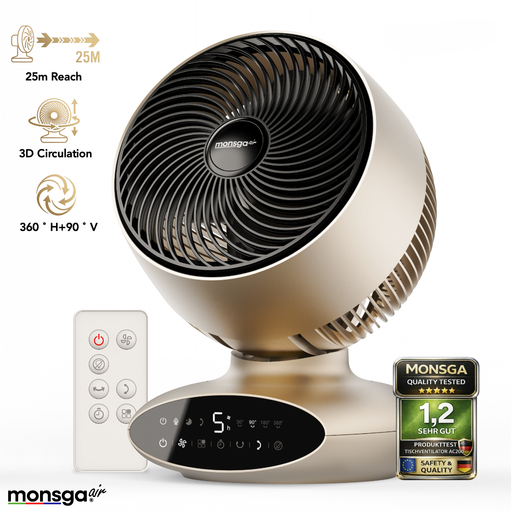
Why it stands out: The Monsga AC200 is not just a table fan. It's a pure air circulator designed to move air into every corner of the room. Its secret weapon? A 360° oscillation that eliminates stagnant air pockets and distributes coolness perfectly evenly.
Advantages:
Who is it for? Ideal for those looking to cool a large living area or a spacious bedroom, and who appreciate the versatility of a device that's effective all year round for optimising air circulation.
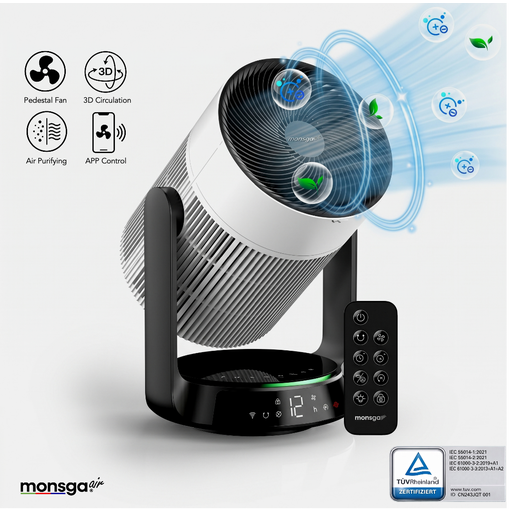
Why it stands out: The Monsga AP200 goes even further by combining an air purifier with a pedestal air circulator. It doesn't just move the air; it filters it. This is the solution of choice for people sensitive to allergens, pollen, or indoor pollution.
Advantages:
Who is it for? Perfect for families, allergy sufferers, or city dwellers who want an all-in-one device to combine thermal comfort and healthy air, in both summer and winter.
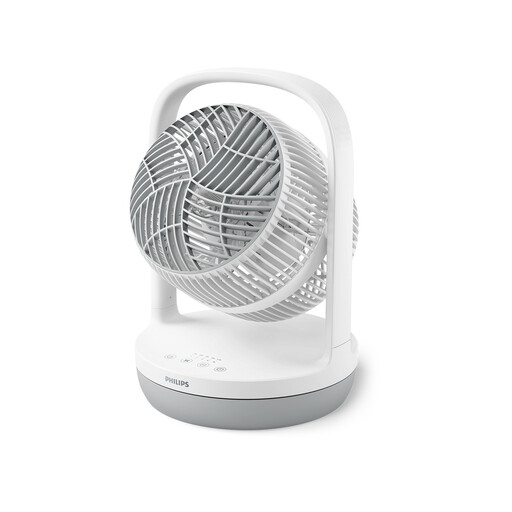
Why it stands out: Philips focuses entirely on top-tier acoustic performance. The manufacturer claims its technology, inspired by owl wings, ensures nearly inaudible operation. With a minimum noise level of 23?dB(A), it is designed for those for whom silence is a non-negotiable condition.
Advantages:
Who is it for? The solution of choice for the most sensitive ears, seeking a compact, elegant, and energy-efficient device for close-range use (desk, bedroom).
Our selection is just a preview. To discover other formats and find the perfect model for your budget, explore our complete collection.
? Discover our entire collection of table fans
1. What is the difference between a fan and an air circulator? A standard fan simply pushes air in one direction, creating a direct current. An air circulator, on the other hand, has a much greater ambition: to move the entire volume of air in the room. It generates a vortex that promotes a more even temperature and a more diffuse cooling sensation, even without being directly in its path.
2. Can a powerful fan be truly quiet? Yes, absolutely. Power (airflow in m?/h) and noise level (dB) no longer necessarily go hand in hand. Innovations in blade shape, motor quality (especially DC motors), and overall aerodynamics now make it possible to combine highly effective air circulation with nearly inaudible operation at low speeds.
3. Does a fan use a lot of electricity? Consumption varies, but recent models are increasingly energy-efficient. A modern low-consumption fan typically uses between 20 and 50 watts, which is negligible compared to an air conditioner. Better yet, using an air circulator in conjunction with your air conditioning or heating can even lead to significant savings on your overall energy bill by improving their efficiency.