
Livraison le jour même ou le lendemain

Qualité garantie

Débloquez vos offres de bienvenue: Livraison GRATUITE | Jusqu'à -80 % | 30 jours d'essai gratuits à JoyPlus
Téléchargez l'application
As the first chill of winter sets in, finding an effective electric space heater becomes a top priority. However, the market is saturated with marketing promises that too often lead to disappointment. A heater that's too loud to sleep with, a skyrocketing electricity bill, a model that breaks down after just one season... Fortunately, these outcomes aren't inevitable.
As a product expert for Joybuy, my mission is to help you cut through the noise and make a truly informed decision. Let's forget the technical jargon and focus on what really matters. Here are the most common pitfalls to avoid and the criteria that truly count when choosing a quiet, energy-efficient fan heater that won't let you down.
The siren song of marketing is often misleading. Too many users end up with a device unsuited to their needs by falling into one of these three traps.
To avoid these pitfalls, focus on three non-negotiable technical features.
Old-fashioned metal-coil heaters have had their day. Today, the technology to choose without hesitation is the PTC (Positive Temperature Coefficient) ceramic heater.
A good fan heater with a thermostat is essential for keeping your energy consumption in check. Look for a model that allows for precise temperature adjustment (ideally to the degree). The inclusion of multiple heat settings (e.g., 900W, 1500W) and an "ECO" mode that adjusts power on the fly is a real asset for an economical space heater.
For a bedroom or office, silence isn't an option—it's a deal-breaker. A noise level below 40?dB is the threshold you shouldn't cross to preserve sleep and concentration. Other features enhance daily comfort:
Based on these criteria, here are a few models that stand out for their design and performance, tailored to different needs.
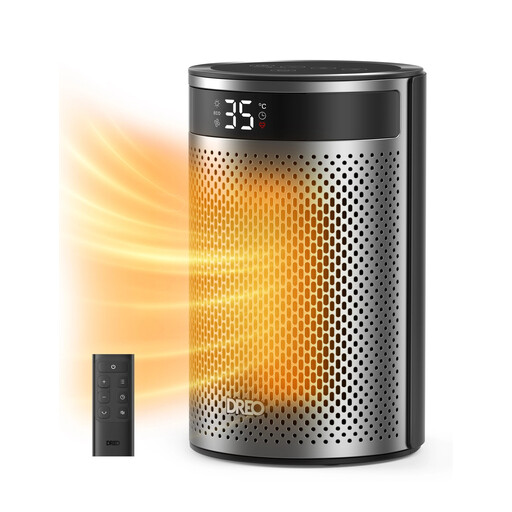
Why it stands out: Perfect for those who need targeted heat without any noise disturbance. Its compact size and quiet operation (as low as 34 dB) make it the quintessential quiet office heater or a discreet companion for your nights.
It sidesteps the noise trap with its brushless DC motor, which ensures minimal sound levels. Its precise thermostat and smart power modes prevent overconsumption.
PTC ceramic technology, ultra-quiet operation (34 dB), and an 8-point safety package including tip-over and overheat protection.
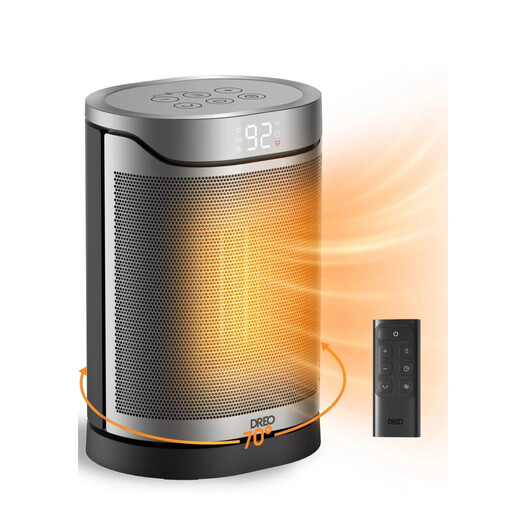
Why it stands out: The perfect balance for heating a living room or a bedroom up to 20 m?. Its 70° oscillation, remote control, and adjustable thermostat ensure maximum comfort and convenience for the whole family.
It addresses the safety pitfall with its comprehensive Shield360? system, which combines flame-retardant materials and tip-over protection for total peace of mind.
Rapid heating (2 seconds), precise thermostat (5–35 °C), wide oscillation, and a remote control. A complete unit that puts safety first.
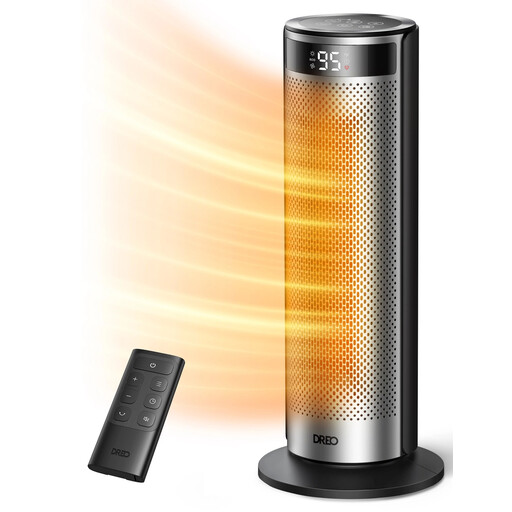
Why it stands out: Designed for those who need more power to heat a living room or a large space (up to 25 m?). Its tower design and 2000W output ensure rapid heating and excellent heat distribution.
It avoids the undersizing trap. Instead of running a smaller model at full blast, its 2000W power allows it to quickly reach the target temperature before self-regulating via its thermostat, thereby optimising consumption.
2000W power (up to 25 m?), near-silent operation (from 25 dB), precise thermostat, and a comprehensive 8-level safety package.
We have compiled a complete, up-to-date list of products that meet these strict selection criteria and European safety standards.
Consumption depends on the power (in Watts), duration of use, and the thermostat's efficiency. For example, a 1500W (or 1.5 kW) device running at full power for one hour will consume 1.5 kWh. A model with a precise thermostat and an ECO mode will be more economical, as it will only run at full power intermittently to maintain the desired temperature.
Yes, a 1500W model is generally sufficient for a well-insulated 20?m? room. The oscillation feature is a plus for distributing heat evenly. For larger rooms, poorly insulated spaces, or rooms with high ceilings, a 2000W model will be more effective.
Yes, absolutely. Their main advantage is their self-regulating capability: the ceramic heats up quickly but cannot reach extreme temperatures, which significantly reduces the risk of overheating. Combined with tip-over sensors and thermal protection, this technology offers a very high level of safety for home use.