Buying priorities
Freestanding
Consider this if: you want a finished door with no furniture panel, or your kitchen does not allow for complete integration.
Good to know: it is generally more visible in the living space; the format does not indicate the model’s noise level or consumption.
Built-under with visible control panel
Consider this if: you want to fit it beneath the worktop while keeping the controls visible.
Good to know: the niche, plinth and type of door panel must be compatible with the exact model.
Integrated or fully integrated
Consider this if: your priority is to conceal the appliance behind a door panel that matches your open-plan kitchen.
Good to know: the door panel adds further fitting and dimensional requirements; also check the model’s repairability score.
When comparing models in different formats, start with the energy label, then confirm the installation requirements and the programmes you will actually use.
| Priority |
What to check |
Your needs |
| Noise comfort |
Compare the dB figure and the noise emission class on the label. Also consider the duration of the Eco programme if the cycle runs while you are at home. |
I want to be able to talk, relax or watch a programme in the living room without being excessively disturbed by the cycle. ADEME states that the noise level and noise class appear on the energy label. |
| Capacity and installation |
Compare the number of place settings with your usual volume of washing-up. Check the width, niche, plinth, door panel and control panel according to the format you choose. |
The capacity needs to suit my meals and cookware, without choosing an appliance that cannot be installed or panelled as intended. |
| Consumption and programmes |
Compare kWh per 100 cycles, litres per cycle and the Eco duration on the same basis. For Quick or Intensive cycles, look for comparable test results where available. |
I want to limit consumption without confusing the label’s reference programme with programmes used occasionally. |
| Repairability |
Check the repairability index shown for the exact reference. Also consult information about parts and repair instructions where available. |
When two appliances have similar labels, I also want to compare their repairability and access to essential parts. |
Joybuy products
Joybuy options for an open-plan kitchen, including a freestanding model and an integrated model to compare according to declared noise level, capacity and installation requirements.
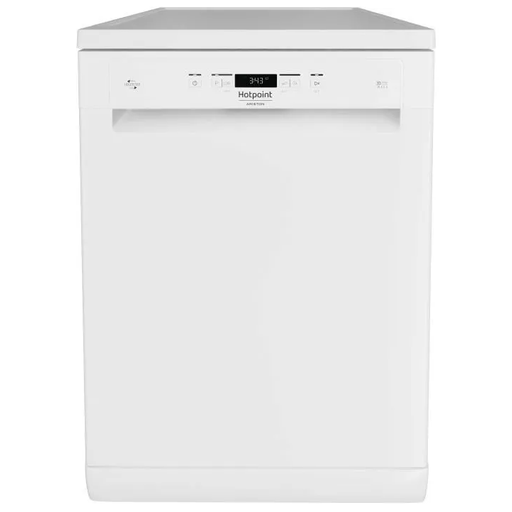 Image unavailable
Hotpoint H4FD641A freestanding, 14 place settings, 60 cm
For households looking for plenty of capacity without a furniture door, this freestanding model offers 41 dB and 14 place settings.
Energy class C, with Eco, Auto, Intensive and Quick programmes, plus automatic door opening at the end of the cycle.
Check the exact reference’s label for kWh per 100 cycles, Eco duration, noise class and repairability index. Also allow sufficient clearance in front of the door when it opens at the end of the cycle.
Joybuy
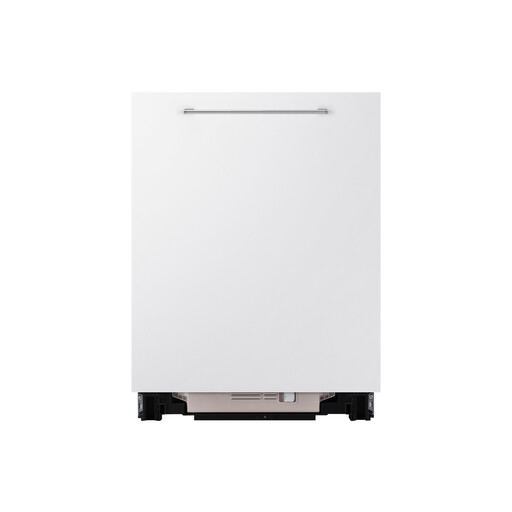 Image unavailable
Samsung DW80H72YBB0U1 integrated, 13 place settings, 60 cm
For a fitted kitchen with a matching door panel, this fully integrated model offers 13 place settings and an Extra Silence programme at 42 dBA.
The stated general noise level is 44 dB(A), with energy class B, a three-level adjustable basket and automatic door opening.
The 42 dBA figure applies to the Extra Silence programme. Confirm the niche dimensions, door panel, fixed hinge, Eco consumption, noise class and repairability index for the exact model.
Joybuy
Frequently asked questions
Is the same energy-label information available for a freestanding appliance and an integrated model?
Yes. The European Commission states that electric household dishwashers, including built-in appliances, are covered by the labelling rules. For the exact reference, compare the energy class, kWh per 100 cycles, water per cycle, capacity, Eco duration, airborne acoustical noise emissions and their class.
Does a noise class of A or B guarantee that the dishwasher will be inaudible in the living room?
No. ADEME describes classes A and B as particularly quiet, but the level of disturbance also depends on the room, what you are doing and your sensitivity to noise. Use the noise class together with the dB figure to compare models, rather than treating it as a guarantee that the appliance will be completely imperceptible.
Should you check the repairability index for a dishwasher bought in France?
Yes. According to Légifrance, the French scheme covers mains-powered household dishwashers, including the relevant integrated and built-in models. Check the score shown for the exact reference rather than one for another version in the same range.
What should you check about spare parts before buying?
For household dishwashers sold in the European Union, the European Commission states that certain parts, including hinges, door seals, spray arms, filters and baskets, must remain available for ten years after the model is withdrawn from the market. Also consult EPREL for the specific model where repair instructions or parts information are provided.


