If your kitchen is close to the living room, a workspace or a bedroom, start by comparing the noise level shown on the energy label. Then choose a size that suits your crockery and can actually be installed in your kitchen. The energy label also shows water use per cycle, energy use per 100 cycles and the Eco programme duration, as noted by ADEME and the European Commission. These figures can help you compare models that suit your space, without assuming that size alone determines how quiet a dishwasher will be.
Who is this guide for?
People with an open-plan kitchen
If you run a cycle while watching television, working or sleeping nearby, pay particular attention to the noise level listed for the model. The distance from the dishwasher and the room’s acoustics also make a difference.
Households with a built-in space or restricted connections
If you’re installing a dishwasher under a worktop or in a small kitchen, check the available space, door clearance and connections before choosing programmes. For a fully integrated appliance, the cabinet door must also be compatible with the model.
People keeping an eye on energy and water use
If you run cycles regularly, compare water use per cycle and energy use per 100 cycles on the energy label. As ADEME and the European Commission explain, these figures relate to the reference Eco programme.
Which features should you compare?
If your dishwasher will be used near living areas, check its noise level first, then rule out any sizes that won’t fit your kitchen or your usual load. Next, compare the energy labels of the models that remain suitable.
| Feature |
What to check |
Who it matters to |
| Noise disturbance |
Compare the dB level and noise class on the label for each model, rather than relying on a marketing claim that it is quiet. |
If a cycle is running while I work or relax nearby, I want to keep the noise I hear in the room to a minimum; around 33% of consumers rank noise disturbance as their top concern. |
| Size and installation |
Measure the usable width, height and depth; check the door clearance, any cabinet door and the connections. |
In a kitchen where space is limited, I need to be able to install and open the appliance without making changes based on guesswork; for around 27% of consumers, installation compatibility comes first. |
| Water and electricity |
Compare litres per cycle and kWh per 100 cycles for the Eco programme, as well as its duration. |
If I run cycles often, I want to know how much water and energy they use without comparing different programmes; consumption is the main priority for around 20% of consumers. |
| Usable capacity |
Compare the place setting capacity with the amount of crockery you get through between cycles, and check the basket layout. |
If I regularly load serving dishes or saucepans, I want space that I can genuinely use, not just a place setting figure; around 20% of consumers prioritise capacity and loading above all else. |
A countertop model is mainly suited to limited space and smaller loads; don’t assume it will be quieter. An integrated model needs a compatible cabinet space and door, while a freestanding model avoids the need for an integrated cabinet door but still requires a suitable space and connections.
Mistakes to avoid before buying
-
Choosing based on one noise figure
Near a living room or workspace, the stated noise level alone won’t tell you whether the model is the right choice overall. Capacity, cycle duration and consumption matter too.
Compare the energy labels for the exact models you’re considering, including their dB level, noise class and Eco programme figures.
-
Measuring only the width of an integrated dishwasher
Height, depth, door clearance, the cabinet door and connections can also prevent the appliance from being installed.
Measure the cabinet space, check the model’s installation diagram and confirm which work is included in the installation service.
An incompatible cabinet space or door may require adjustments or additional accessories.
-
Assuming a smaller dishwasher will be quieter
A countertop dishwasher takes up less space, but its capacity may not be enough for all the crockery that builds up between cycles. Its size alone doesn’t determine its noise level or consumption.
Think about your usual loads, then check the capacity, energy label and connection instructions for the model you’re considering.
Brands to consider, depending on the model
Bosch
A brand to consider for freestanding, integrated or compact dishwashers. Compare the features of each model.
- Bosch lists a noise level of 44 dB and flexible baskets for the SMS4HAW48E.
- These features may not apply to other Bosch models; check their dimensions and energy labels.
Miele
Worth considering if you’re looking for an integrated or freestanding appliance and want to compare noise levels and interior layouts.
- Miele’s range includes the integrated G 7795 SCVi XXL AutoDos K2O, listed at 41 dB and featuring MaxiComfort baskets.
- Noise levels and features vary by model, so this example isn’t representative of the whole range.
Beko
Worth comparing if you’re looking for a 60 cm freestanding dishwasher and capacity matters as much as noise.
- Among its models listed at 44 dB in France, Beko includes options with a 14 place setting capacity and a C energy rating.
- Check the capacity and energy rating of the specific model you choose rather than assuming they apply to the whole range.
Candy
Worth considering if the space available points you towards a countertop model.
- Candy offers a countertop model with a 6 place setting capacity, measuring 550 × 501 × 443 mm and listed with an E energy rating.
- Its capacity is limited compared with the needs of larger loads; check the noise level and consumption separately for the model you choose.
Dishwashers to consider on Joybuy
This selection includes countertop models for smaller loads, a 14 place setting freestanding dishwasher and an integrated model for a fitted kitchen. For each one, make sure the size suits your installation and compare the stated features with the energy label for the exact model.
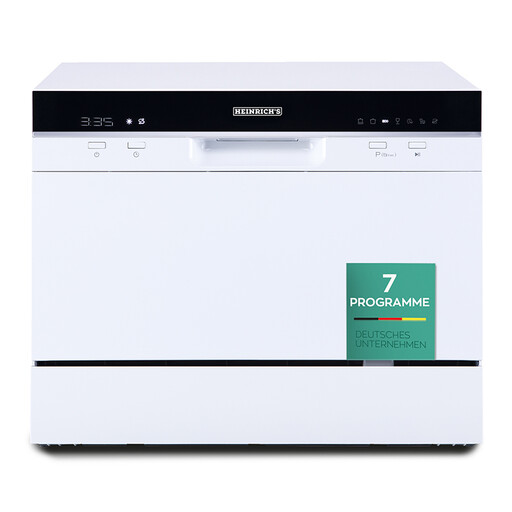 Image unavailable
Heinrich's HTG 8840 Weiss, countertop dishwasher with a 6 place setting capacity
Worth considering if you’re short on space and wash smaller loads.
The product title lists 7 programmes, 47 dB and a D energy rating. Check the noise class on the energy label, along with the dimensions and connections required.
View on Joybuy
 Image unavailable
Hotpoint H4FD641A, freestanding dishwasher with a 14 place setting capacity
Worth considering if you regularly need space for 14 place settings and a freestanding model suits your kitchen.
The product title lists a width of 60 cm, 41 dB and a C energy rating. Measure the space and check the energy label to compare the noise class, water use and energy use of the Eco programme.
View on Joybuy
 Image unavailable
Samsung DW80H72YBB0U1, integrated dishwasher with a 13 place setting capacity
Worth considering for a fitted kitchen, provided the cabinet space, door and connections match the installation diagram.
The product title lists a width of 60 cm and a B energy rating. Check the energy label for this model to compare its noise level and consumption with other options.
View on Joybuy
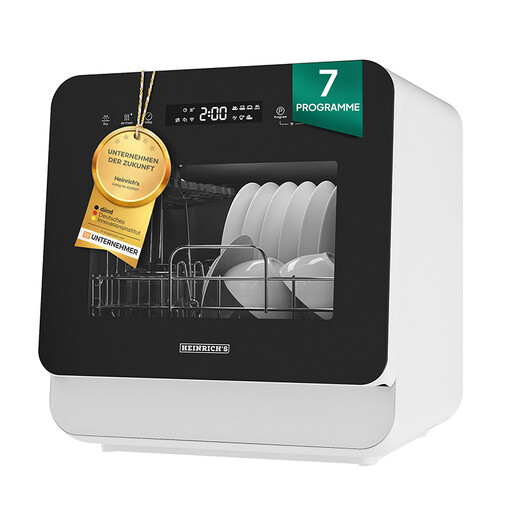 Image unavailable
Heinrich's HTG 8855, mini countertop dishwasher with a 3 place setting capacity
Worth considering for smaller loads if there isn’t room for a larger appliance.
The product title lists 7 programmes, 56.3 dB and a C energy rating. If a cycle will run near an occupied room, check the noise class on the energy label. Also confirm the dimensions and the connection method that suits your home.
View on Joybuy
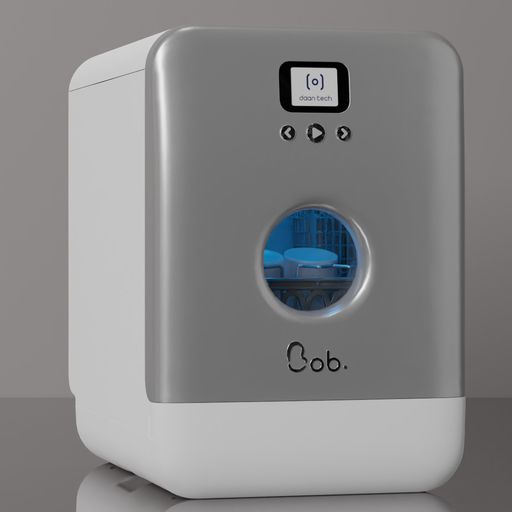 Image unavailable
Bob Mini Dishwasher, 3 place settings, metallic grey and white
Worth considering for a small kitchen if a 3 place setting capacity suits the crockery you need to wash between cycles.
The product title lists a compact size of 34 cm. Check the space available, water supply, drainage and energy label before comparing its noise level or consumption.
View on Joybuy
Frequently asked questions
How do you compare the noise levels of two dishwashers?
Compare the dB level and noise class on the energy labels for the exact models. ADEME notes that noise classes A and B are particularly quiet. How noisy a dishwasher seems in your living room also depends on the distance, the room and when you run the cycle.
Can you compare litres per cycle and kWh per 100 cycles?
Yes, as long as you use the energy label figures for the models you’re comparing. The European Commission relates these to the reference Eco programme. Check its duration and the stated capacity too, rather than comparing these figures with those for a different programme.
Does a compact dishwasher mean you don’t need to check the connections?
No. Its small size doesn’t determine how it connects to the water supply or drainage. Check the instructions for the model you choose, make sure you have a suitable electrical supply and confirm that its capacity suits your usual loads.
What should you check before ordering an integrated dishwasher?
Measure the cabinet space and check it against the installation diagram for the exact model, including the height, depth and door clearance. Check that the cabinet door and connections are compatible, then confirm what’s included in the installation service. Electrolux France’s pre-installation guide explains that its installers don’t carry out carpentry, plumbing or electrical work.


