
Livraison le jour même ou le lendemain

Qualité garantie

Débloquez vos offres de bienvenue: Livraison GRATUITE | Jusqu'à -80 % | 30 jours d'essai gratuits à JoyPlus
Téléchargez l'application
Winter is setting in, the heating is running at full blast, and the air in your home is becoming increasingly dry. A scratchy throat when you wake up, tight skin, disturbed sleep… These discomforts probably sound familiar. A quiet air humidifier seems like the perfect solution, but be careful: the market is saturated with marketing promises that often lead to unpleasant surprises.
As a product expert at Joybuy, my role is to help you see things more clearly. Before you rush into a decision, let's break down the 3 most common pitfalls that can turn a promising purchase into a real disappointment.
To avoid these setbacks, let's focus on concrete technical specifications. Here are the 3 things you absolutely must check before you buy.
Silence isn't a marketing claim; it's a measurable value in decibels (dB). For optimal comfort, especially in a baby's room or an adult's bedroom, a quiet air humidifier worthy of the name must operate below 30?dB in night mode.
Demand this information. A reputable manufacturer will always state it clearly on the technical specifications sheet.
The underlying technology has a direct impact on the device's efficiency, maintenance, and even its noise level.
The choice will therefore depend on the hardness of your water and your tolerance for fan noise.
These three elements are inseparable. A large tank is only useful if it's suited to the size of your room and how you plan to use it.
Also, remember to check the mist output (expressed in ml/h). The higher it is, the faster you'll reach the ideal humidity level.
To move from theory to practice, here are a few models that meet specific needs while avoiding the pitfalls we've discussed.
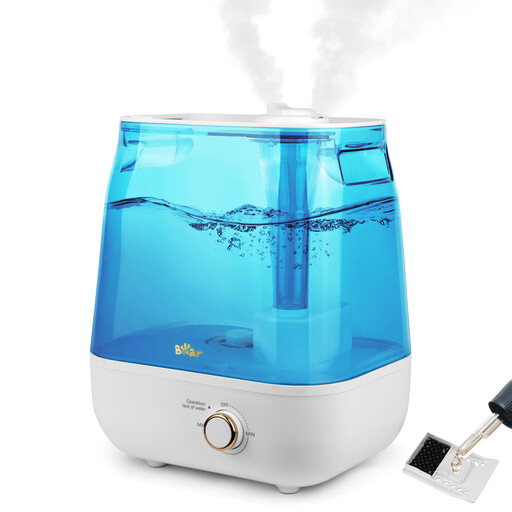
Why it stands out: Perfect for those who prioritise silence and simplicity for their bedroom. Its 28 dB operation ensures quiet nights, while its large 6L tank provides over 24 hours of runtime, saving you from constant refills.
It avoids the "fake silence" trap with a clearly stated noise level of 28 dB. Its top-fill design and wide opening greatly simplify cleaning, steering clear of the complex maintenance pitfall.
Long runtime (up to 35h) thanks to the 6L tank. Simple rotary knob control, with no superfluous features. Compatible with essential oils for an essential oil diffuser function.
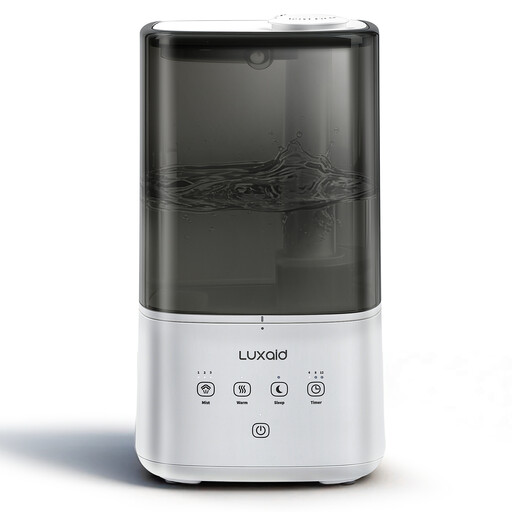
Why it stands out: Perfect for anyone looking for a versatile device for a large room. The dual cool and warm mist function allows it to adapt to any season, while its 20 dB sleep mode is exceptionally quiet.
Its 20 dB sleep mode is one of the lowest on the market, beating the "fake silence" trap. The removable tank and top-fill design make maintenance easy, and its patented leak-proof system is a real bonus for peace of mind.
Cool/warm mist versatility. Very large 6L capacity. Intuitive touch control panel with a timer (4/8/12h). 360° rotating nozzle for even distribution.
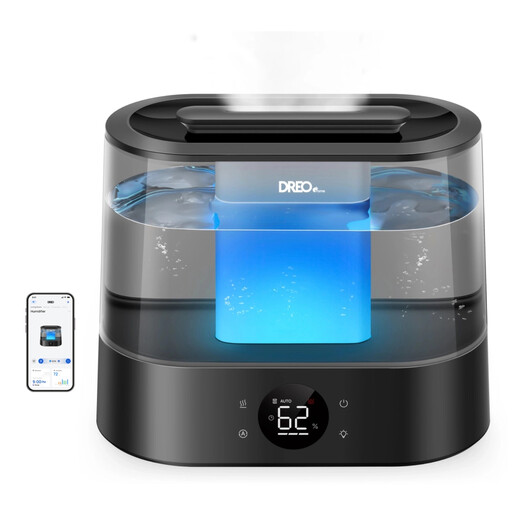
Why it stands out: For those who appreciate control and automation. This smart humidifier allows for fine-tuned adjustments via an app, with an auto mode that adjusts mist output based on ambient humidity. It's the "set it and forget it" solution.
It avoids the "useless gadget" trap by offering a functional app that lets you schedule routines and monitor humidity in real time. The precision sensor and Auto Mode add real value to your comfort without overcomplicating things.
Smart control via the DREO app. Auto mode with humidity sensor. Quiet operation at 28 dB. Integrated aroma tray for diffusing essential oils.
We have selected a full range of products for you that meet these selection criteria and UK/EU safety standards.
No, and this is a crucial point. Never add essential oils directly into the water tank of a standard humidifier. The oils can damage the tank's plastic and the ultrasonic mechanism. Only use a device that has a dedicated compartment or pad, often indicated by the term essential oil diffuser or "aroma tray".
For a bedroom, and especially a child's room, a cool mist humidifier is recommended for obvious safety reasons: there is no risk of burns. Cool mist is just as effective at combating dry air. Warm mist can feel more comforting in winter and helps to slightly warm the ambient air, but it consumes more energy.
Regular maintenance is essential. Ideally, empty and rinse the tank daily. Once a week, perform a deep clean with water and white vinegar to remove limescale and prevent bacteria growth. Above all, always follow the manufacturer's instructions. A well-maintained device is your guarantee of genuinely healthier air.