
Livraison le jour même ou le lendemain

Qualité garantie

Débloquez vos offres de bienvenue: Livraison GRATUITE | Jusqu'à -80 % | 30 jours d'essai gratuits à JoyPlus
Téléchargez l'application
In an age where our smartphones are the centre of our universe, running out of battery is the ultimate modern-day dread. Power banks have become our most trusted allies, but the market is flooded with models whose marketing promises are often vague. While magnetic wireless charging technology has certainly made our lives easier, it has also created a new jungle of spec sheets. Before you pull out your credit card, it's crucial to avoid a few common pitfalls to prevent buyer's remorse.
The 2 Pitfalls to Avoid Before Buying a Magnetic Power Bank:
To cut through the noise, focus on a few key technical specifications that make all the difference in daily use.
The Qi2 standard (pronounced "chee-two") is THE true innovation to look for in 2026. Unlike older wireless chargers, it integrates a Magnetic Power Profile directly inspired by Apple's MagSafe technology.
These two values determine the true performance of your power bank.
Design details can transform a simple battery into a true mobile Swiss Army knife.
Rather than an endless list, here are a few models that cater to specific user profiles, based on our criteria for performance and practicality.
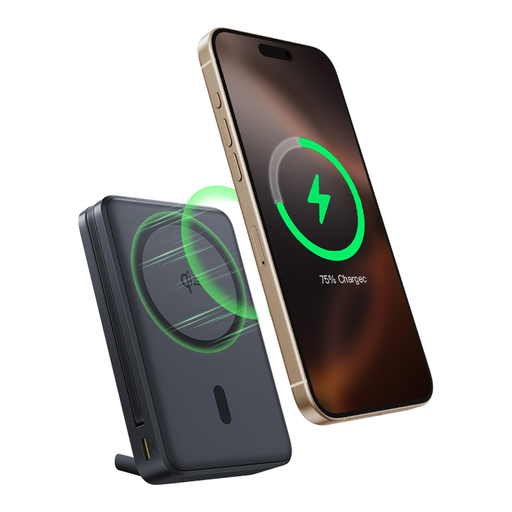
Why we chose it: This is the all-in-one solution for the user who wants no compromises. It combines all the cutting-edge technologies: fast 15W Qi2 wireless charging, ultra-fast 45W wired charging via its built-in cable, and a kickstand for optimal convenience.
This model is Qi2 certified, guaranteeing 15W wireless charging, far beyond basic magnetic chargers. The 45W power output is clearly specified and verifiable.
It integrates a 45W USB-C cable and a kickstand. It's a true nomadic charging station that is completely self-sufficient.
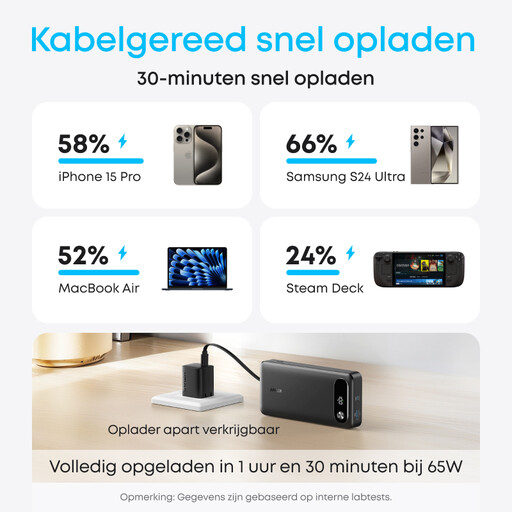
Why we chose it: For those who are away for several days or need to power multiple devices, including a laptop. Its 20,000mAh capacity offers a huge energy reserve, and its 87W output is powerful enough to fast-charge a MacBook or other ultraportable.
It doesn't rely on "magnetic" marketing but on raw, verifiable performance: a very high capacity (20,000mAh) and a high power output (87W) clearly stated for heavy-duty use.
Its ability to charge a laptop on the go. The built-in USB-C cable simplifies life for mobile professionals.
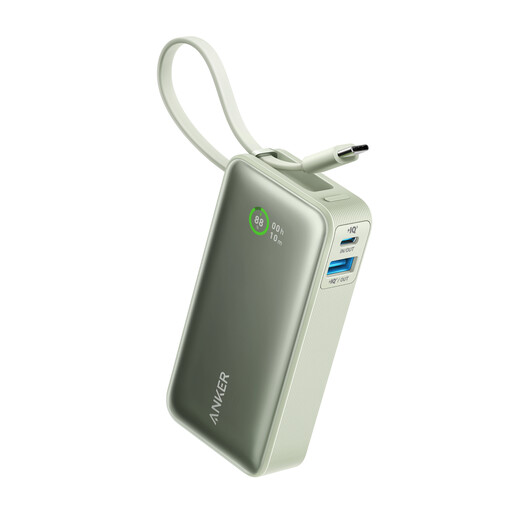
Why we chose it: Ideal for those who prioritise compactness and fast wired charging. Its pocket-friendly size and built-in cable make it an everyday companion that fits anywhere. The 30W power output ensures fast and efficient recharging.
This model focuses on a clear value proposition: fast wired charging (30W) and portability. No empty promises about wireless, just solid and reliable performance for its primary use case.
An excellent balance between size, weight, and performance. The built-in cable and two-way charging (the power bank recharges as fast as it charges) are major assets.
We have put together a complete selection of products that meet our selection criteria and current safety standards.
Yes, compatibility is guaranteed. If your phone supports standard Qi wireless charging, it will charge, but at a lower speed (usually 5W or 7.5W). The magnetic attachment will work perfectly with MagSafe-compatible iPhones. For other devices, alignment will need to be done manually. Of course, wired charging via the USB-C port remains universal and is often faster.
In practical terms, a 10,000?mAh power bank can recharge a modern smartphone (like an iPhone 15 Pro or a Samsung Galaxy S24) about 1.5 to 2 times. This is ideal for daily use. A 20,000?mAh power bank doubles this capacity, offering 3 to 4 full recharges. It is better suited for long weekends, travel, or if you need to share the power bank or charge a tablet in addition to your phone.
No, there is absolutely no risk. Modern smartphones and power banks use smart charging protocols like USB Power Delivery (PD). The device and the charger "communicate" to determine the maximum power the phone can safely accept. A 45W portable charger will only deliver that power if the connected device is designed to receive it. For a smartphone limited to 25W, the power bank will automatically adapt to that speed.