
Livraison le jour même ou le lendemain

Qualité garantie

Débloquez vos offres de bienvenue: Livraison GRATUITE | Jusqu'à -80 % | 30 jours d'essai gratuits à JoyPlus
Téléchargez l'application
Seeing your child pull themselves up for the first time is an unforgettable moment. Soon after, you'll want to support them in their first explorations. The push walker, or walking cart, emerges as an excellent ally for this milestone. But with an overwhelming number of options, it's easy to make a mistake and end up with a disappointing or even unsuitable purchase. As a product expert at Joybuy, my mission is to guide you in making the right choice.
Before you start shopping, here are the 3 common pitfalls to avoid?:
To ensure the push walker is a genuine walking aid and not a purchase you'll regret, several technical points deserve your attention.
A walking cart's primary mission is to provide stable support. To achieve this, two points are essential?:
The choice of material directly impacts durability, maintenance, and even the play experience.
A good activity panel built into the walker should stimulate fine motor skills and curiosity. Instead of just lights, look for a variety of interactive elements?:
These activities engage hand-eye coordination and problem-solving skills, offering far more lasting educational play value than a simple music button.
Every family has different needs. Here are our recommendations, selected to meet specific uses while adhering to our strict safety and quality criteria.
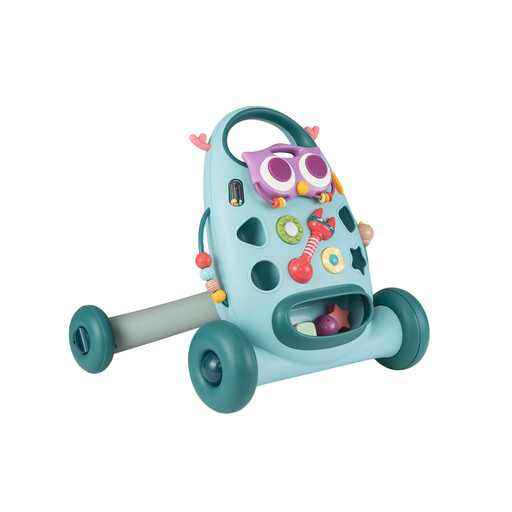
Why it stands out : This 2-in-1 walker is an excellent starter solution. It combines a safe walking aid with a removable activity panel for floor play. A smart choice that adapts to different moments of the day.
Its triangular structure and, most importantly, its adjustable speed control on the rear wheels address issues of stability and excessive speed. The removable panel avoids the "all-in-one" trap where the toy becomes useless once walking is mastered.
Its modularity: it serves as both a push walker to learn to walk and an independent activity panel for floor play.
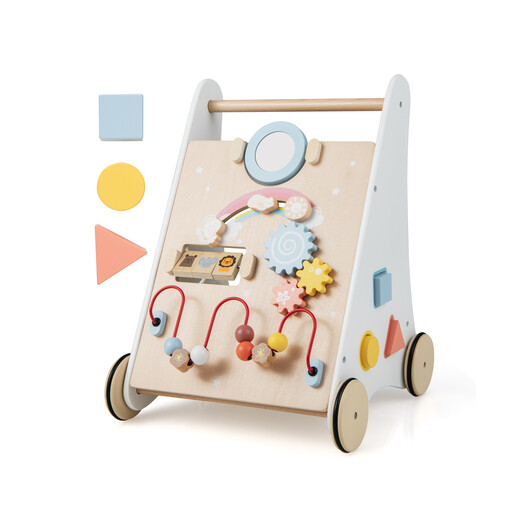
Why it stands out : This wooden walker is perfect for families who prefer traditional, durable toys. Its clean design and mechanical activities encourage development focused on manipulation and discovery, without the overstimulation of electronic toys.
Its quality wood construction gives it the weight and sturdiness needed for excellent stability. The activities (abacus, shapes, etc.) are designed for active development, a far cry from passive electronic gadgets. Bonus: the rubber-coated wheels protect floors and reduce noise.
Its durability and dual function: it's a push toy that also serves as a storage chest for other toys, extending its usefulness long after your child has learned to walk.
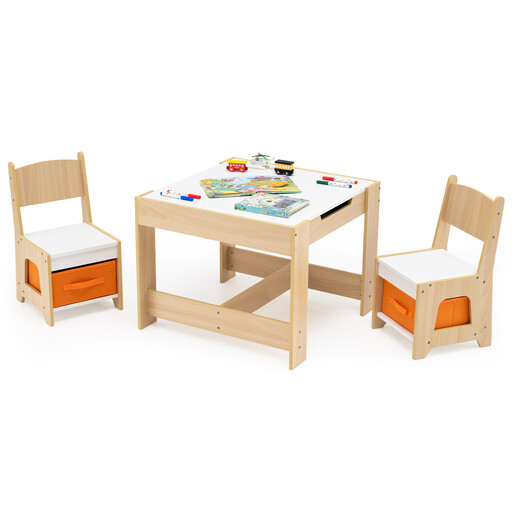
Why it stands out : Once a child is walking confidently, they need their own space to play, draw, and create. This table and chair set is the natural evolution of the activity panel, offering stable, child-sized furniture for hours of play.
More than a temporary toy, this is a long-term investment. The reversible top (whiteboard/chalkboard) and integrated storage make it a functional piece of furniture that encourages organisation and creativity, going far beyond a simple toy.
Its versatility and space-saving design: it serves as a desk, a play table, and a storage unit. The chairs slide neatly under the table, which is a welcome space-saving feature.
We have selected a full range of products that meet our quality criteria and current safety standards.
There's no specific age, but rather a key developmental milestone to watch for. A push walker is suitable as soon as your child can pull themselves up to a standing position while holding onto furniture and shows a desire to move around. This stage typically occurs between 9 and 12 months. Remember, it's an aid to support a natural movement, not a tool to force the process of learning to walk.
This is a common concern, often stemming from confusion with older "sit-in" walkers (where the child is suspended in a seat). Unlike those, the push walker encourages a healthy posture. The child stands upright, supports their own weight, and pushes the object. This action naturally strengthens their leg and core muscles, which, according to many paediatricians and developmental specialists, promotes proper leg alignment.
Most models equipped with this feature use a simple mechanism. It's usually a knob or a tension setting located on the rear wheels. By tightening it, you increase friction and slow the wheel's rotation. For a beginner, it's best to set the resistance to maximum so the walker moves very slowly. As your child gains balance and strength, you can gradually loosen the mechanism to give them more freedom of movement.