
Livraison le jour même ou le lendemain

Qualité garantie

Débloquez vos offres de bienvenue: Livraison GRATUITE | Jusqu'à -80 % | 30 jours d'essai gratuits à JoyPlus
Téléchargez l'application
From pastel lavender to deep crimson, purple brings your 3D creations to life. But for a successful print, colour isn't everything. Between an easy-to-use purple PLA filament for your decorative objects and an ultra-durable PETG for mechanical parts, it's easy to feel lost.
Our mission? To help you cut through the noise. This guide breaks down the technical specs and practical uses to help you find the perfect 3D printing material that will elevate your project and your machine.
Before you commit to a spool of 3D filament, these few technical aspects will make all the difference in the final result.
This is the fundamental choice that will dictate your object's properties.
A good filament is, first and foremost, one that's compatible with your machine.
The finish can completely transform your purple object. A standard PLA will have a slightly glossy finish, typical of plastic. A matte PLA, in contrast, absorbs light and offers a soft, elegant surface, ideal for art or design objects. PETG, on the other hand, provides a very glossy, almost translucent finish.
Here are our recommendations, each tailored to specific needs, whether you're looking for durability, aesthetics, or speed.
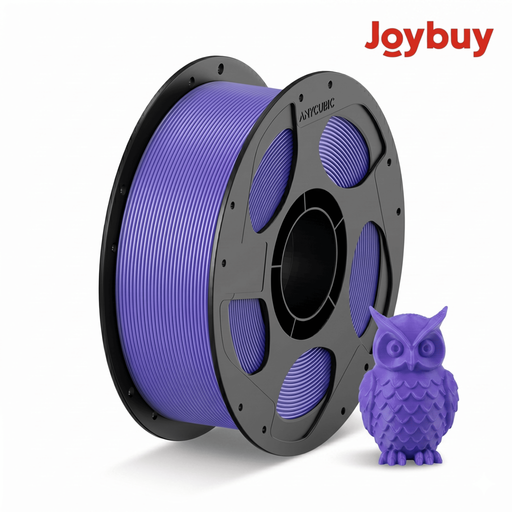
Why we love it?: This PETG filament from Anycubic is built for endurance. It's the material of choice for parts that need to withstand mechanical stress and face the elements. Its formula provides excellent resistance to water and chemicals, making it highly versatile.
Advantages?:
Who is it for??: For makers printing mechanical parts, protective cases, gardening accessories, or any object requiring greater strength than PLA.
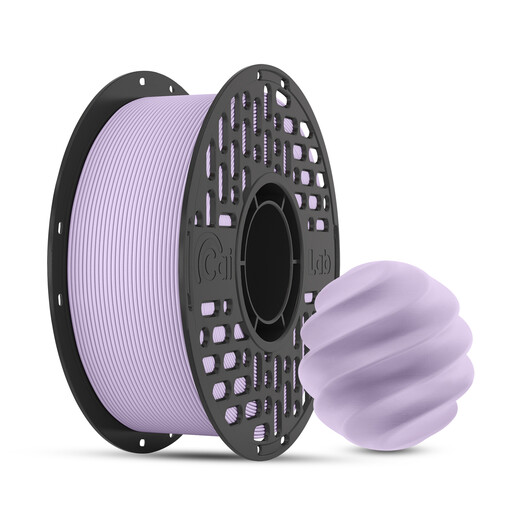
Why we love it?: Its key feature is an exceptional matte finish. This "Misty Lilac" matte PLA is designed for projects where aesthetics are paramount. Its velvety surface absorbs light and blurs layer lines, delivering a finish worthy of a designer object.
Advantages?:
Who is it for??: For designers, artists, and enthusiasts creating decorative objects, architectural models, figurines, or prototypes where the final appearance is the number one criterion.
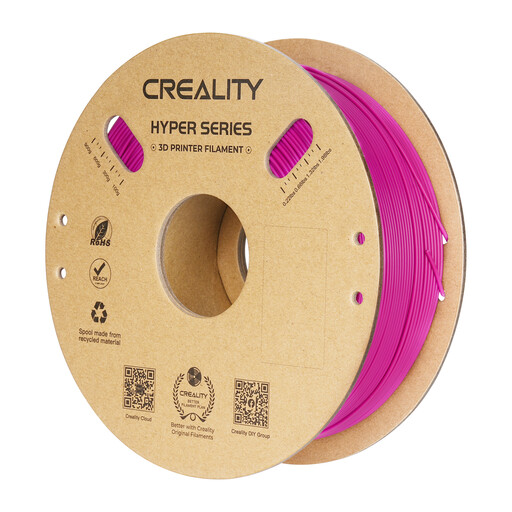
Why we love it?: Its superpower? Speed. This Creality Hyper PLA filament is formulated for new-generation 3D printers that shatter records (up to 600?mm/s!). This allows you to produce parts at lightning speed, far faster than with a standard PLA.
Advantages?:
Who is it for??: For owners of high-speed printers (like the Creality K1 series, Ender V3, or competing models) who want to maximise their productivity, whether for rapid prototyping or small-batch production.
Our selection highlights filaments that are perfect for durability, aesthetics, or speed. However, the world of purple filament is vast, with a multitude of shades, materials, and finishes.
If you haven't found what you're looking for or simply want to explore more options, we invite you to browse our full catalogue.
? Explore our complete collection of purple 3D printing filaments
The difference lies mainly in their properties and ease of printing. Purple PLA filament is simpler to use, more rigid, and perfect for decorative objects. Purple PETG, on the other hand, is more flexible, more durable, and has better resistance to heat and impact, making it the champion for functional parts.
Absolutely. A high-speed filament like Creality's Hyper PLA will work without any issues on a standard printer. You'll just need to apply the speed and temperature settings of a classic PLA. You won't be breaking any speed records, but the print will be flawless.
For your 3D filament spool to retain all its properties, it's crucial to protect it from moisture and UV rays. The secret? Store it in an airtight bag with its desiccant packet, in a cool, dry place away from direct sunlight. This ensures you preserve its performance and the vibrancy of its colour.