
Livraison le jour même ou le lendemain

Qualité garantie

Débloquez vos offres de bienvenue: Livraison GRATUITE | Jusqu'à -80 % | 30 jours d'essai gratuits à JoyPlus
Téléchargez l'application
Choosing Purina cat food is not simply a matter of comparing a recipe’s flavour or the colour of the packaging. Between dry food, wet food, formulas for neutered cats and products for kittens, the real differences mainly concern age, lifestyle, ingredients, pack size and daily portions.
Certain pitfalls come up time and again when shopping. A recipe presented as “with chicken” may contain only a limited amount of chicken, clearly stated in the ingredients list. Likewise, a large bag may seem more economical, but the dry food could lose its freshness if your cat eats only a small amount. Finally, claims such as “with prebiotics” or “with bacteria” describe a formulation, not a guaranteed result for every animal.
Here are the criteria to check before adding anything to your basket.
For chicken dry food for cats, beef dry food for cats or fish dry food for cats, check the percentage shown in brackets. Some Purina ONE products state 17% chicken, 16% beef derivatives, or 2% trout and 2% cod.
The full ingredients list remains essential: cereals, dehydrated proteins, fats, fibre, minerals and additives can also make up a significant proportion of the recipe.
The needs of a growing kitten are not the same as those of an adult cat. Kitten food should be explicitly designed for this stage, generally from weaning up to 12 months, depending on the product labelling.
The Purina ONE Bifensis Kitten product, for example, contains 41% crude protein and 20% crude fat. These figures cannot be compared directly with those of an adult recipe without taking age, activity level and recommended portions into account.
A multi-pack of cat food can reduce the price per pouch or kilogram, but it must still suit the household’s actual consumption. Wet food in individual pouches is easy to use, while a 6 or 7.5kg bag requires airtight storage away from heat and moisture.
Once opened, always follow the recommendations shown on the packaging. Dry food that has lost its aroma may be less appealing, even if its use-by date has not passed.
For everyday feeding, look for the wording “complete food for cats”. This indicates that the product is formulated to meet a cat’s nutritional needs when served according to the recommendations.
Wet cat food can therefore make up the main meal if it is complete. You should then follow the recommended portion and adjust the quantities if you combine wet and dry food.
For comparison, Purina ONE Indoor Adult chicken dry food contains 36% crude protein, 13% crude fat and 5.5% crude fibre. The adult chicken recipe supplied in a 3kg multi-pack states 34% protein and 14% fat. These figures allow you to compare products objectively, without inferring any guaranteed health benefit.
For several Purina ONE recipes, the manufacturer recommends a gradual transition over 7 days. Mix increasing amounts of the new food with the old food, then adjust the quantity according to your cat’s weight, activity level and body condition.
A 1.35kg pack is convenient for trying a recipe or for a small eater. Bags weighing 3 to 7.5kg may offer better value in a household with several cats, provided they are kept in a clean, airtight container. Always make sure fresh water is available, especially when the diet contains a high proportion of dry food.
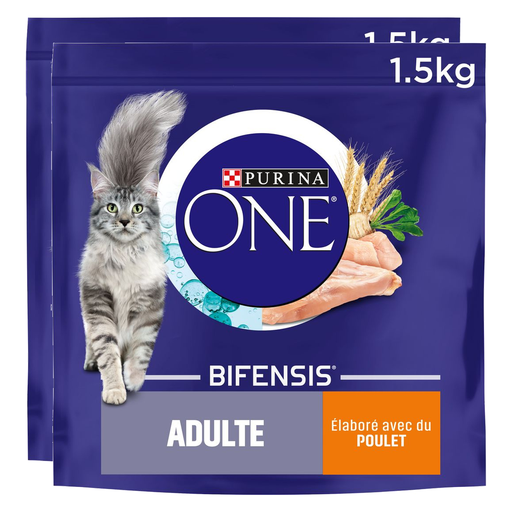
Why this product suits this profile: This 3kg multi-pack helps you stay within budget while keeping two separate bags, which are easier to store than one single pack.
The ingredients and portions are detailed, while a 7-day transition is recommended to avoid an overly sudden change.
34% crude protein, 14% crude fat and 2% chicory root, according to the product details.
Why this product suits this profile: This large pack is ideal for owners looking for a fish recipe and a long-lasting supply, whether for several cats or regular consumption.
The percentages of cod and trout are listed separately. So the “with fish” claim cannot be mistaken for a recipe made exclusively with fish.
34% crude protein, 14% crude fat and a 7.5kg bag, which should be sealed carefully after opening.
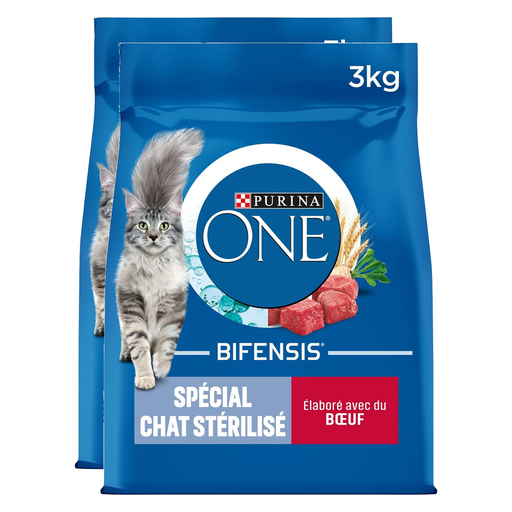
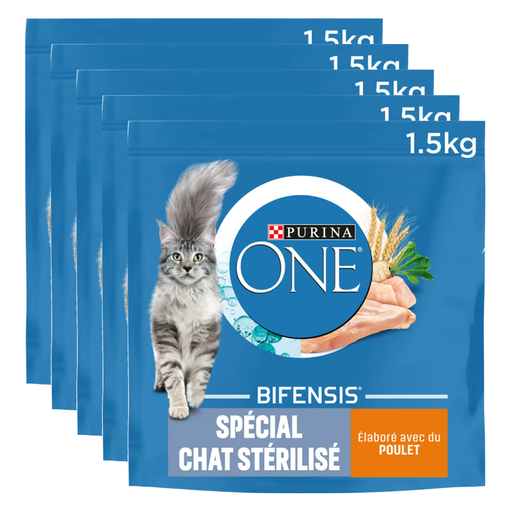
Why this product suits this profile: This formula is intended for neutered adult cats and households that want to buy a sizeable bag while carefully controlling portions.
The label clearly states that this is a formula for neutered adults and provides portions according to weight rather than one fixed amount.
16% beef derivatives, approximately 34% protein and 2.5% crude fibre, according to the available information.
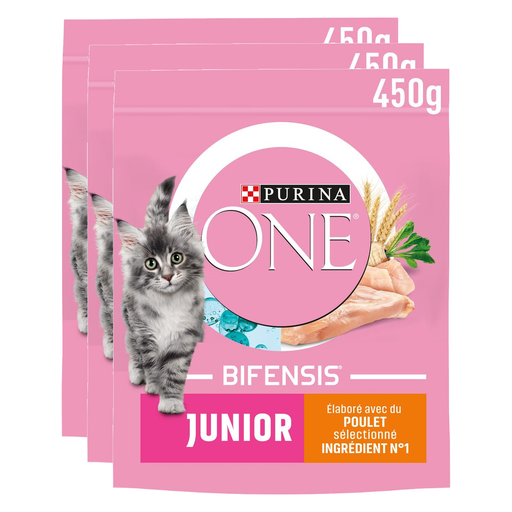
Why this product suits this profile: The 1.35kg bag lets you start with a sensible amount for a kitten, without building up a large supply before checking whether they enjoy the recipe.
The age range, suggested quantities and option to moisten the dry food are specified in the product details.
Chicken recipe with 41% crude protein, 0.05% DHA and 700mg of taurine per kilogram.
Adult cat dry food is easy to portion and simple to store. Wet food provides a different texture and contains 78% moisture in Purina ONE pouches with salmon, turkey and carrot. It can be served on its own or included as part of a mixed diet, in which case you should reduce the amount of dry food.
For wet food in a pouch, serve it at room temperature and place the opened pouch in the fridge, following the instructions. Avoid leaving a portion of wet food out for several hours in a warm room. Portions should be calculated based on the manufacturer’s recommendations and your cat’s body condition.
Purina ONE beef and chicken recipes, supplied in packs of 12 x 85g pouches, are a practical way to add variety to meals: see Purina ONE beef and chicken wet food.
We have put together a complete, real-time updated list of products that meet these strict selection criteria and European safety regulations.
Start with a product whose label clearly states “neutered adult cat”. Then compare the recommended portion according to weight and monitor changes in your pet’s body condition. Neutering does not automatically mean that every cat needs the same reduction in food: weight and activity level should also be taken into account.
Yes, provided both products are complete foods and you adjust the quantities. The mixed-feeding guidelines shown on the product page are a good starting point. Always introduce a new recipe gradually to avoid an overly sudden digestive change.
Reseal the bag after every use and store it somewhere dry, cool and away from light. The practical shelf life depends on the information on the packaging and how quickly your cat eats. For a single pet, a smaller pack generally makes it easier to preserve freshness. A larger multi-pack is better suited to regular consumption or several animals.