People keeping an eye on the calories in their snacks
If you eat the whole bar, the kcal per bar give you a more direct guide than its size alone. Also compare the values per 100 g when the bars come in different sizes.


To choose a protein bar while keeping an eye on the calories in your snack, compare the protein and kcal per whole bar, then check the ingredients: a ‘low calorie’ claim alone isn’t enough. Carrefour lists 15 g of protein and 162 kcal for a 45 g INSHAPE Nutrition Crispy Caramel & Milk Chocolate bar; Auchan states at least 32 g of protein per 100 g and no more than 202 kcal per bar for the 55 g nu3 Fit Peanut-Caramel bar. Your choice between these portions also depends on the allergens and ingredients you want to avoid.
If you eat the whole bar, the kcal per bar give you a more direct guide than its size alone. Also compare the values per 100 g when the bars come in different sizes.
Check the amount of protein per bar, then compare it with the kcal and portion weight. A protein percentage shown per 100 g doesn’t directly tell you how much protein is in one bar.
Depending on the recipe, milk, soya, peanuts, nuts, sweeteners or polyols may affect your choice. Check the ingredients list and allergen information for the flavour you’ve chosen.
When choosing a high-protein snack, start with the portion you plan to eat, then weigh up its protein content and ingredients.
| Criteria | What to check | Who is it for? |
|---|---|---|
| Calories per portion | Check the kcal per whole bar and per 100 g, especially when comparing bars of different weights. | If I’m planning to have a bar as a snack, I want to know the energy content of the portion I’ll actually eat. Around 42% of consumers would make checking calories their priority. |
| Protein per bar | Compare the grams of protein per bar and per 100 g, and consider them alongside the kcal in each portion. | When I’m mainly looking to add protein to my snack, the amount in each bar matters more than the percentage highlighted on the pack. Around 33% of consumers would make this their priority. |
| Ingredients and allergens | Read the ingredients and allergen information for the exact product; also look out for sweeteners and polyols. | If I need to avoid certain ingredients or take my tolerance to polyols into account, the recipe comes before the figures on the front of the pack. Around 25% of consumers would put suitability first. |
Portion size and energy per 100 g answer two different questions. Carrefour lists 162 kcal per bar and 361 kcal per 100 g for the INSHAPE Nutrition Crispy Caramel & Milk Chocolate bar; Auchan gives a maximum of 202 kcal per bar and 389 kcal per 100 g for the nu3 Fit Peanut-Caramel bar. European Regulation (EC) No 1924/2006 sets the threshold for the ‘low energy’ claim on solid foods at no more than 40 kcal per 100 g.
Choose the kcal guide that works for your snack and compare whole portions. Use the per-100 g figures to compare recipes, but don’t assume that these examples qualify for the regulated claim.
Two bars with similar protein content may have different weights and ingredients. The Carrefour and Auchan product listings for the products reviewed mention ingredients such as milk, soya or peanuts, depending on the recipe.
Check the exact flavour and size, especially if you need to avoid an allergen. Also read the ingredients list to look for sweeteners and polyols.
Auchan’s listing for Barebells Cookies & Cream says ‘no added sugars’ and also notes the presence of sweeteners. On its own, this claim doesn’t tell you how many kcal are in the bar.
Check the nutrition information per portion separately, including kcal, sugars and fat, before deciding whether the bar is right for your snack.
For the 45 g Crispy Caramel & Milk Chocolate bar, Carrefour lists 15 g of protein and 162 kcal per bar.
For the 55 g Fit Peanut-Caramel bar, Auchan lists at least 32 g of protein per 100 g and a maximum of 202 kcal per bar.
Auchan lists 20 g of protein per 55 g bar for Cookies & Cream and displays the claim ‘no added sugars’.
Compare these protein bars, available individually or in multipacks, by bar weight, nutritional information and ingredients. Check the values and ingredients for each flavour before choosing.
 Image unavailable
For an individual bar snack, compare the kcal and protein listed for the 55 g portion. Also check the ingredients for this flavour, including allergens and polyols, rather than relying on the figures for another nu3 bar.
 Image unavailable
Compare this multipack per 60 g bar, rather than by the full pack. Check the protein content on the label of the pack you receive before comparing it with other products: the information associated with this bar gives both 20 g and 21 g per portion. Also check for allergens and polyols.
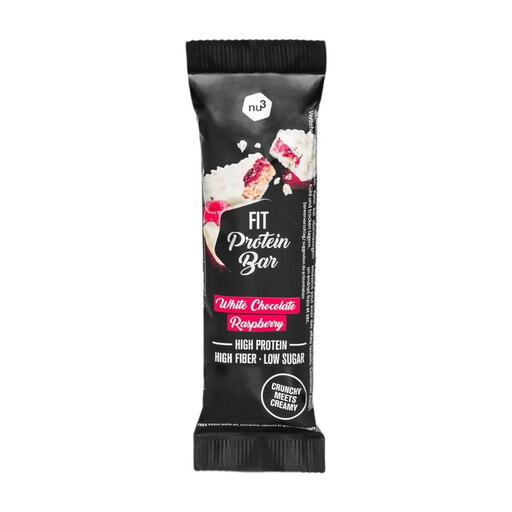 Image unavailable
If you’re comparing several nu3 Fit flavours, use the nutritional information for this 55 g White Chocolate Raspberry bar. Check the kcal and protein per bar, then look at the allergens and polyols listed for this recipe.
Not based on the kcal per bar alone. For solid foods, European Regulation (EC) No 1924/2006 reserves this claim for products containing no more than 40 kcal per 100 g. Carrefour lists 361 kcal per 100 g for the INSHAPE Nutrition Crispy Caramel & Milk Chocolate bar, while Auchan lists 389 kcal per 100 g for the nu3 Fit Peanut-Caramel bar.
Use both figures: kcal per bar tells you about the whole portion you plan to eat, while kcal per 100 g makes it easier to compare different sizes. Manger Bouger explains that Nutri-Score, when shown, is also calculated per 100 g or 100 ml; it doesn’t replace checking the figures per portion.
No. Auchan’s listing for Barebells Cookies & Cream displays this claim while also listing maltitol, sucralose and acesulfame-K, among other ingredients. Check the ingredients list and nutritional information for the bar separately.
Check the ingredients and allergen information for the flavour and pack you’re buying, including any warnings about possible traces. The Directorate-General for Competition Policy, Consumer Affairs and Fraud Control notes that prepacked food labels include an ingredients list, a nutrition declaration and the net quantity, among other details; the brand name alone isn’t enough to establish the composition of a specific product.