People looking for a snack around their workout
If protein content is what’s driving your purchase, compare the grams per bar rather than relying only on the claim highlighted on the packaging.


To go with a bakery sandwich, choose a bar based on what you want from your break: a protein cereal bar if that’s the type of recipe you’re looking for, or a protein bar if your main priority is the amount of protein per serving. Then compare the sugars, ingredients and allergens in the specific variant you’re buying. The word ‘protein’ doesn’t tell you everything about its ingredients, and a bar won’t necessarily replace a meal.
If protein content is what’s driving your purchase, compare the grams per bar rather than relying only on the claim highlighted on the packaging.
A dietary restriction, allergy or sensitivity to sweeteners may influence your choice before you even consider the amount of protein. A bar labelled vegan may still contain allergens.
Whether you’re having it with a sandwich or during another meal on the go, the individual bar size and pack format matter. Also check whether the product is intended as a simple snack or comes with specific usage advice.
Start by identifying the category and portion you plan to eat, then check the ingredients in that particular variant. Examples listed by Auchan include a 35 g Kellogg's cereal bar and 55 g FULFIL and KoRo protein bars. The weight alone doesn’t tell you how much protein they contain.
| What matters to you | What to check | Who is it for? |
|---|---|---|
| Protein per serving | The amount per 100 g, the weight of one bar and, if shown on the label, the amount per bar. | After being active or between meals, I want to know what I’ll get from the bar I actually eat. Around 31% of consumers would put protein per serving first. |
| Recipe suitability | The ingredients, highlighted allergens and any ‘may contain’ warnings for the exact variant. | If some ingredients aren’t suitable for me, I need to rule out the recipe before considering its format. Dietary suitability would be the top priority for around 25% of consumers. |
| Sugars and other ingredients | Sugars and energy per serving, followed by any polyols or sweeteners. | When comparing snacks, I want to understand their ingredients rather than infer them from a claim on the packaging. Around 25% of consumers would make this their top priority. |
| Format for your break | The weight of each bar, the number of bars and any usage or storage instructions. | To go with a sandwich, I’m mainly looking for a portion that’s easy to take with me and suited to the occasion. This would be the top priority for around 19% of consumers. |
Two protein figures per 100 g won’t necessarily mean the same amount of protein per bar if the portions are different.
Check the weight of each bar and the amount of protein in the portion you plan to eat.
The KoRo peanut bar labelled vegan on Auchan’s product page contains peanuts, soya and almonds, among other ingredients. The page also warns that traces of other ingredients may be present.
If you have an allergy or need to avoid certain ingredients, check the ingredients and any ‘may contain’ warnings on the packaging of the variant you buy.
A recipe that’s low in sugars may also contain polyols or sweeteners. Carrefour’s product page for the Barebells Protein Bar Cookie warns that excessive consumption may have a laxative effect.
Check the nutritional information, ingredients list and any warnings on the product.
The E.Leclerc product page for the Milical bar reviewed here distinguishes between using it as a snack and as a meal replacement. This guidance doesn’t apply to all protein bars.
To go with a sandwich, first choose the type of product you’re looking for and follow only the instructions for the one you buy.
Auchan describes the salted caramel protein cereal bar as being sold in a pack of 4 × 35 g.
The 55 g peanut butter and chocolate bar listed by Auchan is a protein bar, not the same variant as the 40 g bar multipack featured below.
The 55 g Deluxe peanut protein bar is labelled vegan on Auchan’s product page.
The chocolate product described by E.Leclerc is intended as a snack or meal replacement, according to the product-specific instructions.
The Protein Bar Cookie described by Carrefour is a protein bar sold in a multipack.
These are protein bars to consider as snacks to take with you or enjoy around an activity. If you’re having one with a sandwich, check its recipe and portion size. Their inclusion here doesn’t mean they’re all cereal bars.
 Image unavailable
Worth considering if you’re looking for a protein bar to take with you. Before comparing protein per serving, check the weight and protein content on the packaging of the variant being sold: the available information for this product varies.
The listed ingredients include milk and soya, with possible traces of gluten, egg, tree nuts and peanuts. Check the label if these ingredients are relevant to you.
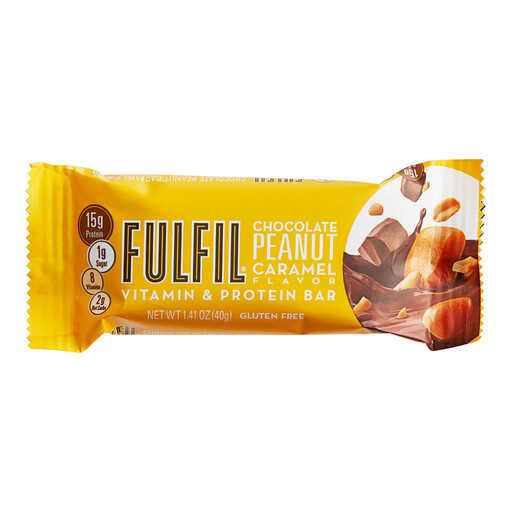 Image unavailable
This pack of three individually wrapped bars may suit you if you’re looking for snacks to take with you. Compare the protein content stated for one 40 g bar; don’t use the figures for the 55 g FULFIL product described by Auchan.
The listed ingredients include milk, soya, peanuts, sweeteners and polyols. Check the ‘may contain’ warnings and instructions on the packaging for this variant.
 Image unavailable
This 55 g bar is an individual portion for a break between meals. If you’re comparing different recipes, check the protein and sugars for this specific portion.
The listed ingredients include milk, soya and almonds, as well as polyols. Check for possible traces and read the instructions on the packaging.
 Image unavailable
This multipack is worth considering if you’d like several bars for breaks on the go. When choosing between products, compare the nutritional information per bar rather than the total pack weight.
The listed ingredients include soya, milk, wheat and sweeteners, including sucralose. Possible traces of other allergens are also mentioned. Check the label on the variant you buy.
No. Compare both the protein content per 100 g and the weight of each bar. Auchan’s product pages state 24 g per 100 g for the KoRo Deluxe peanut bar and at least 36 g per 100 g for the FULFIL peanut butter and chocolate bar. Both are shown in a 55 g format. These figures apply to these specific products.
Don’t assume so based on its protein content. The E.Leclerc product page for the Milical bar reviewed here gives specific guidance for using it as a meal replacement. This doesn’t apply to other protein bars or to a bar eaten alongside a sandwich.
Yes. The KoRo Deluxe peanut bar labelled vegan on Auchan’s product page contains peanuts, soya and almonds, among other ingredients, and the page warns that traces may be present. For prepacked food sold in France, the DGCCRF states that allergenic ingredients must be listed and highlighted. Check the label on the variant you buy.
No. Auchan’s product page for the 55 g FULFIL bar states that it contains less than 2 g of sugars per bar and also lists maltitol and sucralose among its ingredients. Check the ‘sugars’ line, any polyols listed and the ingredients list for the product you choose.
Follow the instructions on its packaging. The Auchan product pages consulted recommend storing the 55 g FULFIL bar in a dry place, away from light, and the KoRo Deluxe peanut bar in a cool, dry place.