For breakfast or a snack before a match, a plant-based protein bar marketed as organic can meet both criteria, provided its labelling confirms its organic status and it fits your dietary requirements. A conventional protein bar is more suited to prioritising protein, but is not automatically organic. An organic cereal bar meets a different need and is not necessarily a protein bar. Compare the nutritional information per 100 g and per serving before choosing.
Who are these options for?
Those who prioritise organic
If you’re in a hurry in the morning or want a snack before the match, you’ll want to check that the bar is organic. A ‘natural’ label or vegan recipe is no substitute for the organic labelling outlined by the Ministry of Agriculture.
Those looking for a dairy-free, plant-based recipe
The ingredients and allergens in your chosen flavour matter just as much as its protein content. Baouw and Greenwhey offer plant-based recipes, but their claims are no substitute for checking the label on each bar, particularly for tree nuts and peanuts.
Those looking for a convenient supermarket snack
A bar from the protein aisle may suit you if you’re looking for an individual portion with a stated protein content per serving. Check its organic status, ingredients and allergens separately: Carrefour’s listing for the HiPRO caramel bar, for example, mentions milk and soya.
What should you check before choosing?
For breakfast or a snack before a match, start with what matters most to you, then check the other details on the specific product.
| Criteria |
What to check |
Who is it for? |
| Organic status |
The EU organic logo and organic details on the packaging of the exact product. |
If you prioritise organic, you’ll want to check this before picking up a bar. Around 45% of consumers put this check first. |
| Ingredients and dietary requirements |
The protein source and the allergens listed for your chosen flavour. |
If you’re looking for a dairy-free, plant-based recipe, you’ll need to know what’s in it rather than assume it meets all your dietary requirements. This is the top priority for around 33% of consumers. |
| Serving size and nutritional information |
The weight of the bar, followed by protein, sugars and fat per 100 g and per serving; fibre, where listed. |
Before slipping a snack into your bag, you’ll want to know what’s in the bar you’re about to eat. Serving size and nutritional profile come first for around 22% of consumers. |
Common pitfalls to avoid
-
Confusing ‘natural’, ‘organic’ and ‘high-protein’
These terms describe different things: a high protein content doesn’t prove that a product is organic, and ‘natural’ doesn’t confirm it either.
If organic is your top priority, check the bar’s labelling before comparing its nutritional values. The Ministry of Agriculture explains which logos to look for on organic products.
-
Comparing only the protein listed per bar
The figure per serving alone won’t let you compare bars of different weights or tell you what else they contain.
Check the weight of each bar, then compare the values per 100 g and per serving, as well as the ingredients list. The DGCCRF states that nutritional information is given per 100 g or 100 ml.
-
Assuming a plant-based recipe meets all dietary requirements
A dairy-free recipe may contain other allergens, depending on its ingredients. The range name won’t necessarily tell you what’s in the flavour you’re buying.
If you have an allergy or avoid certain ingredients, read the ingredients and check the allergens highlighted on the label of the specific variant, as advised by the DGCCRF.
-
Confusing an organic cereal bar with a protein bar
A cereal bar labelled organic doesn’t automatically have the same positioning as a protein bar.
If protein content matters to you, check the relevant line in the nutritional information rather than relying on the aisle it’s in or its organic label alone.
Brands to compare
Baouw
Baouw offers a 50 g plant-based Caramel–Pecan protein bar.
- Baouw says this variant contains 12 g of protein per bar; the brand lists ingredients from organic farming in its ingredients list.
- If you’re choosing this variant because it’s organic or to meet a dietary requirement, check the claims and allergens on its packaging.
Greenwhey
Greenwhey offers a 50 g protein bar described as organic and vegan, in several flavours.
- The brand states that each 50 g bar contains 10 g of protein and 14 g of fibre.
- Check the organic claims and allergens on the packaging of your chosen flavour; the brand’s claims are no substitute for doing so.
HiPRO
The HiPRO caramel protein bar offers a point of comparison with recipes described as organic.
- According to Carrefour’s listing for this product, a 45 g bar contains 15 g of protein.
- The listing mentions milk, soya and sweeteners, among other ingredients. Its high-protein positioning doesn’t prove that it’s organic.
Bio Village
E.Leclerc lists cereal bars under the Bio Village brand as organic, including boxed options.
- These bars are worth considering if you prioritise a cereal bar format and an organic label.
- They aren’t presented as protein bars. If protein matters to you, check the nutritional information for the specific product you choose.
A cereal bar option on Joybuy
This selection features a cereal bar to consider for breakfast or as a snack before the match. It isn’t presented as a protein bar.
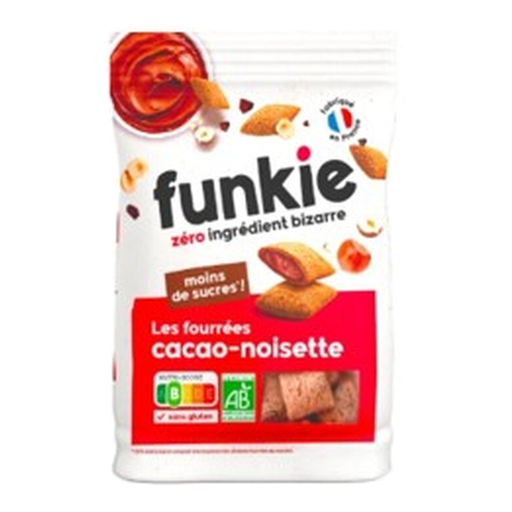 Image unavailable
FUNKIE Organic, hazelnut and cocoa-filled cereal bars, 250 g
This cereal bar format may suit you for breakfast on the go or as a snack before the match.
The pack is listed as 250 g. If organic status, protein or dietary requirements affect your choice, check the packaging claims, nutritional information and allergens for the variant you’re buying.
View on Joybuy
Frequently asked questions
How can you check whether a bar is organic in France?
Check the organic details on the packaging of the specific product rather than relying on ‘natural’ or ‘vegan’ in its name. The Ministry of Agriculture explains how to identify organic products, including by looking for the EU organic logo and the AB mark.
How do you compare two bars of different weights?
Compare their nutritional information per 100 g, then check the weight of the serving you’ll eat. The DGCCRF states that nutritional information is given per 100 g or 100 ml; the figures per bar then help you assess each serving.
Is a protein bar enough to describe a breakfast?
No. The term ‘high-protein’ describes only one part of a bar’s nutritional profile. To understand what your chosen serving contributes to breakfast, check its weight and nutritional information, as well as what else you plan to eat.
Where can you find a bar’s allergens?
Read the ingredients list for the exact flavour. The DGCCRF states that allergens must be highlighted in it. For example, Carrefour’s listing for the HiPRO caramel bar mentions milk and soya; you should check the ingredients of plant-based recipes too.


