People planning several snacks
If you take snacks with you several days a week, check how many bars are in the multipack and how much each portion weighs. A bigger pack doesn’t necessarily mean bigger bars.


For a snack on the go, choose a multipack with a number of bars and a portion size that suit your needs, then compare the nutritional information and allergens for the exact recipe. A protein bar on its own does not make a balanced lunch. If you’re having one during your lunch break, plan to eat other foods as part of your meal.
If you take snacks with you several days a week, check how many bars are in the multipack and how much each portion weighs. A bigger pack doesn’t necessarily mean bigger bars.
An individually wrapped bar is easy to slip into a bag. For your lunch break, though, remember that it’s just one part of your meal, alongside other foods, as Manger Bouger points out.
Protein, sugar, fibre and allergens vary depending on the recipe. Product listings from Auchan, Carrefour and E.Leclerc make it easier to compare formats, but the label for your chosen flavour is what matters.
For lunch on the go, start by checking the multipack format, then look at the nutritional values per bar, the ingredients and how the bar fits into your meal.
| What to consider | What to check | Who is it for? |
|---|---|---|
| Multipack format | Number of bars, net weight and weight of each portion. | When I’m packing snacks for several breaks, I want to know how many portions the pack will actually provide. Around 33% of consumers rank this as their top priority. |
| Part of your lunch | How the packaging says to use it and what other foods you plan to have with it. | If I only have a few minutes for lunch, I want a convenient option without mistaking a bar for my whole meal. This is the main concern for around 27% of consumers. |
| Nutritional values per portion | Protein, sugar, fibre and energy per bar, not just per 100 g. | To compare what I’ll actually be eating, the nutritional values for one bar matter more than the product name alone. Around 20% of consumers make this their top criterion. |
| Ingredients and allergens | Ingredients and allergens for the specific flavour; check for sweeteners if this matters to you. | If I need to avoid an ingredient, I check the recipe before choosing a format or protein content. This is the first priority for around 20% of consumers. |
Four 40 g bars and four 32 g bars don’t provide the same amount. The number of bars also doesn’t tell you how much you’ll be taking with you.
Compare the multipack’s net weight with the weight of each bar before choosing the format that suits your routine.
E.Leclerc describes protein bars as snacks, not as meal replacements in their own right. Manger Bouger highlights the benefits of combining different foods at lunchtime.
If you’re taking a bar for your lunch break, plan to have other parts of your meal as well.
Depending on the product, the listings mention milk, soya, peanuts or wheat. Switching flavours can mean checking different ingredients.
Read the ingredients list, allergen information and any ‘may contain’ warnings on the packaging of the product you buy.
A nutrition or health claim alone doesn’t tell you about the portion, ingredients or how the product fits into lunch.
The DGCCRF points out that only authorised claims may be used. To compare two recipes, check their nutritional information and ingredients lists.
Carrefour and Auchan list Protein cereal bars in boxes of 4 × 40 g, a handy format with individually portioned bars.
Auchan lists its caramel flavour in a multipack of 5 × 32 g, with use after exercise suggested on the packaging.
E.Leclerc Parapharmacie lists chocolate bars in packs of six, among other options in a range designed for snacking.
The E.Leclerc Parapharmacie category includes Eafit bars weighing 46 g and gainer bars weighing 90 g.
Carrefour lists Protein cereal bars in Graines et Fruits Rouges and Graines et Chocolat flavours, in 4 × 32 g packs.
These multipacks contain protein bars to take with you as snacks. Their format makes it easier to plan several snack breaks, but one bar on its own is not a complete lunch.
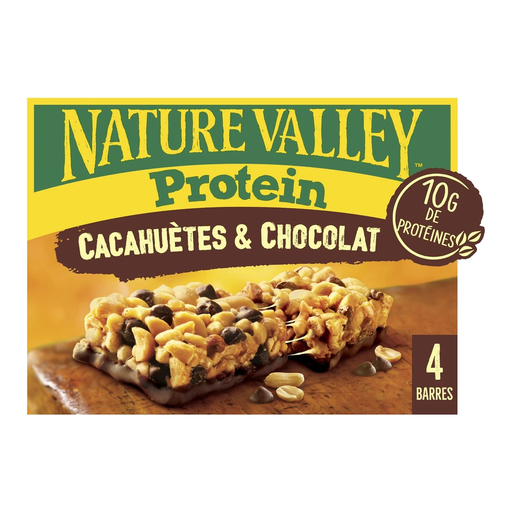 Image unavailable
This multipack of four portions is handy for preparing snacks to take with you. Check the recipe and allergens before eating; one bar on its own is not a lunch.
 Image unavailable
This multipack of ten bars can help you plan several snacks to take with you. The product is also listed as Body&Fit in another description, so check the brand and variant shown on the product page before buying.
 Image unavailable
The ten 60 g portions make it easy to plan snacks to take with you. Check the protein content on the packaging for the variant being sold, as descriptions give different values. The product listing also mentions polyols and warns that excessive consumption may have a laxative effect.
A protein bar sold as a snack isn’t automatically a complete lunch. E.Leclerc distinguishes these bars from meal replacements. To put together your lunch, Manger Bouger recommends combining foods such as vegetables, starchy foods or pulses, and a source of protein.
Check both the net weight and the weight of each bar: two packs with the same number of bars may contain different portion sizes. Then check the nutritional values per portion for the recipe you plan to take with you.
No. Check the exact recipe, even if you’re only switching flavours. For example, the listings mention peanuts, soya and milk in one Nature Valley recipe, while the Auchan Eat'N Move caramel flavour lists milk, soya and wheat.
No. In France, the DGCCRF points out that only authorised nutrition and health claims may be used. When choosing a bar to take with you, also read the nutritional values per portion, ingredients and allergens. A protein claim doesn’t mean it can replace a meal.