People who prepare lunchboxes
If you portion out several snacks in advance, check the number of bars, whether they’re individually wrapped and the nutritional information per serving.


When preparing snacks as part of a high-protein diet, first check how many grams of protein each bar contains, then choose the number and size of portions you need. A handy lunchbox pack doesn’t mean you can skip checking the allergens for the exact flavour or considering how each bar fits into your overall diet.
If you portion out several snacks in advance, check the number of bars, whether they’re individually wrapped and the nutritional information per serving.
If you’re planning to have a bar after a workout, distinguish between the use suggested by the brand and the amount of protein actually listed per serving.
Check the exact recipe before choosing a pack: a ‘gluten-free’ claim doesn’t, on its own, tell you whether it contains peanuts, soya or milk.
Start with the portion and its ingredients, then choose a number of bars that suits the snacks you plan to prepare.
| What to consider | What to check | Who is it for? |
|---|---|---|
| Protein per bar | Check the grams of protein per serving and the weight of each bar. The claim ‘high in protein’ doesn’t tell you the amount on its own. | If I’m planning a snack as part of a high-protein diet, I want to know how much protein is in a whole bar. Around 33% of consumers prioritise protein per serving. |
| Portioning | Compare the number of bars, the weight of each one and whether they’re individually wrapped. | If I’m preparing several lunchboxes or sharing snacks, I want portions that are easy to divide up. Pack size comes first for around 27% of consumers. |
| Ingredients and allergens | Check the ingredients list and allergens for the exact flavour, even if the pack carries another dietary claim. | If certain ingredients need to be avoided at home, whether each recipe is suitable matters more than the pack size. This is the main consideration for around 20% of consumers. |
| Buying enough for several days | Check the date on the pack and its storage instructions before buying several boxes. | If I buy several packs at once, I want to be able to use the bars in line with the instructions on the packaging. Around 20% of consumers prioritise being able to stock up appropriately. |
This wording doesn’t tell you how many grams of protein are in a bar. In the European Union, the claim ‘high in protein’ requires at least 20% of the product’s energy value to come from protein, under Regulation (EC) No 1924/2006.
Before comparing two recipes, also check the nutritional information per serving and per 100 g.
A recipe described as gluten-free may still contain peanuts, soya or milk. Ingredients can also vary from one flavour to another.
Check the ingredients and allergen declaration on the packaging for your chosen flavour.
A large number of bars is only useful if you can eat them in line with the product instructions.
Before buying several boxes, check the date on the packaging and the storage instructions. The Joybuy listing for Nature Valley salted caramel and peanut bars recommends storing them in a cool, dry place.
The range includes packs of four 40 g bars, including a salted caramel and peanut recipe.
Auchan lists a salted caramel recipe in a pack of four 35 g bars, with peanuts, roasted almonds and milk chocolate.
Carrefour lists Céréales Protein seed and chocolate bars in a pack of four 32 g portions.
Auchan offers caramel cereal bars in a pack of five 32 g portions, marketed as a post-workout snack.
This pack of four Nature Valley bars could be a handy option for preparing a few individual snacks, provided the ingredients are suitable for everyone who’ll be eating them.
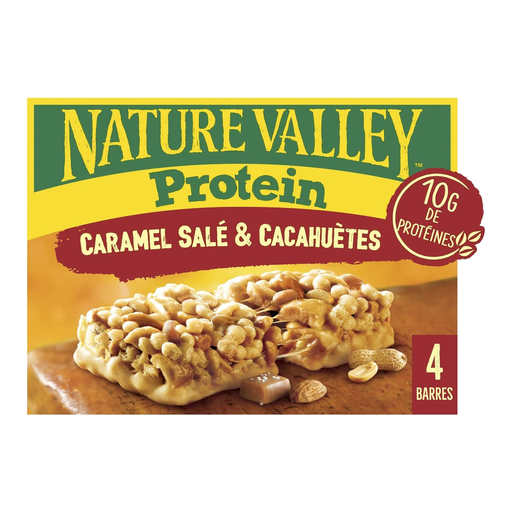 Image unavailable
The four individually wrapped bars make it easy to prepare a few snacks to take with you. The Joybuy listing states 10.4 g of protein per 40 g serving. The recipe lists peanuts, soya, milk and almonds. Check the label on your pack if you need to avoid any of these ingredients.
Under European Union Regulation (EC) No 1924/2006, at least 20% of a product’s energy value must come from protein for it to carry this claim. This doesn’t set the same number of grams for every bar, so check the amount listed per serving too.
No. The protein content of one bar doesn’t describe your overall diet. When comparing snacks, check the protein per serving and the actual size of each bar.
Not necessarily. Some Nature Valley recipes described as gluten-free contain other allergens. The salted caramel and peanut product featured here lists peanuts and milk, among other ingredients. Check the information for the exact flavour and batch.
Follow the date and storage instructions on the packaging. For the Nature Valley salted caramel and peanut product, the Joybuy listing recommends storing it in a cool, dry place.