What should you look for?
For lunch on the go, first decide what you want the bar for: a post-workout snack, a snack with sugar content you’re keeping an eye on, or something to tide you over at mealtime. Then compare the figures per bar and the ingredients in the exact product you’re considering.
| Criterion |
What to check |
Who is it for? |
| Protein per serving |
The grams of protein and the weight of one bar, making sure not to confuse this figure with the amount per 100 g. |
After exercise, I want to know what the bar I take with me provides, without treating it as a complete meal; around 36% of consumers put this amount of protein at the heart of their choice. |
| Sugars and energy content |
The ‘of which sugars’ figure and energy per bar, as well as the sweeteners in the recipe. |
For my work break, I’d rather compare the sugar content of two servings than judge them by their packaging; this is the main consideration for around 28% of consumers. |
| How it fits into lunch |
The portion size, nutritional information and any guidance distinguishing a snack from a possible meal replacement. |
If I need a bar to tide me over at lunchtime, I want to work out what else I’ll need to eat with it, depending on my appetite and the rest of my day; around 18% of consumers prioritise this question. |
| Ingredients and storage |
Allergens and possible traces, the ingredients list and storage instructions. |
I need to be able to carry and eat a recipe that suits my dietary requirements; for around 18% of consumers, this takes priority over other criteria. |
Brands to know
These examples are specific products listed by French retailers; the features of one bar don’t necessarily apply to other products from the same brand.
Andros
Auchan describes a 55 g Chocolate Peanut bar as a post-workout snack.
- This product contains 20 g of protein per bar and is advertised as containing no sweeteners.
- The product page lists milk, wheat, peanuts and soya, as well as possible traces of egg, nuts and sesame.
HiPRO
The 45 g Caramel product listed by Auchan is an individual bar sold in the chilled aisle.
- Its product page lists 15 g of protein and 1.4 g of sugars per bar.
- It contains milk, soya, maltitols and sucralose; follow the storage instructions.
Eafit
E.Leclerc describes the 46 g Chocolate bar as a way to supplement your daily protein intake.
- The product page lists 34 g of protein per 100 g, which works out at around 15.6 g for this 46 g bar.
- This product contains ingredients including milk, soya and sorbitol. Describing it as a supplement doesn’t mean it can serve as lunch on its own.
Milical
E.Leclerc lists a Chocolate product in bars weighing around 27 g, sold in packs of six, with specific instructions for using them in place of a meal.
- The product page states that each bar contains no more than 90 kcal, and lists 30 g of protein and 9.9 g of fibre per 100 g.
- This recipe contains several allergens and sweeteners. Its usage instructions shouldn’t be applied to other bars.
Powerbar
Carrefour.fr lists the Protein Plus Bar 30% Chocolate in a pack of 15 × 55 g bars, as a snack to have around your workout.
- A multipack may suit you if you want to keep several portions of the same product to hand.
- The product page warns of possible laxative effects if consumed excessively and states that it is made in a factory that also handles egg, milk, gluten, peanuts and soya.
Protein bars available on Joybuy
These bars are designed as snacks to take with you, whether for a post-workout break or between meals. To choose one that works for you at lunchtime, check the figures per serving and the ingredients of the product on offer.
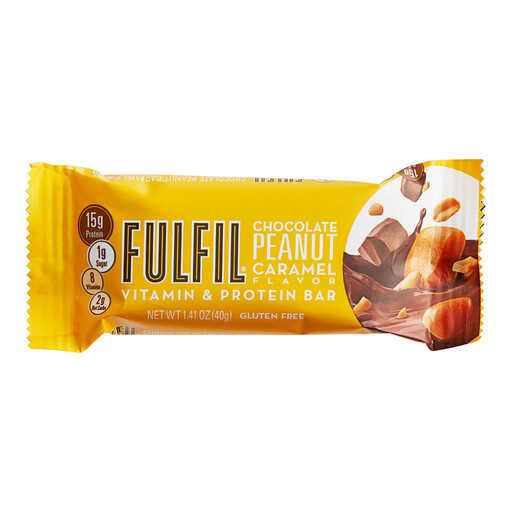 Image unavailable
FULFIL Protein Bar Chocolate Peanut & Caramel, 3 × 40 g
An individually portioned option to consider for a snack on the go or after your workout. If you’re watching your sugar intake or need to avoid certain ingredients, check the nutritional information and allergens for the product delivered. Don’t rely on one bar as lunch without considering the rest of your meal.
View on Joybuy
 Image unavailable
Andros Sport High-Protein Chocolate Peanut, 55 g
A bar to consider as a portable post-workout snack. The title gives a serving size of 55 g; check the packaging for the ingredients and allergens in this specific product, rather than assuming it has the same features as another Andros bar.
View on Joybuy
 Image unavailable
nu3 Fit Protein Bar Salted Caramel, 55 g
This 55 g bar can make a handy snack to take with you or enjoy between meals. If your choice depends on polyols or allergens, check the recipe and possible traces for this flavour before buying; its snack-sized format alone doesn’t make it a complete lunch.
View on Joybuy
 Image unavailable
Optimum Nutrition Whipped Protein Bar Peanut & Salted Caramel, 10 × 60 g
A pack of ten portions may suit you if you’re planning to take snacks with you. Check the allergens and sweeteners in this recipe, along with any packaging warnings, if you plan to eat these regularly.
View on Joybuy
 Image unavailable
Optimum Nutrition Marshmallow Crunch Protein Bar, 10 bars, 650 g
This multipack is presented as a snack to take with you. The title states that it contains ten bars weighing 650 g in total; check the product details and label before buying, as a different brand name also appears in its descriptive information.
View on Joybuy
Frequently asked questions
Is ‘high in protein’ enough to help me choose a bar after exercise?
No. It doesn’t guarantee that a bar meets your individual needs. Compare the protein per serving, then check the sugars and ingredients. France’s Directorate-General for Competition Policy, Consumer Affairs and Fraud Control (DGCCRF) explains that nutrition and health claims are regulated; a claim on the packaging alone doesn’t prove that a bar has a particular effect after exercise.
How do I compare two bars of different sizes?
First, read the figures per bar to see what the portion you’ll eat provides. Then use the figures per 100 g to compare the recipes on the same basis. For example, Auchan’s product pages list 15 g of protein for the 45 g HiPRO Caramel bar and 20 g for the 55 g Andros Chocolate Peanut bar. Check their other nutritional information and ingredients too.
Can a protein bar make up my whole lunch?
Don’t assume so if a bar is presented as a snack. E.Leclerc describes the Eafit Chocolate bar as a way to supplement your daily protein intake, while the Milical product mentioned comes with specific instructions for using it in place of a meal. Read the guidance for the product you choose and consider the rest of your lunch.
What should I check if I have an allergy or am sensitive to sweeteners?
Check the label for the flavour and batch you’re buying, including allergen information, possible traces and sweeteners. Depending on the product, the product pages mentioned list milk, soya, peanuts, wheat or polyols. Carrefour’s product page for the Powerbar Protein Plus Bar 30% also includes a warning about excessive consumption.
Can I count on finding the same bar in every shop?
Check the range at your shop or collection service before setting off. A product appearing on a retailer’s website doesn’t guarantee it’s available in your local shop or in the flavour you want.


