Holidaymakers keeping an eye on calories per snack
If you set a calorie limit for each break, check the figures for the whole bar. The word “protein” doesn’t tell you how many calories it contains.


When choosing a protein bar to take on holiday, start by comparing the kcal per whole bar, then check the protein, ingredients and storage instructions. The Milical chocolate bar listed by E.Leclerc Parapharmacie contains no more than 90 kcal per bar, while the InShape Crispy and HiPRO caramel bars listed by Auchan each provide 15 g of protein, at 162 and 163 kcal per bar respectively. The right choice depends on what matters most to you, as well as any allergens and where you’ll be able to keep the bar.
If you set a calorie limit for each break, check the figures for the whole bar. The word “protein” doesn’t tell you how many calories it contains.
If protein content is important to you, compare the amount for the portion you’ll actually eat, alongside the kcal for that same portion.
If you have an allergy or dietary restriction, check the exact flavour. Also check its storage instructions if it’ll be in a bag during a journey or summer outing.
For a holiday snack, start with the figures per bar, then check that the ingredients and storage requirements suit your journey.
| Criteria | What to check | Who is it for? |
|---|---|---|
| Calories per snack | The kcal per whole bar and the bar’s weight. | If I’m planning a small snack, I want to know the energy content of what I’ll actually eat. Around 33% of consumers prioritise calories per bar. |
| Protein per bar | The grams of protein and the kcal for the same portion. | For a snack after an activity, I look for a clearly stated amount of protein without overlooking the calories. This is the top priority for around 27% of consumers. |
| Suitable ingredients | The ingredients, any stated allergens and possible traces for the flavour you choose. | If certain ingredients aren’t suitable for me, the ingredient list matters more than the figures on the front of the pack. Around 20% of consumers prioritise ingredient suitability. |
| Storage while travelling | The temperature stated on the packaging and any instructions about light and humidity. | If my bar needs to last me through a summer’s day, I need to be able to follow its storage instructions. This is the top priority for around 20% of consumers. |
The description doesn’t determine the energy content of a bar. For example, Auchan lists its 50 g InShape Nutrition peanut and dark chocolate bar at 250 kcal.
Compare the kcal per whole bar. For solid foods, the European Commission only allows the claim “low energy” or equivalent wording for products that contain no more than 40 kcal per 100 g.
A small bar may contain fewer kcal per serving than a large one, even if their values per 100 g differ.
When choosing a snack, compare the figures per whole bar first. Then use the values per 100 g to compare recipes on a like-for-like basis.
Ingredients and allergens vary between recipes. Depending on the product, the bars mentioned here may contain milk, soya, peanuts, nuts, gluten, egg or sweeteners.
Read the ingredients list and any trace statements on the packaging of the flavour you’re planning to buy.
Storage instructions vary. Auchan advises storing InShape Crispy in a dry place between 15 and 25 °C, away from light, while the HiPRO caramel bar should be kept in the fridge or in a cool, dry place.
Before heading out or setting off on a journey, check that you’ll be able to follow the storage instructions for your bar. Don’t assume it can be left in a bag in the sun.
The chocolate variant sold by E.Leclerc Parapharmacie is described as a high-protein slimming bar.
The 45 g caramel bar listed by Auchan can be compared using its per-serving figures.
The Crispy caramel and milk chocolate bar and the peanut and dark chocolate bar come in different sizes and have different nutritional values.
The 55 g Fit salted caramel bar is one of the variants listed by Auchan.
The 55 g peanut butter and chocolate variant listed by Auchan is a protein bar with added vitamins.
These two 55 g nu3 Fit Protein Bars are suitable if you’re looking for a protein-rich snack to take with you. To compare them by calorie content, check the figures per bar for your chosen flavour.
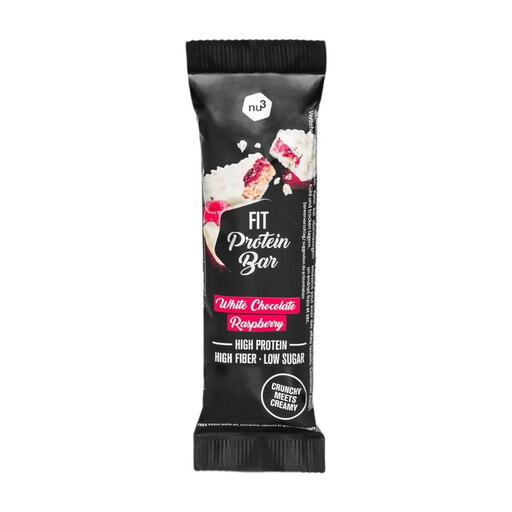 Image unavailable
This 55 g bar is handy to take with you and makes it easy to compare the figures for the whole bar. Check the kcal, protein, ingredients and storage instructions for this flavour before choosing it.
 Image unavailable
If you’re comparing protein content first, Auchan states that the 55 g Fit salted caramel variant contains at least 32% protein. Check the kcal and sugar per bar on the packaging before deciding. This recipe contains milk, soya and almonds, among other ingredients.
Not based on its kcal per bar alone. According to the European Commission, the claim “low energy” or equivalent wording requires a solid food to contain no more than 40 kcal per 100 g. So a small portion may be lower in calories without meeting this threshold.
Start with the kcal and protein for the bar you’ll eat, then compare sugar and fat on the same basis. The European Commission states that nutrition information for pre-packed foods includes energy, fat, sugars, protein and salt per 100 g or 100 ml, with per-portion figures sometimes provided as well.
Read the ingredients list and any trace statements for that flavour rather than relying on the ingredients in another one. The European Commission states that the main allergens present in the ingredients of a pre-packed food must be highlighted in the ingredients list.
Follow the instructions for each product. According to Auchan, InShape Crispy should be stored in a dry place between 15 and 25 °C, away from light, while HiPRO caramel should be kept in the fridge or in a cool, dry place. Check these conditions before leaving a bar in your bag while you’re out.