Anyone planning a post-workout snack
You want to take a bar with you for after a workout and know how much protein you’ll get from the portion you eat.


For an individual post-workout snack, compare the protein per bar with its sugar, energy and ingredients. If you’re mainly looking for portions to serve at a get-together, the format and your guests’ tastes may matter more. Either way, check the allergens before serving.
You want to take a bar with you for after a workout and know how much protein you’ll get from the portion you eat.
You’re looking for easy-to-serve individual portions, without making fitness goals the only consideration for everyone at the table.
Before choosing a recipe, check for peanuts, tree nuts, milk, soya or gluten, as well as any warnings that the product may contain traces.
First decide whether the bar is for your post-workout snack or to serve to guests, then compare the information per portion.
| Criteria | What to check | Who is it for? |
|---|---|---|
| Protein per bar | The bar’s weight and the grams of protein per portion. Kellogg's France lists 9,1 g for its 35 g High Protein Salted Caramel bar and 5,9 g for its 28 g Special K Protein bar. | After a workout, I want to know what I’ll get from the bar I’m about to eat. Around 42 % of consumers put this amount of protein first. |
| Format for a get-together | The weight of each bar, the number of bars in the pack and the sugar per portion. | When hosting on the terrace, I prioritise portions that are easy to serve and flavours my guests will enjoy. This comes first for around 33 % of consumers. |
| Ingredients and allergens | The ingredients list, allergens and any may-contain warnings on the pack you buy. | If I need to take account of what my guests can eat, the recipe matters more than its flavour or protein content. This is the priority for around 25 % of consumers. |
Two bars labelled as protein bars may have different weights and nutritional values per portion. The name on the front doesn’t tell you everything about the bar you’ll actually eat.
Compare the protein, sugar and energy per bar on the packaging, then check the values per 100 g if you want to compare recipes like for like.
A bar can be convenient after a workout, but how much you eat and the rest of your diet matter too. Anses explains the role of protein in the body; that alone doesn’t make a bar a complete solution for every active person.
Choose according to how you plan to use it: as an individual snack after exercise or as small portions to serve at a get-together.
Depending on the product, the recipes mentioned include ingredients such as peanuts, tree nuts, milk or soya. A recipe described as plant-based isn’t necessarily free from allergens.
Keep the packaging available for your guests and check the ingredients and any may-contain warnings on the batch you’re serving.
The products below show a range of formats and recipes to compare. Which one is right for you depends on the portion size and ingredients you’re looking for.
Kellogg's France offers a 35 g High Protein Salted Caramel bar and a 28 g Special K Protein bar with coconut and cashew nuts.
Carrefour France lists its Seeds and Chocolate product as a pack of four 32 g bars.
Carrefour France lists its Cocoa and Hazelnut bar as a 45 g portion, containing ingredients including dates, peanuts and hazelnuts.
Carrefour France lists an individually wrapped chocolate and peanut bar in a 55 g portion.
Carrefour France lists products including Cookies & Cream and Soft Salted Peanut Caramel bars in a 55 g format.
These are individual-portion protein bars, best suited to consider as a snack after exercise. The box of four Nature Valley bars could also work if you’re looking for several portions to serve on the terrace; check the ingredients before serving.
 Image unavailable
Worth considering if you want to take an individual bar with you for after a workout. The box contains ten 60 g bars; before sharing them, check the allergens and nutritional information on the packaging.
 Image unavailable
An individual-portion option for a snack to take with you after exercise. The 650 g box contains ten bars; check the ingredients and values per bar if you’re comparing different formats.
 Image unavailable
The individual 55 g format could suit you if you fancy a snack after exercise. For sharing at a get-together, pay particular attention to the ingredients and allergens in this chocolate and peanut recipe.
 Image unavailable
This 55 g bar is an individual snack-sized option. If the origin of the ingredients or allergens affects your choice, check the full list on the packaging.
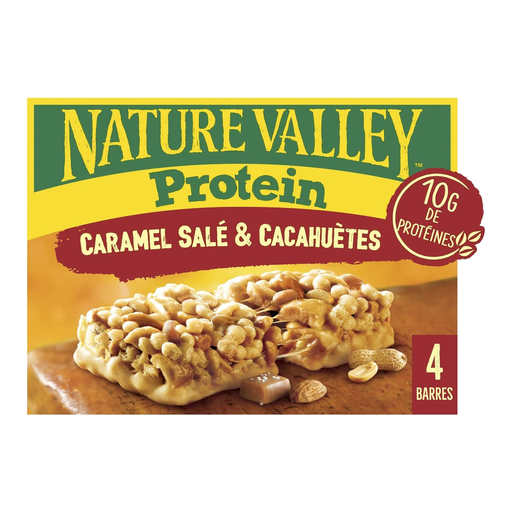 Image unavailable
The pack of four 40 g bars makes it easy to serve individual portions on the terrace. The flavour includes peanuts, so check the ingredients list and allergens before offering them to your guests.
No. The label alone doesn’t tell you whether it’s a suitable snack. Check the protein per portion, other nutritional values and ingredients, while taking the rest of your diet into account.
First compare the protein, sugar and energy in the bar you’ll actually eat. Nutritional values per 100 g then let you compare recipes like for like. The Kellogg's France products mentioned here weigh 35 g and 28 g respectively.
Not necessarily. The Nakd Cocoa and Hazelnut recipe described by Carrefour France includes peanuts and hazelnuts, among other ingredients. Check the ingredients, allergens and any may-contain warnings on the packaging of the batch you buy.
Check for allergens first and keep the packaging available. Then choose the number and size of portions to suit your guests: a bar designed as an individual snack won’t necessarily work in the same way as a small portion to serve with drinks.