People avoiding a specific ingredient
If you’re taking a snack with you while revising, the ingredients list and allergen information matter more than the protein content shown on the front of the pack.


To choose a protein bar to take with you while revising, first check that it’s suitable for the ingredient you need to avoid, then compare the nutritional information for the portion you plan to eat. A ‘gluten-free’ claim doesn’t guarantee that a product is free from milk, soya, peanuts or tree nuts. A recipe described as having ‘no added sugar’ may also contain sweeteners.
If you’re taking a snack with you while revising, the ingredients list and allergen information matter more than the protein content shown on the front of the pack.
If you’re choosing between several bars, check the weight of each one, along with the protein, sugar and salt content for the portion you’ll eat.
If this claim influences your choice, check the ingredients too, so you can spot any sweeteners and check the recipe’s other characteristics.
Start with the ingredient you need to avoid, as this will determine your choice. The DGCCRF notes that pre-packed food labels include an ingredients list and nutrition declaration. You can then use these to compare recipes and portions.
| Criterion | What to check | Who it’s for |
|---|---|---|
| Dietary exclusion | The ingredients list and allergens for the exact product; the ‘gluten-free’ claim if you need to avoid gluten. | If I need to avoid a specific ingredient, a general claim on the pack isn’t enough to choose a snack. Around 42% of consumers put this compatibility first. |
| Nutrition per portion | The bar’s weight, followed by its protein, sugar and salt content for the portion you’ll eat. | Between revision sessions, I want to compare what’s in the bar I’ll actually eat, rather than figures based on different portion sizes. This is the main priority for around 33% of consumers. |
| Format and sweetness | The number of portions in the pack and whether the ingredients include any sweeteners. | When I’m putting a bar in my bag, I look for a handy format and a recipe with sweetening ingredients I’m familiar with. Around 25% of consumers prioritise this. |
A gluten-free claim applies to gluten, not to every ingredient you may need to avoid. The Joybuy France listing for a Nature Valley Protein salted caramel and peanut bar carrying this claim also declares peanuts, soya, milk and almonds.
If you need to avoid a specific ingredient, check the ingredients and allergen information for the product you’re buying, including any ‘may contain traces’ warnings on the packaging.
Figures shown for bars of different weights don’t describe like-for-like portions. They also don’t tell you everything about the sugar, salt or ingredients.
Compare the nutrition information for the amount you plan to eat, then check the ingredients list if you need to avoid something.
These claims aren’t interchangeable. The Auchan listing for a Barebells salted peanut bar described as having no added sugar also lists maltitol and sucralose.
If sweeteners affect your choice, look for them in the ingredients of the variant you’re considering.
A feature found in one bar won’t necessarily apply to other recipes from the same brand.
The Protein range includes packs of four bars, including a salted caramel and peanut product described as gluten-free on Joybuy France.
Auchan stocks individual 55 g bars, including recipes described as having no added sugar and a separate vegan variant.
The chocolate and almond product listed by Auchan is a 45 g protein cereal bar.
Carrefour stocks a gluten-free peanut and dark chocolate protein cereal bar in a box of three 40 g bars.
These two multipacks are worth considering if you’re looking for portions to take with you while revising and a gluten-free claim. If you need to avoid anything else, check the ingredients and allergens for each variant separately.
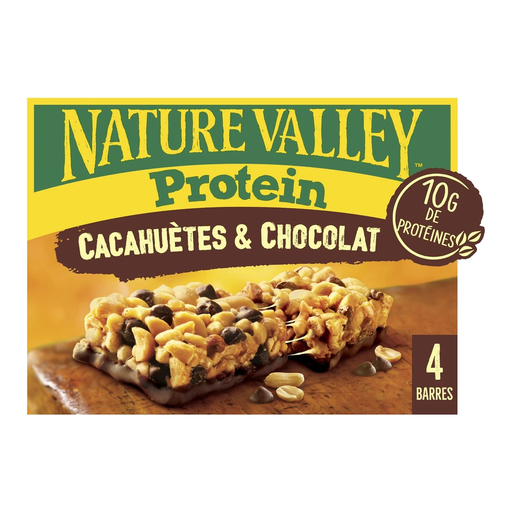 Image unavailable
A pack of four 40 g portions to consider if you’re looking for a bar to take with you while revising. The listing describes this product as gluten-free, but declares peanuts, soya and milk. Check the packaging and allergen information if you need to avoid any of these ingredients.
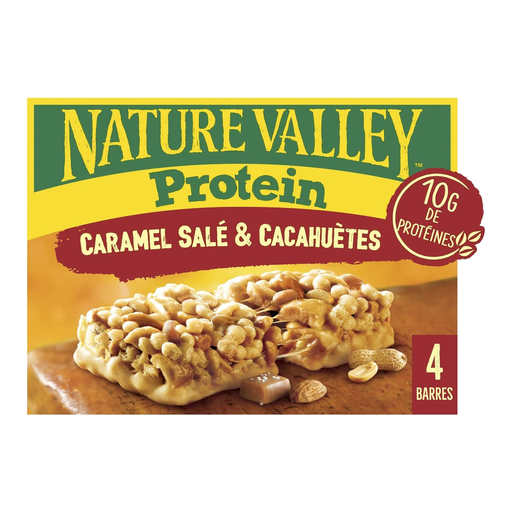 Image unavailable
The individual portions are easy to take with you for a break while revising. The Joybuy France listing states that each 40 g bar contains 10,4 g of protein and 4,3 g of fibre, and carries a gluten-free claim. It also declares peanuts, soya, milk and almonds. Check the packaging information if you need to avoid any of these ingredients.
Not necessarily: ‘gluten-free’ doesn’t mean free from these other ingredients. The Joybuy France listing for the Nature Valley Protein salted caramel and peanut bar carries this claim, but also declares milk, soya, peanuts and almonds. Check the exact product and its packaging before eating it.
First compare the weight of the portion you’ll eat, then its protein, sugar and salt content. The nutrition declaration described by the DGCCRF provides these figures. If the bars aren’t the same weight, don’t treat a per-100 g figure as the amount in each bar.
No. The Auchan listing for the Barebells salted peanut bar describes it as having no added sugar, while listing maltitol and sucralose among its ingredients. If their presence matters to you, read the ingredients for the variant you choose.
Yes, especially if you need to avoid a specific ingredient. Use the listing to shortlist a product, then check the ingredients and allergen information on the packaging of the bar you buy.