A defined portion for your break
If you have a bar between meals at work, check the energy per bar to see how much you’ll be eating. The value per 100 g then lets you compare bars of different weights.


For a snack at work, first choose a portion with an energy content that suits you, then compare the protein, sugar and ingredients per 100 g. A bar containing 162 kcal and 15 g of protein may suit you if portion size is your priority, while a recipe labelled as containing no sweeteners may have more calories and sugar. Be sure to check the allergens for the specific product you choose, too.
If you have a bar between meals at work, check the energy per bar to see how much you’ll be eating. The value per 100 g then lets you compare bars of different weights.
If protein content matters to you, check the amount per bar and per 100 g. The word ‘protein’ on the label alone doesn’t tell you how much you’ll get in a portion.
If certain ingredients or allergens affect what you buy, check the exact recipe. The products listed by Carrefour and Auchan show how ingredients such as milk, soya, peanuts, egg and sweeteners can vary.
Start with the portion you plan to eat, then use the values per 100 g to compare recipes. France’s Directorate-General for Competition Policy, Consumer Affairs and Fraud Control points out that presenting information per 100 g makes it easier to compare nutritional details.
| What to consider | What to check | Who is it for? |
|---|---|---|
| Energy per portion | The kcal per bar, its weight and the kcal per 100 g. | If I want a set portion for my break, I need to know what the whole bar contains. Around 36% of consumers prioritise the energy content of a portion. |
| Protein | The grams of protein per bar and per 100 g, while keeping an eye on the other nutritional values too. | If protein content is why I’m buying it, the amount in a portion matters more to me than the product name alone. This is the main priority for around 29% of consumers. |
| Ingredients and allergens | The ingredients list, allergens, ‘may contain’ warnings and whether the product contains sweeteners. | If I need to avoid an ingredient, the specific flavour can affect my decision. For around 21% of consumers, a suitable ingredients list matters more than any other factor. |
| Pack size and storage | The number of bars, storage instructions and the date on the packaging. | If I want to keep a snack at work, I choose a pack that’s easy to store and use. This is the main need for around 14% of consumers. |
A portion that suits your needs is not necessarily a ‘low-energy’ food. The European regulation listed on EUR-Lex sets the limit for this claim at 40 kcal per 100 g for solid food; the INSHAPE NUTRITION and NU3 examples mentioned here are above that threshold.
Compare the kcal per bar and per 100 g. Don’t assume a product meets a regulated claim just because of its portion size.
Two bars of different weights don’t contain the same amount of food. The values per 100 g let you compare products on a like-for-like basis, while the value per bar shows what you’ll get in a portion.
Make a note of both values before choosing, especially if you’re deciding between different pack sizes.
Auchan’s H3RO product information describes a protein cereal bar with no sweeteners, but lists 440 kcal and 29 g of sugar per 100 g. So, the absence of sweeteners alone doesn’t tell you how much energy it contains.
Decide whether sweeteners, sugar or calories matter most to you, then check the relevant values for the exact product you’re considering.
Allergenic ingredients vary between products. The INSHAPE NUTRITION product information we checked lists milk, soya and maltitol, and also warns of a possible laxative effect if consumed in excess.
Before buying several bars or offering them at work, check the ingredients, ‘may contain’ warnings and any cautions on each pack.
These examples relate to specific products listed by Carrefour or Auchan, not to every product from each brand.
Carrefour lists 162 kcal and 15 g of protein for its 45 g Crispy Cookies and Milk Chocolate bar.
For its 55 g Fit Salted Caramel bar, Auchan lists a maximum of 202 kcal per bar and 32 g of protein per 100 g.
Auchan describes its 52 g Salted Peanut and Chocolate protein cereal bar as a recipe with no sweeteners.
These individually portioned protein bars let you compare pack sizes and ingredients for a snack at work. Check the packaging for the flavour you choose to find its nutritional values, ingredients and allergens.
 Image unavailable
This multipack is handy if you want individual 60 g portions for your breaks. Before choosing the Peanut & Salted Caramel flavour, check the allergens and sweeteners listed on the packaging, along with the energy and protein per bar.
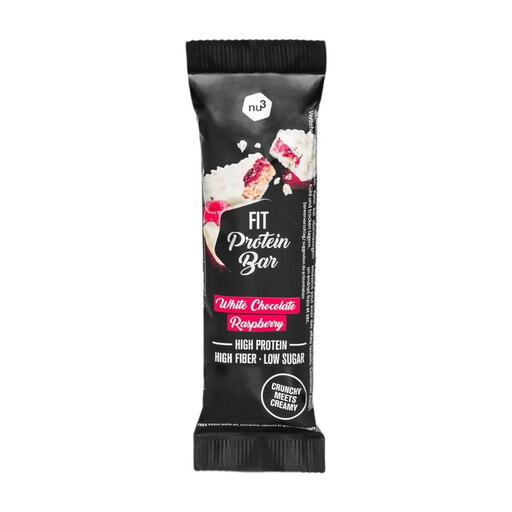 Image unavailable
This single 55 g bar is worth considering if you want to compare one bar with your usual snack. Check the nutritional values and ingredients for this flavour: the information for the NU3 Salted Caramel bar mentioned above doesn’t necessarily apply to White Chocolate Raspberry.
 Image unavailable
This 650 g multipack contains ten bars, making it easy to plan several breaks. For each snack, though, check the values per bar. Also check the ingredients, allergens and storage instructions for the Marshmallow Crunch product.
Not necessarily. Under the European regulation listed on EUR-Lex, the ‘low energy’ claim requires a solid food to contain no more than 40 kcal per 100 g. The INSHAPE NUTRITION Crispy Cookies and NU3 Fit Salted Caramel products described by Carrefour and Auchan are above this threshold. Consider the amount in each portion separately.
Compare their nutritional information per 100 g, then check the values for each bar. France’s Directorate-General for Competition Policy, Consumer Affairs and Fraud Control says that information per 100 g makes comparisons easier. The values per portion help you work out what you’ll actually be eating.
Check the storage instructions and date on the packaging for the product you’ve bought. Also read the ingredients list, highlighted allergens and any ‘may contain’ warnings, especially if you plan to share the bars.
Don’t automatically choose a bar as a lunch substitute just because it contains protein. For a break at work, consider the portion and ingredients in the context of your meals. Manger Bouger emphasises the importance of varied, balanced meals when discussing snacking between meals.