People who prepare lunchboxes
If you’re dividing bars between several days or people, the number of portions, their weight and whether they’re individually wrapped all matter. Before sharing, check the allergens in each recipe too.


To divide bars between several breaks or lunchboxes, start by choosing a pack with a number of portions, bar weight and packaging that suit your needs. If protein per portion is your priority, compare the figures on the label rather than relying on the word ‘protein’ alone. In every case, check the nutritional information and allergens for the exact recipe before sharing the pack.
If you’re dividing bars between several days or people, the number of portions, their weight and whether they’re individually wrapped all matter. Before sharing, check the allergens in each recipe too.
A bar can be convenient to take with you, but the range name alone won’t tell you how much sugar or energy a portion contains. Read the nutritional information for the bar you plan to eat.
If the protein content of each bar guides your choice, check it alongside the portion weight and the rest of the ingredients. A format chosen for this purpose may not be the easiest to divide between several lunchboxes.
For coffee breaks or lunchboxes, start with how you plan to use the bars, then compare like with like: nutritional values per 100 g, values per bar and the ingredients in the recipe you’ve chosen.
| Criterion | What to check | Who is it for? |
|---|---|---|
| Dividing up the portions | Number and weight of the bars; whether they’re individually wrapped. | If I’m filling several lunchboxes or offering bars to share, I want to know how many portions I can hand out without opening the whole pack. Around 25% of consumers make this their top priority. |
| Protein per bar | The protein content listed for one bar and the weight of that portion. | If I’m having a snack on my own, I want to be able to check how much protein is in the bar I’m eating. This is the main criterion for around 19% of consumers. |
| Nutritional values | Energy, sugars, fat, fibre and salt per 100 g, then per bar. | Before stocking up on bars for my breaks, I want to know what’s in the portion I’ll actually eat, beyond what it’s called. This is the priority for around 25% of consumers. |
| Ingredients and allergens | Ingredients list, highlighted allergens and any ‘may contain’ statements for the exact variant. | If the pack is going to be shared, I need to choose a recipe that suits the dietary requirements of everyone concerned. Around 19% of consumers make this check their main priority. |
| Availability of the portions you need | Number of bars needed for your planned breaks and whether the pack is available when you shop. | If I’m planning my breaks in advance, I want to be able to get the format and flavour I have in mind, without relying on a product that’s no longer available. This comes first for around 12% of consumers. |
Two bars of different weights aren’t the same-sized portion. The Eat'N Move bar reviewed by Auchan weighs 32 g and provides 11 g of protein per bar. That figure won’t apply to other formats.
Compare the nutritional information per 100 g, then check the figures for each bar, especially protein, sugars, fibre, energy and salt.
Ingredients vary from one recipe to another. The Eat'N Move caramel bar featured by Auchan contains milk, wheat and soya, among other ingredients; its product information also warns that it may contain traces of other allergens.
Before sharing, check the packaging for the exact variant and consider everyone’s dietary requirements. The DGCCRF reminds consumers that allergens must be highlighted in the ingredients list on prepacked foods.
A product listing may still be available to view even when the pack is no longer available to buy. An ALDI France listing for a pack of four protein cereal bars states that it is unavailable.
Check that your preferred format and flavour are available when you’re getting your lunchboxes ready.
Carrefour features, among other options, an assortment of four 40 g protein bars. It’s a format worth considering if you want to divide portions between several breaks.
Carrefour’s Protein range includes cereal bars in boxes of 4 × 32 g, including seed and chocolate, and seed and red berry varieties.
Auchan’s caramel option comes in a pack of five 32 g protein cereal bars, which the retailer recommends as a post-workout snack.
E.Leclerc stocks Eafit bars in several individual weights. They’re worth considering as single-serve snacks rather than as an assortment to share.
E.Leclerc stocks Milical packs of six bars, a format to consider if you want to plan several snacks in advance.
These three packs contain several protein bars, making it easier to plan your breaks. The number and stated weight of the bars can help you choose a format to divide up, but don’t assume they’re individually wrapped or that every recipe has the same ingredients.
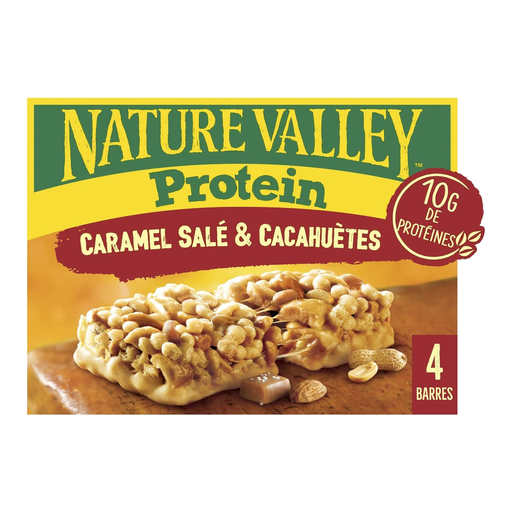 Image unavailable
A pack of four bars to consider if you’re planning a few breaks or lunchboxes. Check the ingredients and allergens for this recipe before sharing the pack.
 Image unavailable
This pack of ten bars is a good option if you want to plan more breaks ahead. If you’ll be taking the portions separately, check how they’re packaged. If you plan to share them, check the ingredients and allergens for the recipe.
 Image unavailable
This pack contains ten 60 g bars for several snacks. If the protein content per bar is what guides your choice, check the exact packaging to confirm it. Also check the allergens and packaging before dividing up the bars.
First, compare the nutritional values per 100 g on the same basis, then check the figures for one bar to see what each portion contains. The DGCCRF identifies information per 100 g as the basis for comparing the relevant foods.
Read the ingredients list and check the highlighted allergens on the packaging for the exact recipe, along with any ‘may contain’ statements. Ingredients can vary between flavours, even within the same brand.
The word ‘protein’ doesn’t mean that a bar is a complete lunch on its own. When choosing a snack, look at its portion size, nutritional information and ingredients rather than assuming it can replace a meal based on its name.
No. A displayed score doesn’t replace checking the bar’s weight, nutritional values per 100 g and per portion, or the ingredients list. These details are especially useful when packs contain bars of different sizes.