
Livraison le jour même ou le lendemain

Qualité garantie

Débloquez vos offres de bienvenue: Livraison GRATUITE | Jusqu'à -80 % | 30 jours d'essai gratuits à JoyPlus
Téléchargez l'application
A professional 1,800 W ionic hair dryer can reduce drying time and make everyday styling easier. But the wattage alone does not tell you everything. Poorly controlled airflow, excessive heat or impractical attachments can quickly turn a good deal into a frustrating appliance to use.
Before choosing a powerful hair dryer, it is therefore worth checking a few specific criteria: temperature control, airflow adjustment, the real benefits of ionic technology and how easy the filter is to maintain.
A power rating of 1,800 W indicates the motor’s maximum power consumption, but on its own it does not tell you how fast the airflow will be. An appliance can consume a lot of power without drying particularly quickly if the air is poorly directed.
The concentrator nozzle lets you target a section of hair precisely. It is particularly useful for blow-drying and limits air dispersion, especially when dealing with thick or difficult-to-manage hair.
A hair dryer with negative ions can reduce static and make hair easier to style. However, the results vary depending on your hair type, how damp it is, the temperature selected and the products used beforehand.
Ionic technology is therefore no substitute for a suitable haircare routine. With fine, curly or weakened hair, moderate heat and well-controlled airflow are still essential.
An air intake grille clogged with dust or hair reduces airflow and can encourage the motor to overheat. A removable rear filter makes cleaning easier and helps maintain consistent performance.
Also check for overheat protection, as well as the condition of the cable and plug. As with any electrical appliance, using it near a bath, a filled washbasin or a container of water should be avoided.
For regular home use, 1,800 W is suitable for many people. Where the manufacturer provides the information, the motor’s rotational speed offers an additional indication of the appliance’s ability to circulate air. The CONFU model featured here claims 20,000 rpm.
A progressive airflow control can be more practical than a simple selector with two or three settings. It allows you to reduce the speed for curly hair or, conversely, increase the airflow to dry the roots and thick hair.
An adjustable-temperature hair dryer should offer several heat settings to suit your hair type and the stage of drying. A high temperature speeds up water evaporation, but it is not necessarily suitable for prolonged use.
The CONFU product information mentions intelligent temperature detection and automatic shut-off when the motor becomes excessively hot. This provides welcome additional safety, but does not replace regular cleaning of the rear grille.
The product information claims a high concentration of negative ions, designed to neutralise static and reduce the appearance of frizz. This is a feature claimed by the manufacturer, and its visible effect depends on your hair type and the conditions of use.
The model also has an air grille described as bioceramic. According to the description, this design helps distribute heat and air evenly to speed up drying. To minimise heat-related damage, keep the appliance moving and use a suitable heat-protective product.
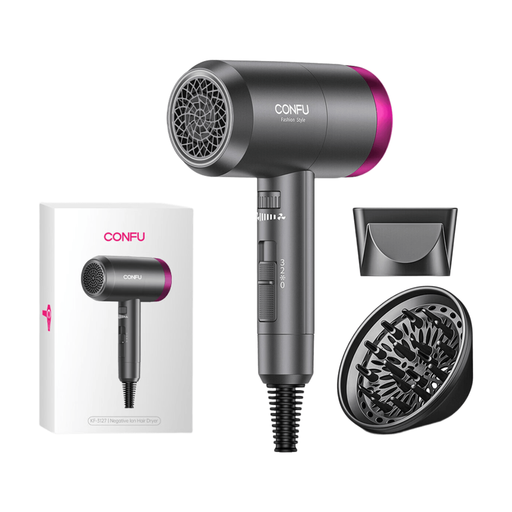
Why it suits this profile: it combines 1,800 W of power, a concentrator nozzle and several settings in an appliance designed for everyday home use.
The product information mentions a sliding speed control rather than a choice limited to a few preset positions.
1,800 W, claimed negative ions, a concentrator nozzle and a removable rear cover.
Why it suits this profile: users who enjoy having control over their styling can adjust the airflow and heat to achieve the desired result.
The listed functions are clearly detailed: three temperature levels, three airflow modes and a thermal sensor.
Claimed bioceramic grille, sliding speed control and concentrated airflow for blow-drying.
Why it suits this profile: its adjustable airflow and directional nozzle are suitable for thick hair, frequent blow-drying and longer drying sessions.
The product information provides for automatic shut-off when the motor reaches an excessive temperature, with restarting possible once it has cooled down.
Motor rated at 20,000 rpm, thermal protection and removable accessories to make maintenance easier.
We have put together a complete, real-time updated selection of products that meet these demanding criteria while complying with European safety regulations.
For an even result, start by gently blotting your hair with a towel rather than rubbing it. Set the appliance to a medium temperature and divide your hair into several sections. For straight hair, direct the air from the roots towards the lengths using the concentrator nozzle.
For curly hair, reduce the speed and avoid repeatedly handling the sections. A diffuser may be essential for preserving the shape of your curls: according to the available information, the model featured here comes with a concentrator nozzle but not a diffuser.
Clean the rear grille and nozzle regularly after unplugging the appliance and allowing it to cool down. If the cable is damaged, stop using the appliance immediately and contact the manufacturer or retailer.
It depends on how long it is used and how much power is actually drawn. At full power, a 1,800 W appliance used for ten minutes theoretically consumes around 0.3 kWh. The heat setting and reduced drying time can make this figure vary.
A negative-ion hair dryer can help reduce static, but it is not enough to define curls. For this type of hair, choose a moderate temperature, a lower speed and, if necessary, an attachment designed to diffuse the air.
This depends on the quality of the motor, how often it is used and how well it is maintained. Regularly removing hair and dust from the intake grille, avoiding knocks and keeping the air inlet clear can help extend the appliance’s lifespan. Overheat protection provides additional safety: it does not mean you can leave the hair dryer unattended while it is operating.