
当日/次日达

品质保障

开启新人专享福利: 全场免邮 | 低至 2 折 | 免费试用 30 天 JoyPlus 会员
下载 Joybuy
Whether you're a professional tradesperson or a passionate DIYer, your tool bag is more than just an accessory: it's a trusted companion that must be reliable, perfectly organised, and jobsite-proof. The problem? The market is flooded with models whose marketing promises fall flat in the field. One bad choice is a recipe for wasted time, damaged tools, and mounting daily frustration.
Before you pull out your credit card, watch out for these three common traps that end up costing you dearly:
To avoid falling for these tricks, ignore the marketing speak and focus on the technical criteria—the only ones that truly matter.
The quality of a professional tool bag lies in the details. These are what make all the difference in the long run and for daily use. Here are the three points on which you should never compromise.
The strength of a fabric bag largely depends on its material's density, often expressed in denier (D).
This is the most exposed area. Opting for a tool bag with a rigid base isn't a luxury; it's a necessity. Usually made of moulded plastic (polyethylene), it checks all the right boxes:
A good professional tool pouch is, above all, a smart, portable tool organisation system. The layout is therefore critical. Look for a variety of internal and external pockets, elastic straps to secure screwdrivers and pliers, and specific compartments. An electrician's tool bag, for example, will require a multitude of small pockets for testers, wire strippers, and other consumables. Finally, a wide-zip opening is an essential convenience for getting a complete overview and grabbing the right tool without digging around.
To move from theory to practice, here are a few models that perfectly illustrate these criteria, tailored for different uses.
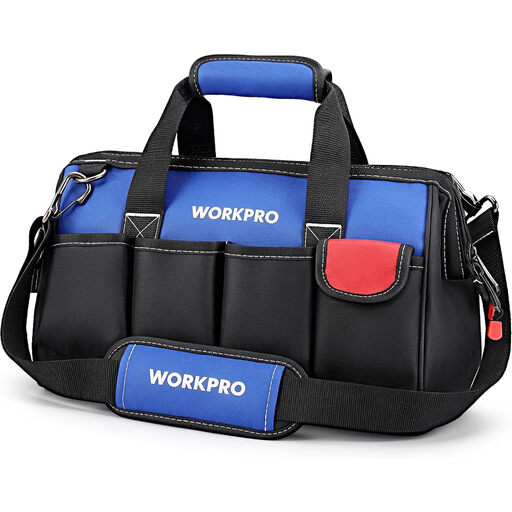
For whom? Those looking for the right balance of volume, organisation, and an affordable price. It's perfect for home projects, service calls, or as a secondary bag for specific jobs.
With its 600D polyester fabric, it leaves entry-level models in the dust in terms of durability. Its numerous internal and external pockets prevent it from sinking into "throw-it-all-in" chaos.
Its wide-zip opening, which provides full access to the contents. Ideal for easily viewing and grabbing medium-sized tools.
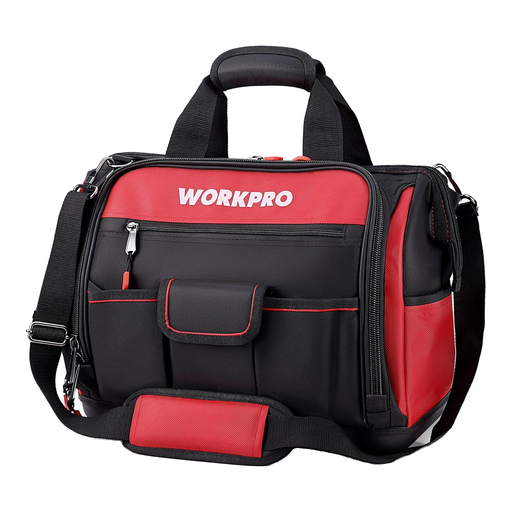
For whom? Construction workers, carpenters, or mechanics who handle heavy tools and operate on tough jobsites. Here, ruggedness is the absolute priority.
It checks all the boxes for durability: its 1680D polyester fabric is built for extreme wear and tear, and its waterproof rigid base forms a true shield against water and impacts.
The winning combination of 1680D fabric + a rigid base. This guarantees maximum protection and unbeatable longevity for uncompromising daily use.
For whom? Electricians, plumbers, or maintenance technicians who juggle a multitude of small tools, testers, and consumables. For them, everything needs its own place.
It avoids the "catch-all" trap thanks to its ultra-comprehensive layout. With 39 pockets, straps, and loops, it allows you to assign a place for every tool and eliminate clutter.
Its surgical organisation. The 39 slots are a precious time-saver for any trade that requires immediate access to a large number of different tools.
Discover our full selection of bags that meet our criteria for durability and practicality.
It all depends on the quality of the materials (a 1680D will always outperform a 600D), the construction (seams, zips), and, of course, the intensity of your use. A quality model that is well-maintained and suited to your trade can easily last for several years.
Empty it regularly to remove dust and debris. For cleaning, a damp cloth and a little mild soap are sufficient for most polyester fabrics. Gently rub any stains, rinse with a clean cloth, and let it air dry. Definitely no washing machine or prolonged soaking! A simple wipe with a sponge is all that's needed for the rigid base.
For a pro, the answer is an unequivocal yes. It's not a gimmick but an insurance policy for your tools. It protects them from moisture, absorbs shocks, and ensures the bag holds its shape. For a weekend DIYer who works in dry conditions, a reinforced fabric bottom may suffice, but a rigid base remains the best guarantee of longevity.