
Livraison le jour même ou le lendemain

Qualité garantie

Débloquez vos offres de bienvenue: Livraison GRATUITE | Jusqu'à -80 % | 30 jours d'essai gratuits à JoyPlus
Téléchargez l'application
For any table tennis player looking to improve, moving from a recreational racket to a more technical model is a decisive step. Navigating the maze of materials, classifications, and playing styles can often be challenging. The goal of this guide is to provide clear benchmarks for choosing the professional table tennis racket that suits your level and ambitions, all without unnecessary marketing jargon.
We will break down the essential criteria to consider before your purchase and then present a selection of relevant models for players seeking high performance.
Before jumping to specific models, it's crucial to understand what distinguishes a racket for an advanced player from one for a beginner. Let's review the three key points.
The racket's "wood", also known as the blade, is the true heart of your equipment. Its composition directly influences speed, control, and feel.
Many manufacturers use a star rating system (from 1 to 7, sometimes more) to classify their pre-assembled rackets. Be aware that this is not an official universal standard, but rather a brand-specific indicator to position the performance level.
The ideal racket is one that enhances your game. An attacker who plays close to the table will have different needs than a defender who relies on spin variations.
As a Joybuy Product Advisor, I have analysed the features of several models to offer you relevant options. The Double Fish Diamond range stands out for its high-quality build and clear positioning for developing players.
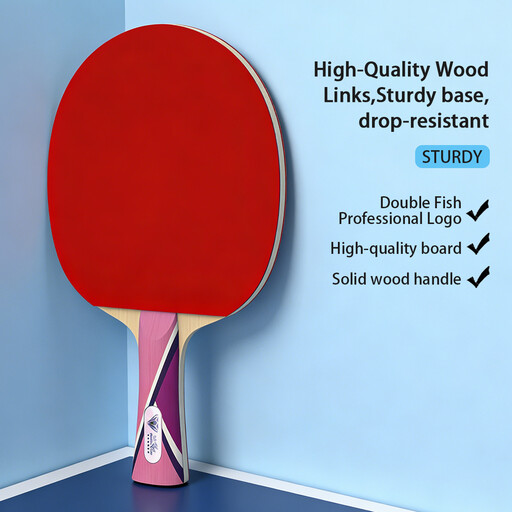
What sets it apart
This model is engineered for pure performance. Its hybrid structure incorporates a layer of high-modulus carbon fibre that provides explosive speed. The blade geometry is designed to enlarge the effective hitting area (sweet spot), offering greater forgiveness on off-centre shots and a more stable ball trajectory.
Key Features
Who is it for?
For the offensive-style advanced player who competes and seeks to maximise shot power without sacrificing consistency. This is an excellent competition racket.
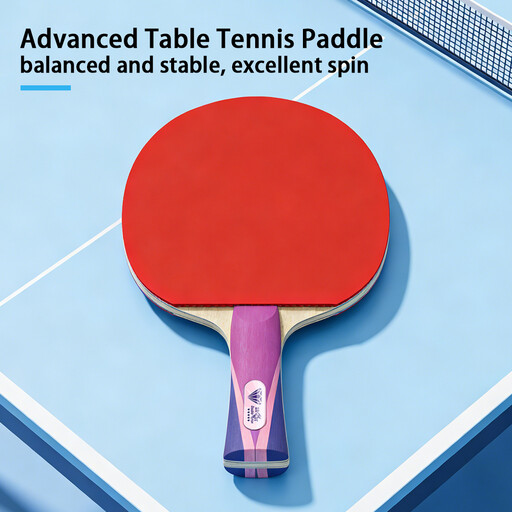
What sets it apart
This 5-star table tennis racket is the very embodiment of versatility. Built around a 7-ply all-wood core, it offers a remarkable balance between speed and control. Its weight redistribution technology and enhanced-friction surface are specifically designed to power up looping topspins while maintaining full control.
Key Features
Who is it for?
The developing club player who wants to build a well-rounded game. Ideal for intensive table tennis training, it allows you to work on all technical aspects without being held back by equipment that is too demanding or extreme.
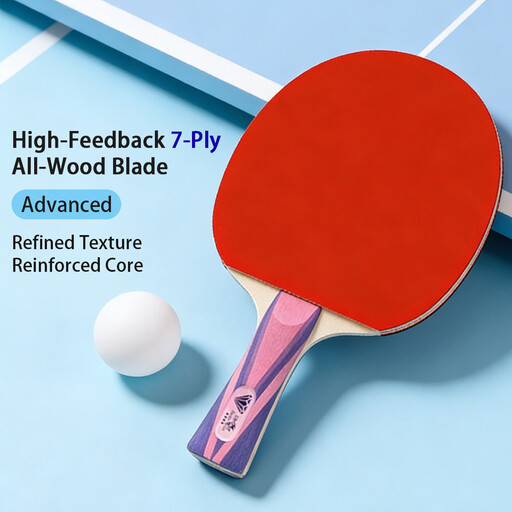
What sets it apart
This model is an excellent stepping stone to competition. Its 7-ply wood blade offers excellent feedback, providing great stability and reassuring control. Its rubbers, both elastic and durable, meet competition standards, allowing you to replicate your training feel in official matches.
Key Features
Who is it for?
The intermediate-level player who has solidified their fundamentals and is looking for their first professional table tennis racket to approach training and initial competitions more seriously.
Choosing a racket is a highly personal decision that depends primarily on your feel. If the models presented don't exactly match what you're looking for, or if you want to compare other types of blades and rubbers, feel free to explore our full range of table tennis equipment.
A "star-rated" racket is a model pre-assembled by the manufacturer, where the blade and rubbers are fixed. It's a turnkey solution that is practical and consistent for intermediate to advanced players. A custom-assembled racket, on the other hand, is 100% personalised: the player separately chooses their blade and two rubbers to create a unique combination. This is the standard for very high-level players.
To preserve the performance of your rubbers, clean them regularly with a damp sponge (or a dedicated cleaning product), then dry them with a soft cloth. Avoid exposing your racket to heat, sunlight, or moisture. Finally, always store it in a case to protect it from impacts and dust.
For a pre-assembled racket, a replacement is needed when the rubbers lose their grip and elasticity. In practical terms, you'll find it harder to generate spin, and the ball will lose speed. For a regular player (training several times a week), this can happen after 1 to 2 years. The blade, on the other hand, can last for many years if it is not damaged.