
Livraison le jour même ou le lendemain

Qualité garantie

Débloquez vos offres de bienvenue: Livraison GRATUITE | Jusqu'à -80 % | 30 jours d'essai gratuits à JoyPlus
Téléchargez l'application
Achieving flawless straight hair or soft waves at home with salon-quality results is an appealing promise. However, the professional straightener market is saturated with devices featuring obscure technologies and often misleading marketing claims. It's easy to get lost between promises of "miracle treatments" and displays of extreme temperatures.
Our mission at Joybuy: to help you see things more clearly. Let's break down the two most common traps that lead to a disappointing or even damaging purchase for your hair.
To make the right choice, focus on the technical features that truly matter for the health and beauty of your hair. Here are the three key points to check.
The plate material is crucial for heat distribution and protecting the hair fibre.
This is the true engine of the straightener. Temperature stability is a non-negotiable criterion for avoiding the thermal shock that weakens hair.
The versatility of your tool will depend directly on its design.
Rather than an endless list, we have selected models that meet specific needs, applying the quality criteria we've just detailed.
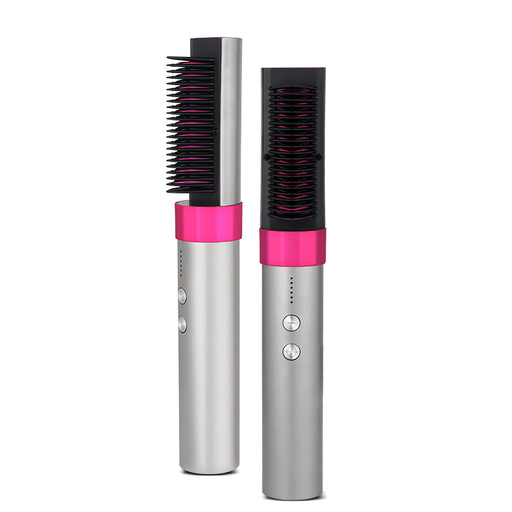
Why we chose it: For those who need a quick touch-up in the morning, after a workout, or before heading out. This hybrid format, both a straightening brush and a cordless straightener, focuses on convenience and speed for natural-looking straight hair, anywhere, anytime.
This model doesn't promise the moon, but rather effective and quick styling. Its strength lies in its ultra-practical design (cordless, PTC heater, anti-scald bristles), not in superfluous "treatment" claims.
The freedom of cordless use, with a convenient battery life thanks to its 3000 mAh battery, and ionic technology to tame frizz in one go. The perfect mini travel straightener.
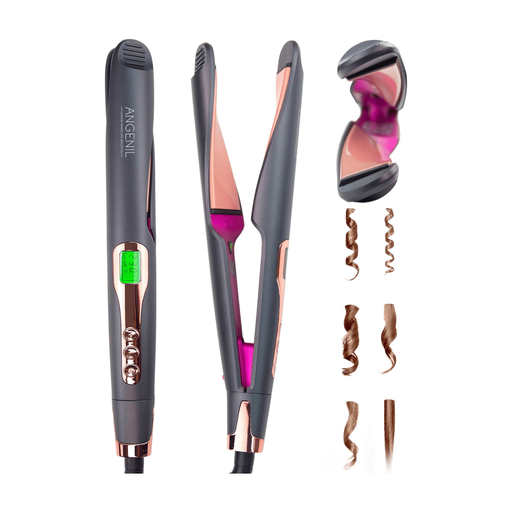
Why we chose it: For those who love to change up their look, going from poker-straight to "wavy" curls in the blink of an eye. This 2-in-1 straightener and curler was designed for maximum versatility, without having to juggle multiple tools.
It avoids the one-size-fits-all temperature trap by offering 11 precise settings (from 130°C to 230°C). This gives the user total control to adapt the heat to their hair type and desired style (straight or curly).
Its unique 3D twisted plates are specially designed to wrap hair sections and form effortless curls. It offers an ease of use that classic flat irons can hardly match.
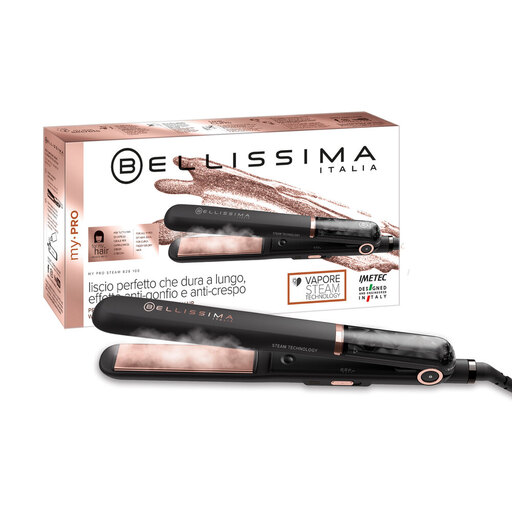
Why we chose it: For dense, sensitised hair or for those wary of dry heat. The steam straightener is the go-to solution for straightening while preserving the hair fibre's moisture, a crucial point for thick or fragile hair.
It tackles the core problem: dehydration caused by heat. Instead of just heating the hair, it releases steam to preserve the hair's moisture balance. The result: long-lasting straightness and an enhanced anti-frizz effect.
The combination of steam technology and floating ceramic plates ensures a perfect glide and optimal protection. Its "Wet & Dry" mode even allows for use on towel-dried hair.
We have selected a full range of products that meet our selection criteria and European safety standards.
A straightener's longevity depends on its build quality and how often you use it. An entry-level model will show its limits after 1 to 2 years. In contrast, a quality device with robust components (MCH heater, solid titanium or ceramic plates) can work perfectly for 4 to 7 years, or even longer, provided it is well-maintained (regular cleaning of the plates).
It all depends on your hair type and your expectations.
There is no absolute rule, but a few common-sense principles apply. Applying a heat protectant spray before each use is non-negotiable. For normal, healthy hair, a frequency of 2 to 3 times a week at a moderate temperature is reasonable. If your hair is fine, colour-treated, or weakened, limit yourself to once a week, choosing the lowest possible temperature. Most importantly: listen to your hair. If it becomes dry, brittle, or dull, it's time to take a break.