
Same-day & Next-day Delivery

Quality Guaranteed

Unlock Your Welcome Offers: FREE Delivery | Up to 80% OFF | Free 30-day JoyPlus trial
Download the APP
A slipping pair of pliers, a mechanism that jams or an uncomfortable handle can quickly make a job more difficult. For plumbing, mechanical engineering and woodworking professionals, as well as regular DIY enthusiasts, choosing professional pliers should therefore not come down to price or a marketing promise alone.
Certain mistakes are particularly common:
Here are the criteria to consider when choosing DIY pliers suited to your working environment.
Each mechanism is designed for a specific use:
For pliers intended for plumbing, check the opening capacity as well as the shape and depth of the teeth. In mechanical work, the precision of the tips, the tool’s rigidity and access to narrow areas are often the main priorities.
Chrome vanadium steel, often referred to as Cr-V, is commonly used for tools subject to considerable force. Heat treatment can improve its hardness and mechanical strength, while a coating protects the metal from oxidation, particularly when tools are stored in a damp workshop.
This does not remove the need for regular maintenance, but it is very straightforward:
The stated maximum opening should always be compared with the actual size of the components to be gripped. A 305 mm groove-joint plier with an opening of up to 50 mm cannot be handled in the same way as a small 180 mm model.
The handle should remain stable without obstructing adjustment. Plastic or rubber coatings can reduce fatigue, but they cannot replace a good working position. Always wear safety goggles when circlips, wires or metal fragments could be ejected. Pliers should never be used beyond their intended capacity or on a live electrical circuit.
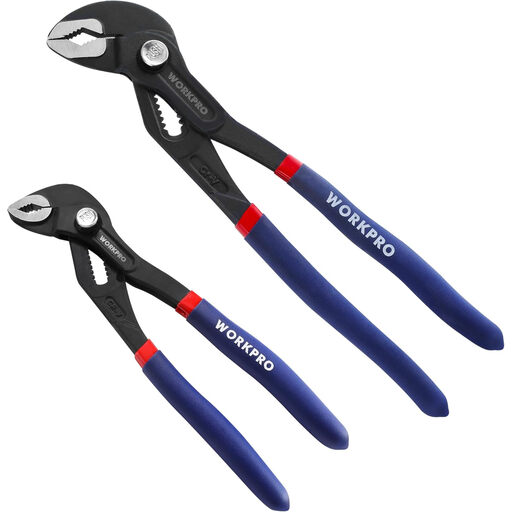
Why this choice suits this profile : This pair covers most small and medium-sized jobs around the home, in the workshop or for occasional plumbing repairs.
The two lengths prevent you from relying on one pair of pliers for components of different sizes. The quick adjustment lets you set the jaw opening before gripping.
Chrome vanadium steel, maximum openings of 33 mm and 43 mm, resin handles and teeth suitable for round, flat or hexagonal components.
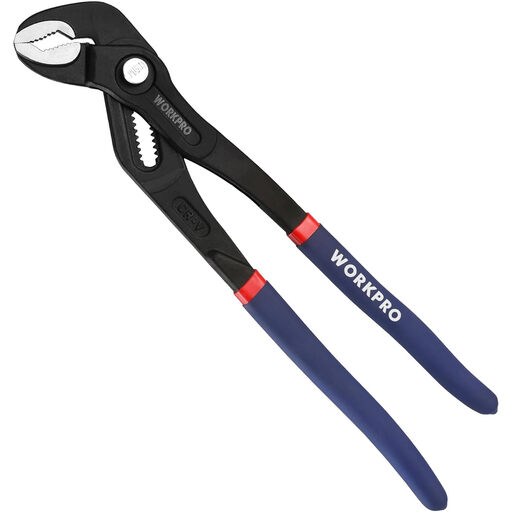
Why this choice suits this profile : At 305 mm, this model is designed for users looking for adjustable pliers for larger fittings and components.
The quick-adjustment button reduces guesswork when making adjustments. The stated maximum opening of 50 mm makes it easy to check compatibility with the components you intend to work on.
Heat-treated Cr-V steel, gripping teeth and ergonomic plastic handles. Stated weight : 630 g.
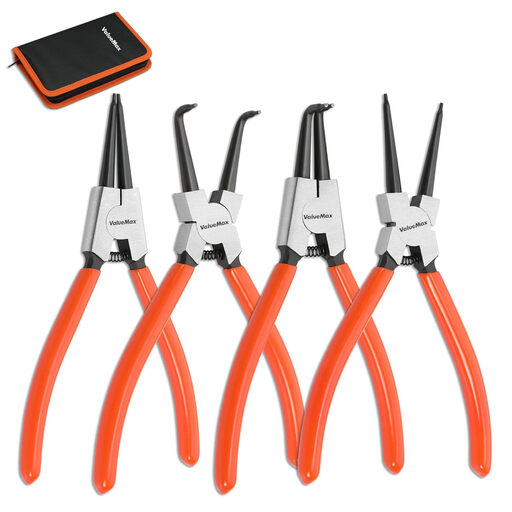
Why this choice suits this profile : Mechanics and vehicle repair specialists get straight and angled models for both internal and external circlips.
The four configurations prevent you from using straight pliers in a space that requires an angled model. The 1.6 mm tip diameter and stated openings make it easier to check suitability before buying.
Four pliers for internal and external circlips, straight or 90° angled jaws, openings of up to 36 mm and a zipped case.
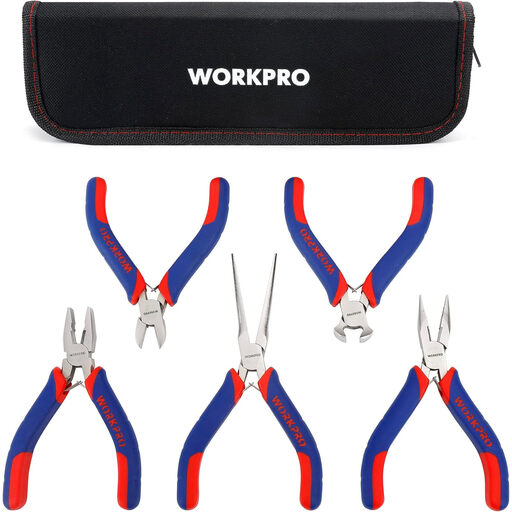
Why this choice suits this profile : This set is suitable for small repairs, jewellery, electronics and creative projects that require several jaw shapes.
The contents are clearly specified : wire cutters, combination pliers, flat-nose pliers and long-nose pliers. However, these tools should not be used on hard wire or materials that exceed their capacity.
Five carbon steel tools with a Ni-Fe coating, non-slip handles and a 600D nylon pouch.
We have brought together a comprehensive, regularly updated selection of products that meet these demanding criteria, as well as European safety standards.
The service life of a pair of pliers depends on how frequently it is used, the force applied and storage conditions. A tool used every day on heavily seized components will naturally wear out faster than a model reserved for small repairs.
Check the following regularly:
Replace the tool if the jaws no longer close properly or if the grip becomes unstable. Applying force with damaged pliers increases the risk of slipping and injury.
For pipes and fittings, groove-joint pliers or adjustable water pump pliers are generally suitable. Compare their maximum capacity with the diameter of the components to be gripped, and choose clearly defined, sharp teeth. For regular jobs, two different lengths may prove more practical than one very large model.
A set containing standard pliers, long-nose pliers and circlip pliers covers a wide range of situations. For retaining rings, check whether they are internal or external circlips and whether access requires straight or angled tips.
Clean them after use, dry them before storing them and apply a thin film of oil to the metal parts. A pouch or case also limits exposure to moisture and prevents the tips from knocking against each other.