
Livraison le jour même ou le lendemain

Qualité garantie

Débloquez vos offres de bienvenue: Livraison GRATUITE | Jusqu'à -80 % | 30 jours d'essai gratuits à JoyPlus
Téléchargez l'application
Flyaway hair, stubborn frizz, curls that are hard to define or drying that seems to take forever: choosing a hair dryer isn’t simply a matter of picking the highest wattage on the box. A professional ionic hair dryer should suit your hair type and routine, as well as the space you have in your bathroom or suitcase.
Before you place an order, it’s worth knowing what to look out for. Higher wattage can speed up drying, but it doesn’t necessarily mean the dryer is comfortable to hold or delivers even heat. Similarly, the term ‘anti-frizz’ doesn’t always explain the conditions needed to achieve the result. Compact models may also leave out certain attachments or deliver a less consistent airflow. Here are the criteria to consider when comparing different models, rather than relying on marketing claims alone.
A 2200 W hair dryer or a 2300 W model can deliver a strong airflow, but wattage alone doesn’t tell you how well it performs. The motor type, fan design, weight and temperature settings all play an important part in how comfortable it is to use.
For thick hair, a powerful hair dryer can indeed reduce drying time. However, if your hair is fine or damaged, prolonged exposure to high heat can make drying uncomfortable. It’s better to look for several heat and speed settings than to automatically choose the model with the highest figure.
Ionic technology is generally presented as a way to reduce static and frizz. In practice, the result also depends on how far the dryer is from your hair, the temperature you choose, the brush you use and the ambient humidity.
A hair dryer with ionic technology may be a good choice if your hair tends to become fluffy, but it’s no substitute for a good drying technique. Direct the airflow along the hair shaft and avoid keeping the dryer in one spot for too long.
A clogged filter gradually reduces airflow and can put extra strain on the motor. Check that it’s removable or, at the very least, easy to clean. Attachments should also suit the way you style your hair: a concentrator for smoothing and straightening, a diffuser to help preserve curls, or a volumising attachment to lift the roots.
For regular use, look for at least two speed settings and three heat settings, if they suit your routine. The cool shot button lets you finish styling and cool your hair after using a brush. It won’t guarantee a perfect hold on its own, but it’s very handy for setting your style.
DC motors are common in hair dryers designed for home use. Some dryers with professional AC motors are heavier, but may be better suited to intensive use. Before prioritising power, compare the weight, cable length and handle ergonomics too.
A hair dryer with styling attachments gives you more options, as long as the attachments included are genuinely useful for your routine:
If you’re looking for a hair dryer with a diffuser, check that the attachment is included and isn’t sold separately.
A folding hair dryer or travel hair dryer is easy to pack away, but take the time to check the handle length, how securely the on/off button stays in place and how easy it is to access the filter. If you’re travelling outside France, a dual-voltage hair dryer compatible with a 100 to 240 V range can help you avoid electrical mishaps. However, you may still need a plug adaptor, depending on your destination.
Always follow the voltage shown on the rating plate, keep the air inlets clear and unplug the dryer after each use. As with any electrical appliance, never use a hair dryer near a bath, a filled sink or any other source of water.
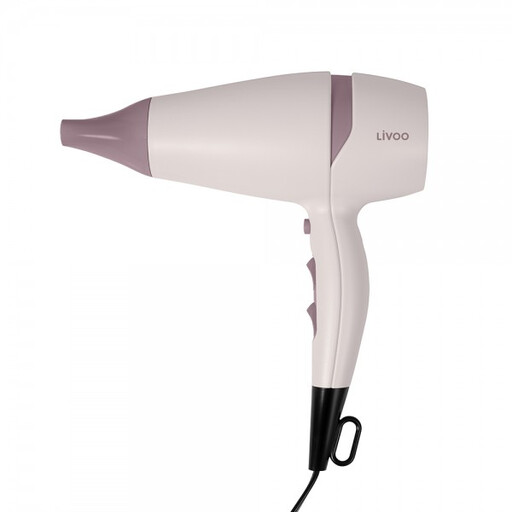
Why it suits this profile: its design makes it a good choice for everyday use at home, with straightforward settings for drying your hair or creating a blow-dry without needing a host of attachments.
The specifications list three heat settings, two speeds and a cool shot, so your choice isn’t based on the advertised 2200 W alone.
Ionic technology, an air concentrator, a 1.70 m cable and a hanging loop. The stated noise level is 80 dB.
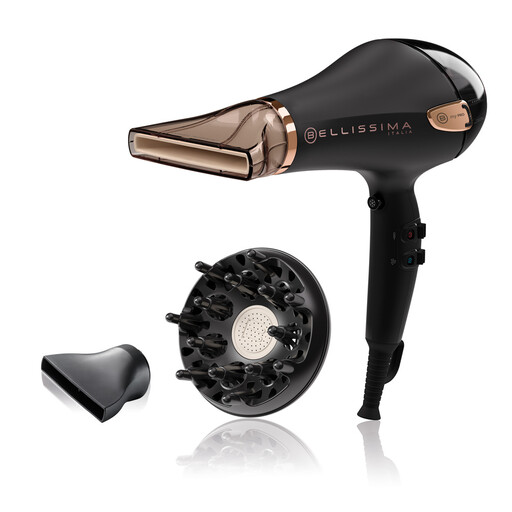
Why it suits this profile: this model is designed for anyone who likes to switch up their look, from a blow-dry to a sleek, straight finish, while still being able to define their curls.
It offers three heat settings, two speeds and a cool shot button, rather than relying on a single temperature. The removable rear filter also makes maintenance easier.
Rated at 2300 W, with a professional AC motor, ionic and ceramic technologies, an included diffuser, a 3 m cable and a 2-year manufacturer’s warranty.
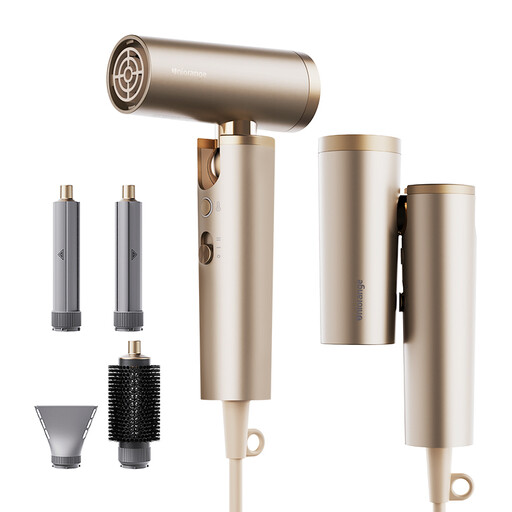
Why it suits this profile: its compact design is ideal for travellers and anyone who wants several functions without taking up much space.
The model is listed as dual voltage (100–240 V), with a removable filter and a reverse-airflow cleaning function: three features worth checking on a travel hair dryer.
Foldable design, a motor rated at 110,000 rpm, plasma ionic technology according to the product listing, and four styling attachments.
We’ve put together a comprehensive selection, updated in real time, of products that meet these criteria and European safety requirements.
It can be a good choice if it delivers a strong enough airflow and offers several settings. For thick hair, compare the stated wattage, motor type and weight, and check whether a concentrator is included. Technique matters just as much: working in sections helps reduce the time your hair is exposed to heat.
Its lifespan depends on how often you use it, how well you maintain the filter, how you store it, and the quality of the cable and motor. There’s no one lifespan that applies to every appliance. However, keeping the filter clean and air inlets clear helps maintain the performance intended by the manufacturer.
Yes, provided the folding mechanism is sturdy and it feels comfortable to hold. For everyday use, also consider the cable length, weight, temperature settings and how easy it is to access the filter. If you’re travelling abroad, check that it supports 100–240 V before you set off.