
Livraison le jour même ou le lendemain

Qualité garantie

Débloquez vos offres de bienvenue: Livraison GRATUITE | Jusqu'à -80 % | 30 jours d'essai gratuits à JoyPlus
Téléchargez l'application
In a restaurant kitchen, hotel or institutional catering environment, rinse quality has a direct impact on service efficiency. Streaked glasses, damp crockery or whitish deposits can make manual polishing necessary, slow down equipment rotation and increase product consumption.
Choosing a professional dishwasher rinse aid is not simply a matter of looking for a promise of “perfect shine”. Certain pitfalls regularly arise when placing an order.
A product designed for a domestic dishwasher is not necessarily suitable for a professional machine, whose cycles may last just 1 to 5 minutes and which operates with automatic dosing. Check for a professional-use designation, compatibility with dosing systems and the recommendations provided by the machine manufacturer.
A 10 L container of rinse aid may be a practical choice for a central kitchen, but unnecessarily cumbersome for a quiet café. Conversely, several small bottles mean more handling and a greater risk of running out in a busy establishment. Compare the volume, recommended dosage and refill frequency.
Using more product does not guarantee a brighter finish. Excessive dosing can leave marks or a noticeable film on the surface. Streaks may also be caused by water hardness, rinse temperature, detergent or a poorly maintained filter.
A professional dishwasher rinse aid must be compatible with your appliance’s dosing system, whether automatic or manual. The product page should specify how it is introduced: dedicated reservoir, suction tube or manual filling.
The Finish Quantum Professional featured here is indicated for short 1- to 5-minute cycles and automatic dosing systems. Its product information recommends a dosage of 0.2 to 0.5 ml per litre of rinse water, adjusted according to water hardness and machine type. This guidance should be compared with the instructions for your dishwasher.
Water hardness varies from one municipality to another in France. Hard water can intensify deposits on glasses, crockery and certain internal machine components. Look for a formula marketed as a limescale-protection rinse aid or streak-free rinse aid, then adjust the settings in accordance with the appliance manual.
This action does not necessarily replace regenerating salt or routine dishwasher maintenance. Rinse aid works primarily during the final phase of the cycle: it helps water run off the crockery and reduces the presence of droplets at the end of the programme.
A 5 L container of rinse aid is often a good compromise for restaurants, cafés and small businesses. The 10 L format is better suited to intensive use, provided that suitable storage space is available.
Before purchasing, check the label, hazard pictograms, expiry date and batch number. Product information generally recommends wearing gloves, protective clothing and eye protection when handling the product. Never mix rinse aid with other chemicals. Keep it in its original, sealed container in a cool, well-ventilated area.
The products below are organised according to specific usage scenarios rather than any claim of absolute superiority. The features mentioned reflect the information available on their respective product pages.
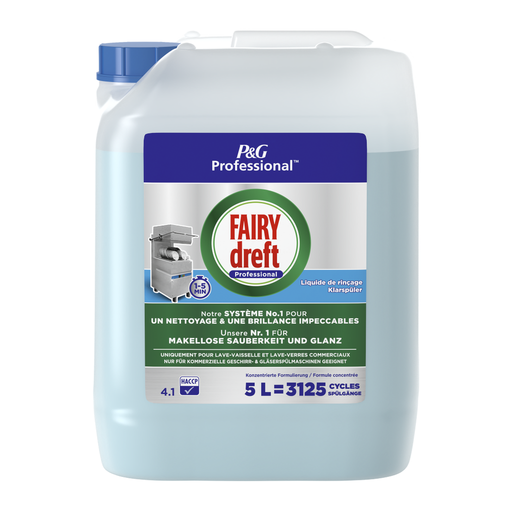
Why we chose it: its 5 L format suits professional kitchens looking to maintain a sensible stock level without moving straight to a 10 L container. The product page positions it for commercial dishwashers and recommends adjusting the setting according to local water hardness.
This mid-sized container limits the risk of overstocking and allows you to validate the dosing settings before moving to a larger format.
5 L format, intended for commercial dishwashers, with stated protection against water spots and limescale, plus a fast-drying function.
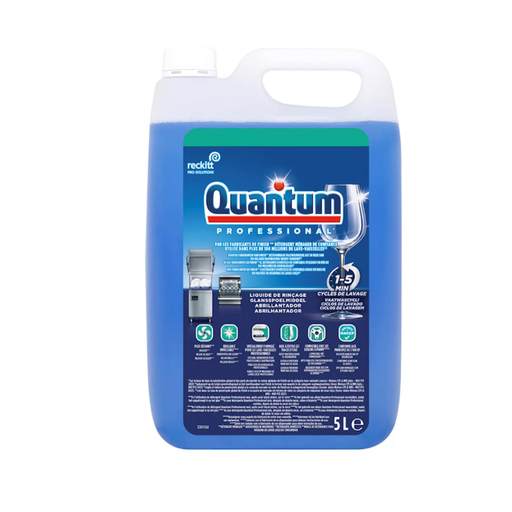
Why we chose it: this professional rinse aid is presented as suitable for short 1- to 5-minute cycles, which are common in food-service and hospitality settings. It may suit businesses looking to reduce manual polishing between services.
The product page specifies a precise dosage and compatibility with automatic dosing systems—two points to verify rather than relying solely on a streak-free claim.
5 L capacity, stated dosage of 0.2 to 0.5 ml per litre, a formula presented as suitable for hard water and manufacturing listed as taking place in France.
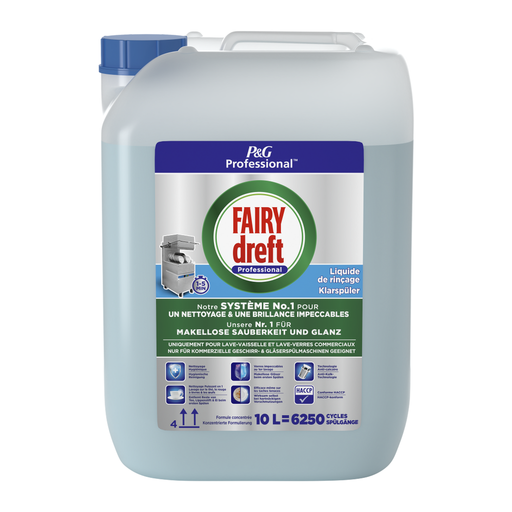
Why we chose it: this large format meets the needs of hotels, central kitchens and food-service operations running cycles continuously throughout the day.
The format reduces container changes, but you should plan for secure storage, check the dosing pump and follow the storage instructions.
10 L container, intended for commercial dishwashers, with stated fast-drying and limescale-deposit reduction functions.
To maintain consistent results, refill the rinse-aid reservoir before it runs empty and use the setting recommended by the manufacturer. Start with the dosage shown on the label, then inspect the crockery after several cycles.
Rinse aid does not replace the main detergent. For glasses that tend to become cloudy, a protective additive such as FINISH Dishwasher Protector Glass & China Anti-Clouding can be used separately, in accordance with the instructions on its product page.
We have brought together an up-to-date selection of dishwasher rinse aids to help you compare formats, applications and available features.
Choose a formula explicitly designed for commercial appliances, compatible with your machine’s dosing system and suited to local water hardness. For short cycles, check that this use is specifically mentioned on the product page.
No. It can help reduce water marks and certain deposits, but results also depend on the water softener, regenerating salt, temperature and appliance maintenance. Follow the dishwasher manufacturer’s recommendations.
The 10 L format may reduce the price per litre, provided the volume is used before the stated expiry date and stored correctly. For moderate use, a 5 L container can prevent too much stock from being tied up and reduce the risks associated with prolonged storage.